题目
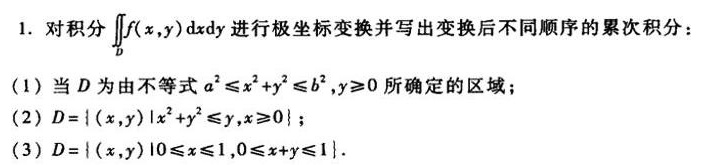
1.对积分I f(x,y)dxdy进行极坐标变换并写出变换后不同顺序的累次积分:-|||-(1)当D为由不等式 ^2leqslant (x)^2+(y)^2leqslant (b)^2 geqslant 0 所确定的区域;-|||-(2) = (x,y)|{x)^2+(y)^2leqslant y,xgeqslant 0} ;-|||-(3) = (x,y)10leqslant xleqslant 1,0leqslant x+yleqslant 1
题目解答
答案
解析
步骤 1:极坐标变换
极坐标变换公式为:$x = r\cos\theta$,$y = r\sin\theta$,其中$r$是极径,$\theta$是极角。在极坐标系中,面积微元$dA$可以表示为$rdrd\theta$。因此,积分$I = \iint_D f(x,y)dxdy$在极坐标系中可以表示为$I = \iint_D f(r\cos\theta, r\sin\theta)rdrd\theta$。
步骤 2:确定积分区域
(1) 当$D$由不等式${a}^{2}\leqslant {x}^{2}+{y}^{2}\leqslant {b}^{2}$,$y\geqslant 0$所确定时,$r$的范围是$a\leqslant r\leqslant b$,$\theta$的范围是$0\leqslant \theta\leqslant \pi$。
(2) 当$D=\{ (x,y)|{x}^{2}+{y}^{2}\leqslant y,x\geqslant 0\}$时,$r$的范围是$0\leqslant r\leqslant \sin\theta$,$\theta$的范围是$0\leqslant \theta\leqslant \pi$。
(3) 当$D=\{ (x,y)|0\leqslant x\leqslant 1,0\leqslant x+y\leqslant 1\}$时,$r$的范围是$0\leqslant r\leqslant 1$,$\theta$的范围是$0\leqslant \theta\leqslant \pi/4$。
步骤 3:写出不同顺序的累次积分
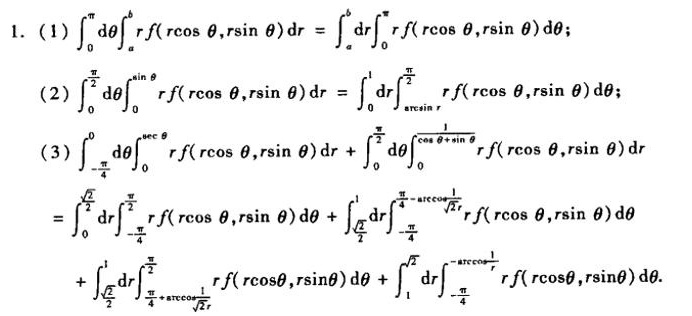
(1) 当$D$由不等式${a}^{2}\leqslant {x}^{2}+{y}^{2}\leqslant {b}^{2}$,$y\geqslant 0$所确定时,积分$I$可以表示为$I = \int_{0}^{\pi}d\theta\int_{a}^{b}rf(r\cos\theta, r\sin\theta)dr$或$I = \int_{a}^{b}dr\int_{0}^{\pi}f(r\cos\theta, r\sin\theta)d\theta$。
(2) 当$D=\{ (x,y)|{x}^{2}+{y}^{2}\leqslant y,x\geqslant 0\}$时,积分$I$可以表示为$I = \int_{0}^{\pi}d\theta\int_{0}^{\sin\theta}rf(r\cos\theta, r\sin\theta)dr$或$I = \int_{0}^{1}dr\int_{\arcsin r}^{\pi-\arcsin r}f(r\cos\theta, r\sin\theta)d\theta$。
(3) 当$D=\{ (x,y)|0\leqslant x\leqslant 1,0\leqslant x+y\leqslant 1\}$时,积分$I$可以表示为$I = \int_{0}^{\pi/4}d\theta\int_{0}^{1/\cos\theta}rf(r\cos\theta, r\sin\theta)dr$或$I = \int_{0}^{1}dr\int_{0}^{\arccos r}f(r\cos\theta, r\sin\theta)d\theta$。
极坐标变换公式为:$x = r\cos\theta$,$y = r\sin\theta$,其中$r$是极径,$\theta$是极角。在极坐标系中,面积微元$dA$可以表示为$rdrd\theta$。因此,积分$I = \iint_D f(x,y)dxdy$在极坐标系中可以表示为$I = \iint_D f(r\cos\theta, r\sin\theta)rdrd\theta$。
步骤 2:确定积分区域
(1) 当$D$由不等式${a}^{2}\leqslant {x}^{2}+{y}^{2}\leqslant {b}^{2}$,$y\geqslant 0$所确定时,$r$的范围是$a\leqslant r\leqslant b$,$\theta$的范围是$0\leqslant \theta\leqslant \pi$。
(2) 当$D=\{ (x,y)|{x}^{2}+{y}^{2}\leqslant y,x\geqslant 0\}$时,$r$的范围是$0\leqslant r\leqslant \sin\theta$,$\theta$的范围是$0\leqslant \theta\leqslant \pi$。
(3) 当$D=\{ (x,y)|0\leqslant x\leqslant 1,0\leqslant x+y\leqslant 1\}$时,$r$的范围是$0\leqslant r\leqslant 1$,$\theta$的范围是$0\leqslant \theta\leqslant \pi/4$。
步骤 3:写出不同顺序的累次积分
(1) 当$D$由不等式${a}^{2}\leqslant {x}^{2}+{y}^{2}\leqslant {b}^{2}$,$y\geqslant 0$所确定时,积分$I$可以表示为$I = \int_{0}^{\pi}d\theta\int_{a}^{b}rf(r\cos\theta, r\sin\theta)dr$或$I = \int_{a}^{b}dr\int_{0}^{\pi}f(r\cos\theta, r\sin\theta)d\theta$。
(2) 当$D=\{ (x,y)|{x}^{2}+{y}^{2}\leqslant y,x\geqslant 0\}$时,积分$I$可以表示为$I = \int_{0}^{\pi}d\theta\int_{0}^{\sin\theta}rf(r\cos\theta, r\sin\theta)dr$或$I = \int_{0}^{1}dr\int_{\arcsin r}^{\pi-\arcsin r}f(r\cos\theta, r\sin\theta)d\theta$。
(3) 当$D=\{ (x,y)|0\leqslant x\leqslant 1,0\leqslant x+y\leqslant 1\}$时,积分$I$可以表示为$I = \int_{0}^{\pi/4}d\theta\int_{0}^{1/\cos\theta}rf(r\cos\theta, r\sin\theta)dr$或$I = \int_{0}^{1}dr\int_{0}^{\arccos r}f(r\cos\theta, r\sin\theta)d\theta$。