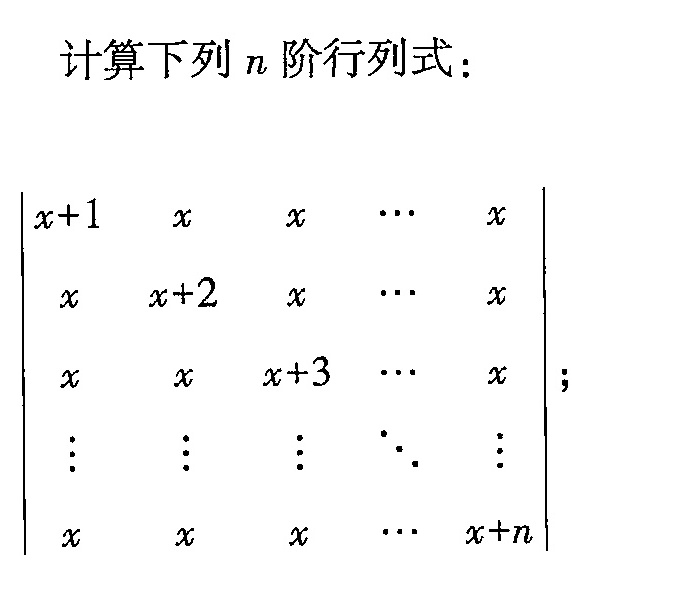
计算下列n阶行列式:-|||-x+1 x x x-|||-x x+2 x ... x-|||-x x .x+3 x-|||-:-|||-x x x x+n
题目解答
答案
解析
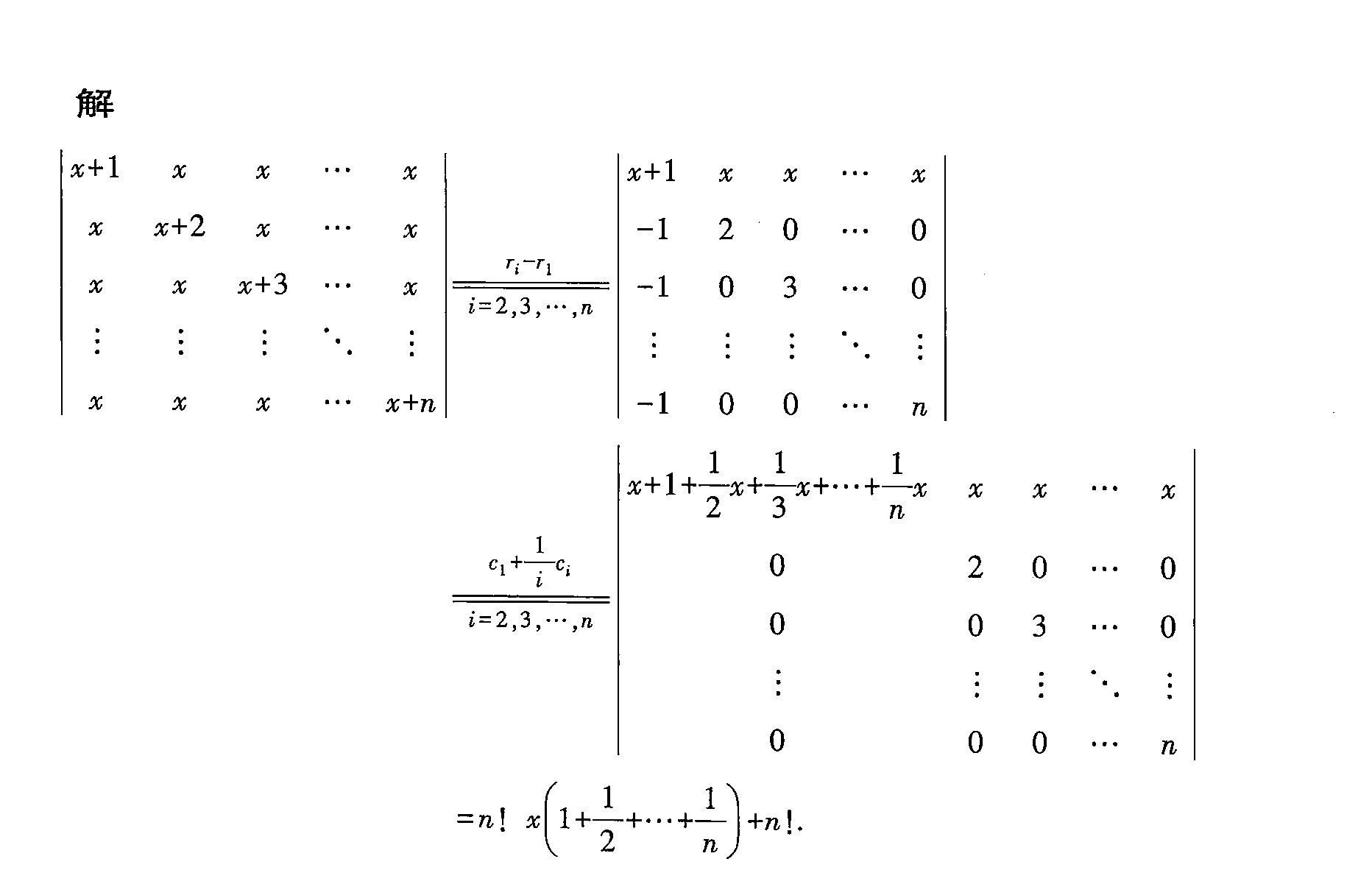
本题主要考察n阶行列式的计算,核心思路是通过行列式的初等行变换将其转化为上三角行列式或对角行列式,从而简化计算。
步骤1:明确行列式结构
题目中的行列式为:
$D_n = \begin{vmatrix}x+1 & x & x & \cdots & x \\x & x+2 & x & \cdots & x \\x & x & x+3 & \cdots & x \\\vdots & \vdots & \vdots & \ddots & \vdots \\x & & x & x & \cdots & x+n\end{vmatrix}$
该行列式的特点是:主对角线元素为$x+i$($i=1,2,\cdots,n$),非主对角线元素均为$x$。
步骤2:利用初等行变换简化行列式
对行列式进行行变换:将第$i$行减去第1行的$\frac{x}{x+1}$倍($i=2,3,\cdots,n$),即$r_i - \frac{x}{x+1}r_1$。
- 第1行保持不变:$[x+1, x, x, \cdots, x]$
- 第$i$行($i\geq2$)的主对角线元素变为:
$(x+i) - \frac{x}{x+1} \cdot x} = x+i - \frac{x^2}{x+1} = \frac{(x+i)(x+1) - x^2}{x+1} = \frac{x^2 + (i+1)x + i - x^2}{x+1} = \frac{(i+1)x + i}{x+1}$ - 第$i$行的非主对角线元素变为:$x - \frac{x}{x+1} \cdot x = \frac{x(x+1) - x^2}{x+1} = \frac{x}{x+1}$
步骤3:按第1列展开
行列式按第1列展开,第1列元素为$x+1, 0, 0, \cdots, 0$,仅第1个元素非零,故:
$D_n = (x+1) \cdot M_{11}$
其中$M_{11$为划去第1行第1列后的$(n-1)$阶行列式,其主对角线元素为$\frac{(i+1)x + i}{x+1}$($i=2,\cdots,n$),非主对角线元素为$\frac{x}{x+1}$。
步骤4:提取公因子并计算
提取$\frac{1}{x+1}$,得:
$M_{11} = \left(\frac{1}{x+1}\right)^{n-1)} \cdot \begin{vmatrix}(2x+2) & x & \cdots & x \\x & (3x+3) & \cdots & x \\\vdots & \vdots & \ddots & \vdots \\x & x & \cdotsdots & (nx+n)\end{vmatrix}$
再次对该行列式进行行变换($r_i - \frac{x}{}{}{(2x+2)}{i\geq2}$),可转化为对角行列式,主对角线元素为$2,3,\,n,n$,故行列式值为$n!$。
步骤5:最终化简
$D_n = (x+1)\cdot \left(\frac{1}{x+1}\right)^{n-1} \cdot (2x+2)(3x+3)\cdots(nx+n) \cdot n!$
提取公因子$2,3,\cdots,n$,得:
$\[
(2x+2)=2(x+1),\ (3x+3)=3(x+1),\ \cdots,\ (nx+n)=n(x+1)$
代入得:
$D_n = (x+1) \cdot \left(\ \ \right)^{n-1} \cdot (x+1)^{n-1} \cdot 2 \cdot 3 \cdots n \cdot n! = (x+1)^n \cdot n! \cdot H_n$
其中$H_n = 1 + \frac{1}{2} + \cdots + \frac{1}{n}$为第$n$个调和数。