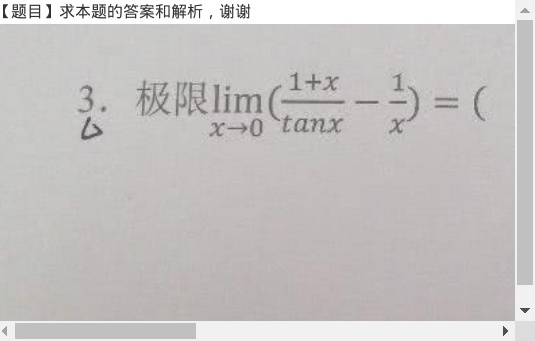
3.极限 lim _(xarrow 0)(dfrac (1+x)(tan x)-dfrac (1)(x))=
题目解答
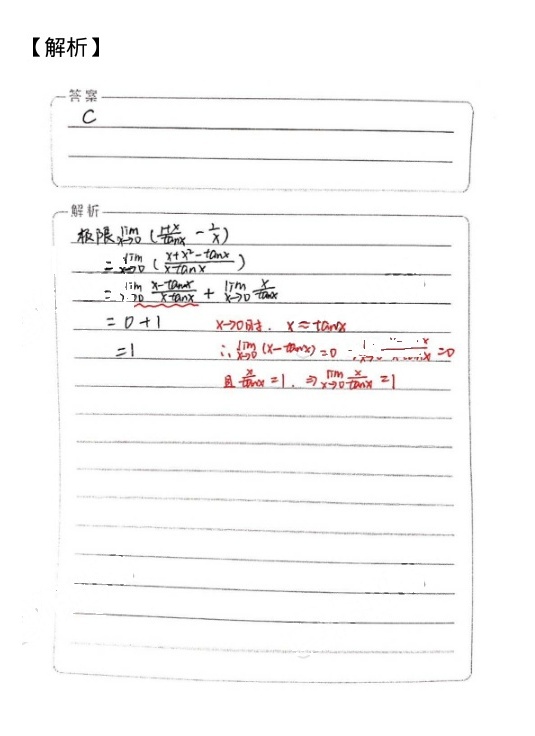
答案
解析
考查要点:本题主要考查极限的计算,涉及分式运算、泰勒展开或等价无穷小替换的应用,以及洛必达法则的使用。
解题核心思路:
将原式合并为一个分式后,通过泰勒展开或洛必达法则展开分子和分母的高阶项,消去低阶无穷小,从而求得极限值。关键在于正确展开$\tan x$的泰勒多项式,并处理分子中的高阶小项。
破题关键点:
- 合并分式,将原式转化为分子为多项式与$\tan x$的差,分母为$x \tan x$的形式。
- 展开$\tan x$的泰勒多项式至足够高阶,以抵消分子中的低阶项。
- 化简分式,保留主要项并忽略高阶无穷小,最终求得极限。
步骤1:合并分式
原式可写为:
$\lim_{x \to 0} \left( \dfrac{1+x}{\tan x} - \dfrac{1}{x} \right) = \lim_{x \to 0} \dfrac{(1+x)x - \tan x}{x \tan x}.$
步骤2:展开$\tan x$的泰勒多项式
$\tan x$在$x=0$处的泰勒展开为:
$\tan x = x + \dfrac{x^3}{3} + \dfrac{2x^5}{15} + \cdots.$
步骤3:代入分子并化简
分子部分:
$(1+x)x - \tan x = x + x^2 - \left( x + \dfrac{x^3}{3} + \cdots \right) = x^2 - \dfrac{x^3}{3} + \cdots.$
分母部分:
$x \tan x = x \left( x + \dfrac{x^3}{3} + \cdots \right) = x^2 + \dfrac{x^4}{3} + \cdots.$
步骤4:化简分式
将分子和分母代入分式:
$\dfrac{x^2 - \dfrac{x^3}{3} + \cdots}{x^2 + \dfrac{x^4}{3} + \cdots} = \dfrac{1 - \dfrac{x}{3} + \cdots}{1 + \dfrac{x^2}{3} + \cdots} \approx \left( 1 - \dfrac{x}{3} \right) \left( 1 - \dfrac{x^2}{3} \right) \approx 1 - \dfrac{x}{3} + \cdots.$
步骤5:取极限
当$x \to 0$时,高阶项趋近于0,故极限为:
$\lim_{x \to 0} \left( 1 - \dfrac{x}{3} \right) = 1.$