题目
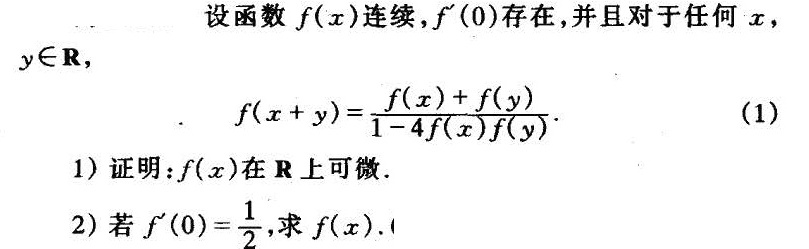
设函数f(x)连续,f'(0)存在,并且对于任何x,-|||-.in R ,-|||-.(x+y)=dfrac (f(x)+f(y))(1-4f(x)f(y)) (1)-|||-1)证明:f(x)在R上可微.-|||-2)若 '(0)=dfrac (1)(2) ,求f(x).(
题目解答
答案
解析
步骤 1:确定f(0)
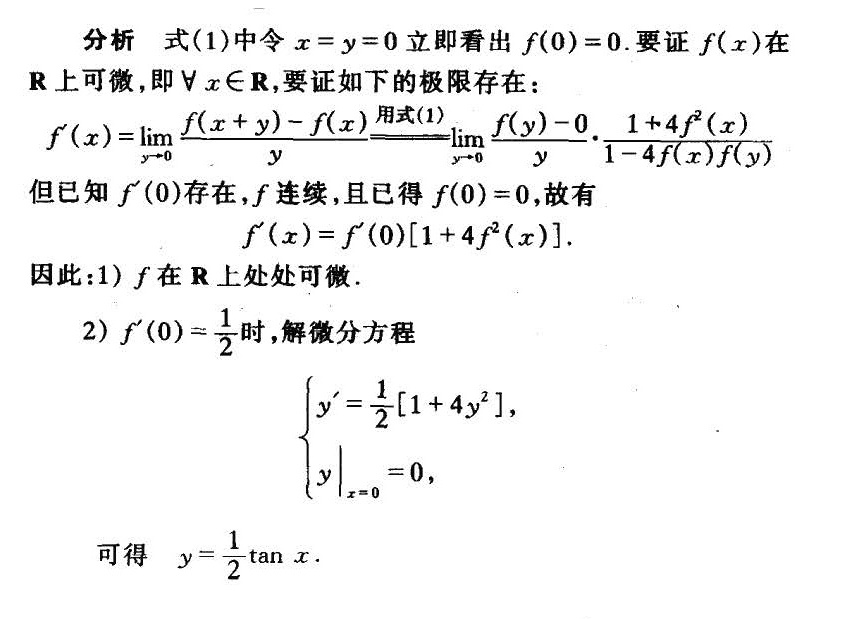
令x=y=0,代入给定的函数方程,得到
$$f(0+0) = \frac{f(0) + f(0)}{1 - 4f(0)f(0)}$$
化简得到
$$f(0) = \frac{2f(0)}{1 - 4f^2(0)}$$
由于f(x)连续,f(0)存在,因此可以解得f(0)=0。
步骤 2:证明f(x)在R上可微
为了证明f(x)在R上可微,我们需要证明对于任意的x,f'(x)存在。根据导数的定义,我们需要证明
$$f'(x) = \lim_{h \to 0} \frac{f(x+h) - f(x)}{h}$$
存在。根据给定的函数方程,我们有
$$f(x+h) = \frac{f(x) + f(h)}{1 - 4f(x)f(h)}$$
因此
$$f'(x) = \lim_{h \to 0} \frac{\frac{f(x) + f(h)}{1 - 4f(x)f(h)} - f(x)}{h}$$
化简得到
$$f'(x) = \lim_{h \to 0} \frac{f(h) + 4f^2(x)f(h)}{h(1 - 4f(x)f(h))}$$
由于f'(0)存在,我们可以将f(h)用f'(0)h近似,得到
$$f'(x) = \lim_{h \to 0} \frac{f'(0)h + 4f^2(x)f'(0)h}{h(1 - 4f(x)f'(0)h)}$$
化简得到
$$f'(x) = f'(0)(1 + 4f^2(x))$$
因此,f(x)在R上可微。
步骤 3:求f(x)
当f'(0) = 1/2时,我们有
$$f'(x) = \frac{1}{2}(1 + 4f^2(x))$$
这是一个一阶非线性微分方程。我们可以通过分离变量法求解。令y=f(x),则有
$$\frac{dy}{dx} = \frac{1}{2}(1 + 4y^2)$$
分离变量得到
$$\frac{dy}{1 + 4y^2} = \frac{1}{2}dx$$
两边积分得到
$$\int \frac{dy}{1 + 4y^2} = \int \frac{1}{2}dx$$
左边的积分可以通过代换u=2y得到
$$\int \frac{dy}{1 + 4y^2} = \frac{1}{2} \int \frac{du}{1 + u^2} = \frac{1}{2} \arctan(u) + C$$
因此
$$\frac{1}{2} \arctan(2y) = \frac{1}{2}x + C$$
解得
$$y = \frac{1}{2} \tan(x + C)$$
由于f(0)=0,我们可以确定C=0,因此
$$f(x) = \frac{1}{2} \tan(x)$$
令x=y=0,代入给定的函数方程,得到
$$f(0+0) = \frac{f(0) + f(0)}{1 - 4f(0)f(0)}$$
化简得到
$$f(0) = \frac{2f(0)}{1 - 4f^2(0)}$$
由于f(x)连续,f(0)存在,因此可以解得f(0)=0。
步骤 2:证明f(x)在R上可微
为了证明f(x)在R上可微,我们需要证明对于任意的x,f'(x)存在。根据导数的定义,我们需要证明
$$f'(x) = \lim_{h \to 0} \frac{f(x+h) - f(x)}{h}$$
存在。根据给定的函数方程,我们有
$$f(x+h) = \frac{f(x) + f(h)}{1 - 4f(x)f(h)}$$
因此
$$f'(x) = \lim_{h \to 0} \frac{\frac{f(x) + f(h)}{1 - 4f(x)f(h)} - f(x)}{h}$$
化简得到
$$f'(x) = \lim_{h \to 0} \frac{f(h) + 4f^2(x)f(h)}{h(1 - 4f(x)f(h))}$$
由于f'(0)存在,我们可以将f(h)用f'(0)h近似,得到
$$f'(x) = \lim_{h \to 0} \frac{f'(0)h + 4f^2(x)f'(0)h}{h(1 - 4f(x)f'(0)h)}$$
化简得到
$$f'(x) = f'(0)(1 + 4f^2(x))$$
因此,f(x)在R上可微。
步骤 3:求f(x)
当f'(0) = 1/2时,我们有
$$f'(x) = \frac{1}{2}(1 + 4f^2(x))$$
这是一个一阶非线性微分方程。我们可以通过分离变量法求解。令y=f(x),则有
$$\frac{dy}{dx} = \frac{1}{2}(1 + 4y^2)$$
分离变量得到
$$\frac{dy}{1 + 4y^2} = \frac{1}{2}dx$$
两边积分得到
$$\int \frac{dy}{1 + 4y^2} = \int \frac{1}{2}dx$$
左边的积分可以通过代换u=2y得到
$$\int \frac{dy}{1 + 4y^2} = \frac{1}{2} \int \frac{du}{1 + u^2} = \frac{1}{2} \arctan(u) + C$$
因此
$$\frac{1}{2} \arctan(2y) = \frac{1}{2}x + C$$
解得
$$y = \frac{1}{2} \tan(x + C)$$
由于f(0)=0,我们可以确定C=0,因此
$$f(x) = \frac{1}{2} \tan(x)$$