题目
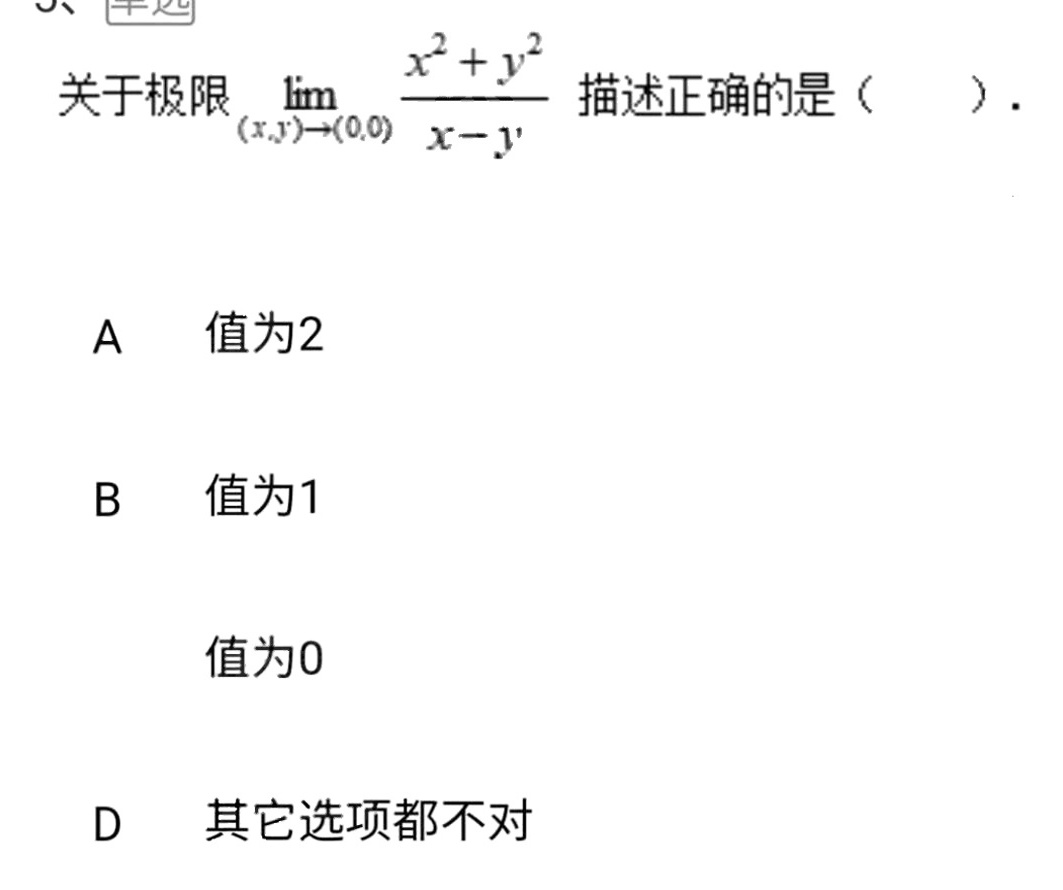
关于极限 lim _((x.y)arrow (0.0))dfrac ({x)^2+(y)^2}(x-y) 描述正确的是 () .-|||-A 值为2-|||-B 值为1-|||-值为0-|||-D 其它选项都不对
题目解答
答案
解析
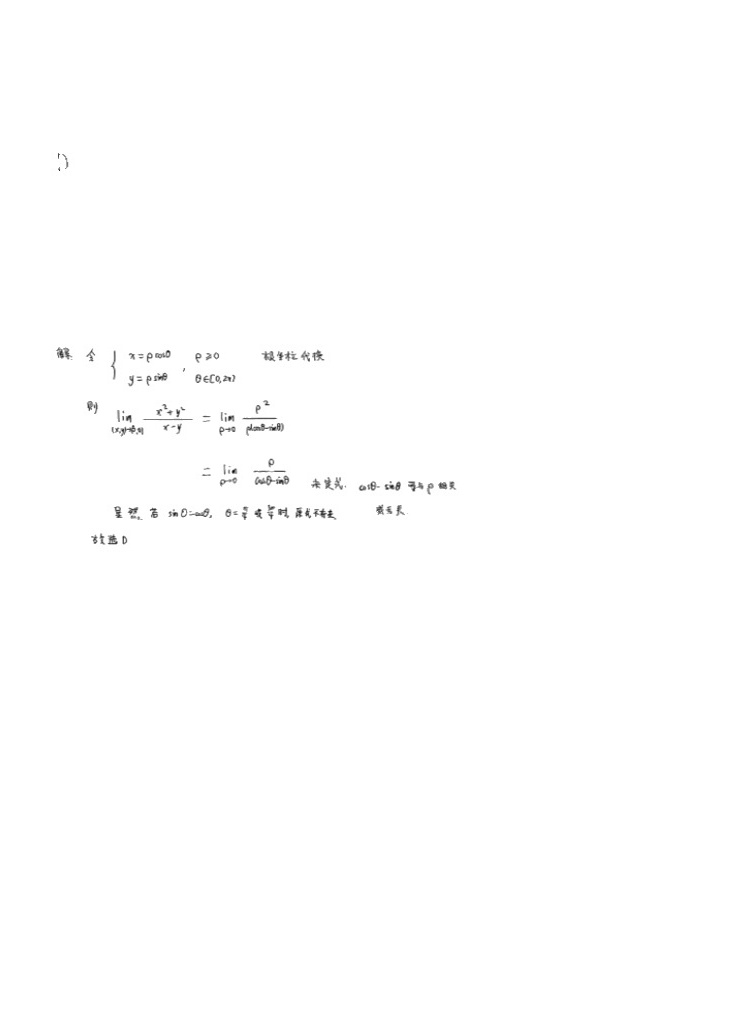
步骤 1:转换为极坐标
将直角坐标系中的点 $(x, y)$ 转换为极坐标系中的点 $(\rho, \theta)$,其中 $x = \rho \cos \theta$,$y = \rho \sin \theta$。这样,原极限可以表示为:
$$\lim _{(x,y)\rightarrow (0,0)}\dfrac {{x}^{2}+{y}^{2}}{x-y} = \lim _{\rho \rightarrow 0}\dfrac {{\rho}^{2}(\cos^2 \theta + \sin^2 \theta)}{\rho(\cos \theta - \sin \theta)}$$
步骤 2:化简表达式
由于 $\cos^2 \theta + \sin^2 \theta = 1$,所以原极限可以进一步化简为:
$$\lim _{\rho \rightarrow 0}\dfrac {{\rho}^{2}}{\rho(\cos \theta - \sin \theta)} = \lim _{\rho \rightarrow 0}\dfrac {\rho}{\cos \theta - \sin \theta}$$
步骤 3:分析极限
当 $\rho \rightarrow 0$ 时,分子 $\rho$ 趋于 0,而分母 $\cos \theta - \sin \theta$ 的值取决于 $\theta$ 的取值。如果 $\cos \theta - \sin \theta = 0$,即 $\theta = \frac{5\pi}{4}$ 或 $\theta = \frac{\pi}{4}$,则分母为 0,极限不存在。因此,原极限不存在,即其它选项都不对。
将直角坐标系中的点 $(x, y)$ 转换为极坐标系中的点 $(\rho, \theta)$,其中 $x = \rho \cos \theta$,$y = \rho \sin \theta$。这样,原极限可以表示为:
$$\lim _{(x,y)\rightarrow (0,0)}\dfrac {{x}^{2}+{y}^{2}}{x-y} = \lim _{\rho \rightarrow 0}\dfrac {{\rho}^{2}(\cos^2 \theta + \sin^2 \theta)}{\rho(\cos \theta - \sin \theta)}$$
步骤 2:化简表达式
由于 $\cos^2 \theta + \sin^2 \theta = 1$,所以原极限可以进一步化简为:
$$\lim _{\rho \rightarrow 0}\dfrac {{\rho}^{2}}{\rho(\cos \theta - \sin \theta)} = \lim _{\rho \rightarrow 0}\dfrac {\rho}{\cos \theta - \sin \theta}$$
步骤 3:分析极限
当 $\rho \rightarrow 0$ 时,分子 $\rho$ 趋于 0,而分母 $\cos \theta - \sin \theta$ 的值取决于 $\theta$ 的取值。如果 $\cos \theta - \sin \theta = 0$,即 $\theta = \frac{5\pi}{4}$ 或 $\theta = \frac{\pi}{4}$,则分母为 0,极限不存在。因此,原极限不存在,即其它选项都不对。