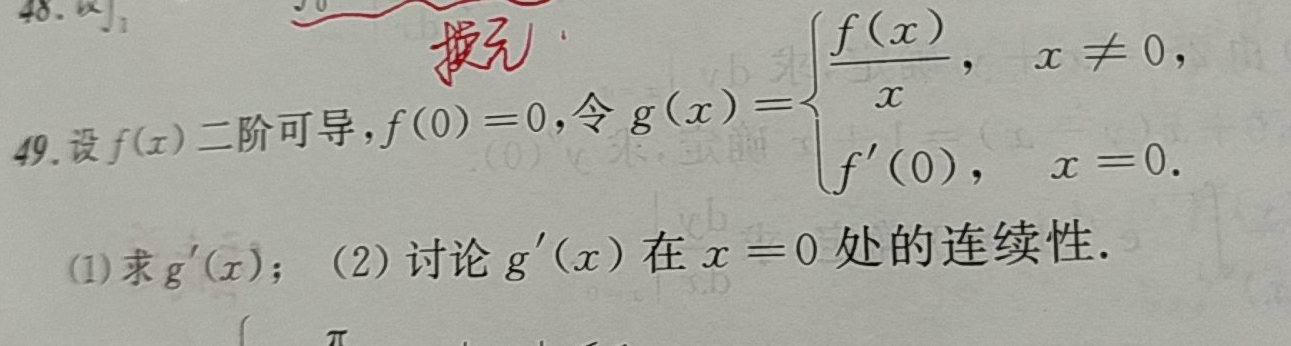
40.以-|||-49.设f(x)二阶可导, (0)=0, 令 g(x)= { , xneq 0 f'(0), x=0 .-|||-(1)求g`(x); (2)讨论g`(x)在 x=0 处的连续性.

题目解答
答案

解析
考查要点:本题主要考查分段函数的导数计算及导数在分段点处的连续性判断,涉及导数定义、洛必达法则或泰勒展开的应用。
解题思路:
- 求导函数g’(x):
- 当x≠0时,直接对分式$\dfrac{f(x)}{x}$应用商的求导法则。
- 当x=0时,需用导数定义计算,结合$f(x)$的二阶可导性,通过泰勒展开或洛必达法则求极限。
- 判断连续性:
- 计算$\lim\limits_{x \to 0} g'(x)$,并与$g'(0)$比较,若相等则连续。
关键点:
- 导数定义在分段点的应用。
- 泰勒展开或洛必达法则处理极限。
- 二阶可导条件保证展开或极限的存在性。
(1)求$g'(x)$
当$x \neq 0$时
对$g(x) = \dfrac{f(x)}{x}$求导:
$g'(x) = \dfrac{f'(x) \cdot x - f(x) \cdot 1}{x^2} = \dfrac{f'(x)x - f(x)}{x^2}.$
当$x = 0$时
用导数定义:
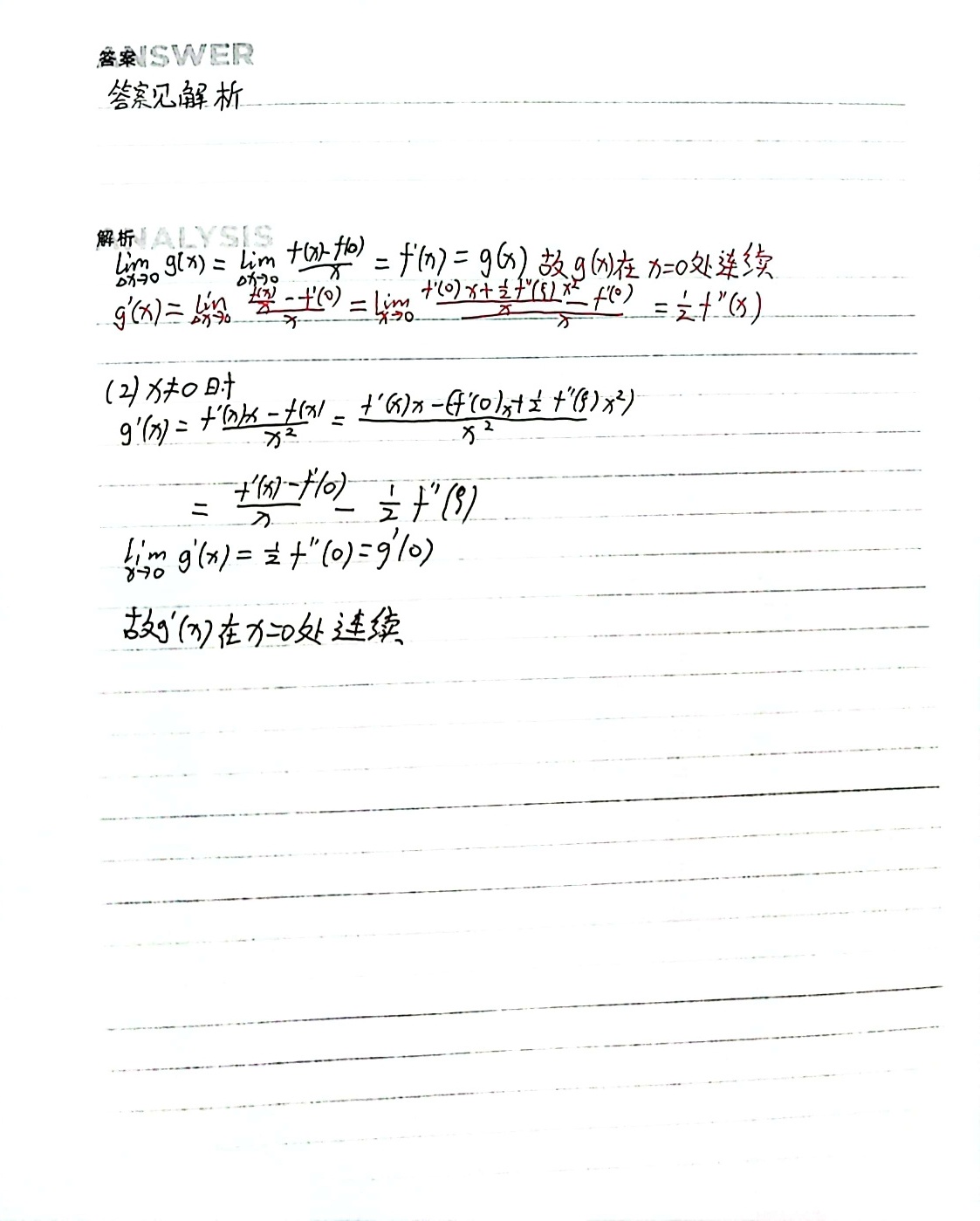
$g'(0) = \lim_{h \to 0} \dfrac{g(h) - g(0)}{h} = \lim_{h \to 0} \dfrac{\dfrac{f(h)}{h} - f'(0)}{h}.$
将$f(h)$展开为二阶泰勒多项式(因$f$二阶可导且$f(0)=0$):
$f(h) = f(0) + f'(0)h + \dfrac{f''(\xi)}{2}h^2 = f'(0)h + \dfrac{f''(\xi)}{2}h^2.$
代入极限表达式:
$\begin{aligned}g'(0) &= \lim_{h \to 0} \dfrac{f'(0)h + \dfrac{f''(\xi)}{2}h^2 - f'(0)h}{h^2} \\&= \lim_{h \to 0} \dfrac{\dfrac{f''(\xi)}{2}h^2}{h^2} = \dfrac{f''(0)}{2}.\end{aligned}$
结论:
$g'(x) =
\begin{cases}\dfrac{f'(x)x - f(x)}{x^2}, & x \neq 0, \\\dfrac{f''(0)}{2}, & x = 0.\end{cases}$
(2)讨论$g'(x)$在$x=0$处的连续性
需验证$\lim\limits_{x \to 0} g'(x) = g'(0)$。
计算$\lim\limits_{x \to 0} g'(x)$
当$x \neq 0$时:
$g'(x) = \dfrac{f'(x)x - f(x)}{x^2}.$
将$f(x)$和$f'(x)$展开为泰勒多项式:
$f(x) = f'(0)x + \dfrac{f''(0)}{2}x^2 + o(x^2), \quad f'(x) = f'(0) + f''(0)x + o(x).$
代入分子:
$\begin{aligned}f'(x)x - f(x) &= \left[f'(0) + f''(0)x + o(x)\right]x - \left[f'(0)x + \dfrac{f''(0)}{2}x^2 + o(x^2)\right] \\&= f'(0)x + f''(0)x^2 + o(x^2) - f'(0)x - \dfrac{f''(0)}{2}x^2 - o(x^2) \\&= \dfrac{f''(0)}{2}x^2 + o(x^2).\end{aligned}$
因此:
$\lim_{x \to 0} g'(x) = \lim_{x \to 0} \dfrac{\dfrac{f''(0)}{2}x^2 + o(x^2)}{x^2} = \dfrac{f''(0)}{2}.$
比较极限与$g'(0)$
因$\lim\limits_{x \to 0} g'(x) = \dfrac{f''(0)}{2} = g'(0)$,故$g'(x)$在$x=0$处连续。