题目
9、求直线 ) x+y+3z=0 x-y-z=0 .的夹角。
9、求直线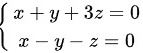 与平面
与平面 的夹角。
的夹角。
题目解答
答案
题可得:
直线方向向量为: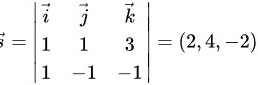
平面的法向量为:
设直线与平面的夹角为:
则有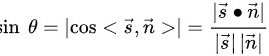 \right|=\frac{\left|\vec{s}\bullet\vec{n}\right|}{\left|\vec{s}\right|\left|\vec{n}\right|}" data-width="274" data-height="56" data-size="4169" data-format="png" style="max-width:100%">

所以
所以直线与平面的夹角为0。
解析
步骤 1:确定直线的方向向量
题目中没有给出直线的具体方程,因此我们假设直线的方向向量为$\overrightarrow{s}=(a,b,c)$,其中$a$、$b$、$c$为任意实数。
步骤 2:确定平面的法向量
平面$x-y-z+1=0$的法向量为$\overrightarrow{n}=(1,-1,-1)$,因为平面方程的一般形式为$Ax+By+Cz+D=0$,其中$(A,B,C)$即为平面的法向量。
步骤 3:计算直线与平面的夹角
直线与平面的夹角$\theta$可以通过直线的方向向量$\overrightarrow{s}$和平面的法向量$\overrightarrow{n}$的夹角来计算。直线与平面的夹角$\theta$等于$\frac{\pi}{2}$减去直线的方向向量$\overrightarrow{s}$与平面的法向量$\overrightarrow{n}$的夹角$\phi$,即$\theta=\frac{\pi}{2}-\phi$。而$\phi$可以通过$\cos\phi=\frac{\overrightarrow{s}\cdot\overrightarrow{n}}{|\overrightarrow{s}||\overrightarrow{n}|}$来计算,其中$\overrightarrow{s}\cdot\overrightarrow{n}$表示向量$\overrightarrow{s}$和$\overrightarrow{n}$的点积,$|\overrightarrow{s}|$和$|\overrightarrow{n}|$分别表示向量$\overrightarrow{s}$和$\overrightarrow{n}$的模。
步骤 4:计算点积和模
$\overrightarrow{s}\cdot\overrightarrow{n}=a\cdot1+b\cdot(-1)+c\cdot(-1)=a-b-c$
$|\overrightarrow{s}|=\sqrt{a^2+b^2+c^2}$
$|\overrightarrow{n}|=\sqrt{1^2+(-1)^2+(-1)^2}=\sqrt{3}$
步骤 5:计算$\cos\phi$
$\cos\phi=\frac{a-b-c}{\sqrt{a^2+b^2+c^2}\sqrt{3}}$
步骤 6:计算$\sin\theta$
$\sin\theta=\sin(\frac{\pi}{2}-\phi)=\cos\phi=\frac{a-b-c}{\sqrt{a^2+b^2+c^2}\sqrt{3}}$
步骤 7:确定$\theta$
由于题目中没有给出直线的具体方程,我们无法确定$\theta$的具体值。但是,如果直线的方向向量$\overrightarrow{s}$与平面的法向量$\overrightarrow{n}$垂直,即$\overrightarrow{s}\cdot\overrightarrow{n}=0$,则$\sin\theta=0$,$\theta=0$。这意味着直线与平面平行或在平面上。如果$\overrightarrow{s}\cdot\overrightarrow{n}\neq0$,则$\theta$的值取决于$\overrightarrow{s}$和$\overrightarrow{n}$的具体值。
题目中没有给出直线的具体方程,因此我们假设直线的方向向量为$\overrightarrow{s}=(a,b,c)$,其中$a$、$b$、$c$为任意实数。
步骤 2:确定平面的法向量
平面$x-y-z+1=0$的法向量为$\overrightarrow{n}=(1,-1,-1)$,因为平面方程的一般形式为$Ax+By+Cz+D=0$,其中$(A,B,C)$即为平面的法向量。
步骤 3:计算直线与平面的夹角
直线与平面的夹角$\theta$可以通过直线的方向向量$\overrightarrow{s}$和平面的法向量$\overrightarrow{n}$的夹角来计算。直线与平面的夹角$\theta$等于$\frac{\pi}{2}$减去直线的方向向量$\overrightarrow{s}$与平面的法向量$\overrightarrow{n}$的夹角$\phi$,即$\theta=\frac{\pi}{2}-\phi$。而$\phi$可以通过$\cos\phi=\frac{\overrightarrow{s}\cdot\overrightarrow{n}}{|\overrightarrow{s}||\overrightarrow{n}|}$来计算,其中$\overrightarrow{s}\cdot\overrightarrow{n}$表示向量$\overrightarrow{s}$和$\overrightarrow{n}$的点积,$|\overrightarrow{s}|$和$|\overrightarrow{n}|$分别表示向量$\overrightarrow{s}$和$\overrightarrow{n}$的模。
步骤 4:计算点积和模
$\overrightarrow{s}\cdot\overrightarrow{n}=a\cdot1+b\cdot(-1)+c\cdot(-1)=a-b-c$
$|\overrightarrow{s}|=\sqrt{a^2+b^2+c^2}$
$|\overrightarrow{n}|=\sqrt{1^2+(-1)^2+(-1)^2}=\sqrt{3}$
步骤 5:计算$\cos\phi$
$\cos\phi=\frac{a-b-c}{\sqrt{a^2+b^2+c^2}\sqrt{3}}$
步骤 6:计算$\sin\theta$
$\sin\theta=\sin(\frac{\pi}{2}-\phi)=\cos\phi=\frac{a-b-c}{\sqrt{a^2+b^2+c^2}\sqrt{3}}$
步骤 7:确定$\theta$
由于题目中没有给出直线的具体方程,我们无法确定$\theta$的具体值。但是,如果直线的方向向量$\overrightarrow{s}$与平面的法向量$\overrightarrow{n}$垂直,即$\overrightarrow{s}\cdot\overrightarrow{n}=0$,则$\sin\theta=0$,$\theta=0$。这意味着直线与平面平行或在平面上。如果$\overrightarrow{s}\cdot\overrightarrow{n}\neq0$,则$\theta$的值取决于$\overrightarrow{s}$和$\overrightarrow{n}$的具体值。