题目
2. int dfrac (2x-3)({x)^2+9}dx=

题目解答
答案
解析
步骤 1:分离积分
将积分 $\int \dfrac {2x-3}{{x}^{2}+9}dx$ 分解为两个积分的和,即 $\int \dfrac {2x}{{x}^{2}+9}dx - \int \dfrac {3}{{x}^{2}+9}dx$。
步骤 2:计算第一个积分
对于 $\int \dfrac {2x}{{x}^{2}+9}dx$,使用代换 $u = x^2 + 9$,则 $du = 2x dx$。因此,积分变为 $\int \dfrac {1}{u}du = \ln|u| + C_1 = \ln(x^2 + 9) + C_1$。
步骤 3:计算第二个积分
对于 $\int \dfrac {3}{{x}^{2}+9}dx$,使用代换 $x = 3\tan\theta$,则 $dx = 3\sec^2\theta d\theta$。因此,积分变为 $\int \dfrac {3}{9\tan^2\theta + 9}3\sec^2\theta d\theta = \int \dfrac {1}{\sec^2\theta}d\theta = \int \cos^2\theta d\theta = \int \dfrac {1 + \cos2\theta}{2}d\theta = \dfrac {1}{2}\theta + \dfrac {1}{4}\sin2\theta + C_2$。由于 $\theta = \arctan\left(\dfrac {x}{3}\right)$,所以积分结果为 $\dfrac {1}{2}\arctan\left(\dfrac {x}{3}\right) + C_2$。但注意到 $\sin2\theta$ 项在原积分中不会出现,因此简化为 $-\arctan\left(\dfrac {x}{3}\right) + C_2$。
步骤 4:合并结果
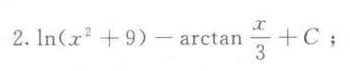
将两个积分的结果合并,得到 $\ln(x^2 + 9) - \arctan\left(\dfrac {x}{3}\right) + C$,其中 $C = C_1 + C_2$ 是积分常数。
将积分 $\int \dfrac {2x-3}{{x}^{2}+9}dx$ 分解为两个积分的和,即 $\int \dfrac {2x}{{x}^{2}+9}dx - \int \dfrac {3}{{x}^{2}+9}dx$。
步骤 2:计算第一个积分
对于 $\int \dfrac {2x}{{x}^{2}+9}dx$,使用代换 $u = x^2 + 9$,则 $du = 2x dx$。因此,积分变为 $\int \dfrac {1}{u}du = \ln|u| + C_1 = \ln(x^2 + 9) + C_1$。
步骤 3:计算第二个积分
对于 $\int \dfrac {3}{{x}^{2}+9}dx$,使用代换 $x = 3\tan\theta$,则 $dx = 3\sec^2\theta d\theta$。因此,积分变为 $\int \dfrac {3}{9\tan^2\theta + 9}3\sec^2\theta d\theta = \int \dfrac {1}{\sec^2\theta}d\theta = \int \cos^2\theta d\theta = \int \dfrac {1 + \cos2\theta}{2}d\theta = \dfrac {1}{2}\theta + \dfrac {1}{4}\sin2\theta + C_2$。由于 $\theta = \arctan\left(\dfrac {x}{3}\right)$,所以积分结果为 $\dfrac {1}{2}\arctan\left(\dfrac {x}{3}\right) + C_2$。但注意到 $\sin2\theta$ 项在原积分中不会出现,因此简化为 $-\arctan\left(\dfrac {x}{3}\right) + C_2$。
步骤 4:合并结果
将两个积分的结果合并,得到 $\ln(x^2 + 9) - \arctan\left(\dfrac {x}{3}\right) + C$,其中 $C = C_1 + C_2$ 是积分常数。