题目
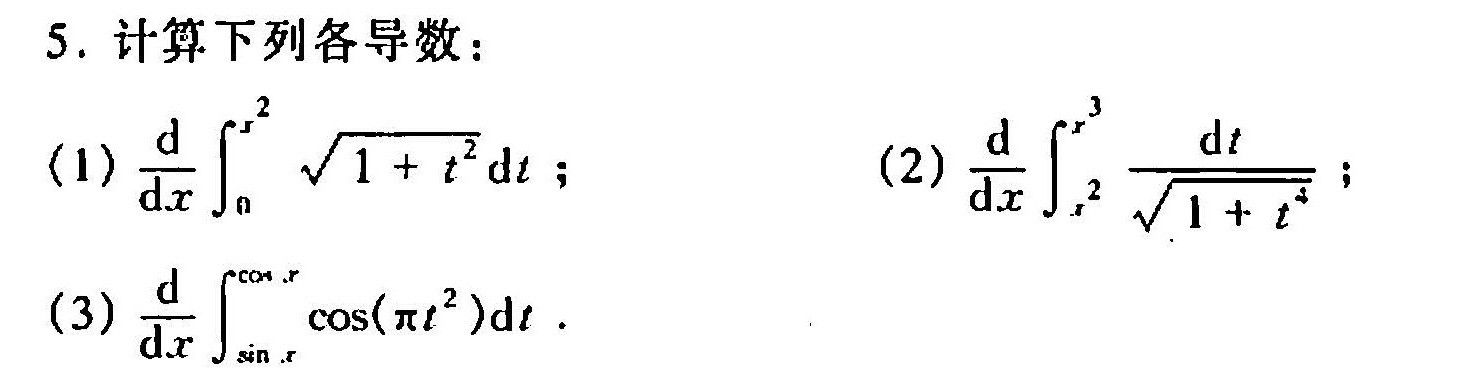
5.计算下列各导数:-|||-(1) dfrac (d)(dx)(int )_(0)^(x^2)sqrt (1+{t)^2}dt;-|||-(2) dfrac (d)(dx)(int )_({x)^2}dfrac (dt)(sqrt {1+{t)^4}} ;-|||-(3) dfrac (d)(dx)(int )_(sin x)^cos xcos (pi (t)^2)dt.
题目解答
答案

解析
步骤 1:应用微积分基本定理
微积分基本定理指出,如果 $F(x) = \int_{a}^{x} f(t) dt$,那么 $F'(x) = f(x)$。对于定积分的上下限是函数的情况,需要使用链式法则。
步骤 2:计算第一个导数
对于 $\dfrac {d}{dx}{\int }_{0}^{{x}^{2}}\sqrt {1+{t}^{2}}dt$,根据微积分基本定理,我们有 $\dfrac {d}{dx}{\int }_{0}^{{x}^{2}}\sqrt {1+{t}^{2}}dt = \sqrt{1+({x}^{2})^{2}} \cdot \dfrac{d}{dx}({x}^{2})$。这里,$\dfrac{d}{dx}({x}^{2}) = 2x$,所以结果为 $2x\sqrt{1+{x}^{4}}$。
步骤 3:计算第二个导数
对于 $\dfrac {d}{dx}{\int }_{{t}^{2}}^{{x}^{3}}\dfrac {dt}{\sqrt {1+{t}^{2}}}$,我们应用微积分基本定理和链式法则。首先,$\dfrac {d}{dx}{\int }_{{t}^{2}}^{{x}^{3}}\dfrac {dt}{\sqrt {1+{t}^{2}}} = \dfrac{1}{\sqrt{1+({x}^{3})^{2}}} \cdot \dfrac{d}{dx}({x}^{3}) - \dfrac{1}{\sqrt{1+({t}^{2})^{2}}} \cdot \dfrac{d}{dx}({t}^{2})$。这里,$\dfrac{d}{dx}({x}^{3}) = 3{x}^{2}$,$\dfrac{d}{dx}({t}^{2}) = 2t$,所以结果为 $\dfrac{3{x}^{2}}{\sqrt{1+{x}^{6}}} - \dfrac{2t}{\sqrt{1+{t}^{4}}}$。由于 $t$ 是 $x$ 的函数,$t = x$,所以最终结果为 $\dfrac{3{x}^{2}}{\sqrt{1+{x}^{6}}} - \dfrac{2x}{\sqrt{1+{x}^{4}}}$。
步骤 4:计算第三个导数
对于 $\dfrac {d}{dx}{\int }_{\sin x}^{\cos x}\cos (\pi {t}^{2})dt$,我们同样应用微积分基本定理和链式法则。首先,$\dfrac {d}{dx}{\int }_{\sin x}^{\cos x}\cos (\pi {t}^{2})dt = \cos(\pi(\cos x)^{2}) \cdot \dfrac{d}{dx}(\cos x) - \cos(\pi(\sin x)^{2}) \cdot \dfrac{d}{dx}(\sin x)$。这里,$\dfrac{d}{dx}(\cos x) = -\sin x$,$\dfrac{d}{dx}(\sin x) = \cos x$,所以结果为 $-\sin x \cdot \cos(\pi(\cos x)^{2}) - \cos x \cdot \cos(\pi(\sin x)^{2})$。简化后,结果为 $(\sin x - \cos x) \cdot \cos(\pi \sin^{2} x)$。
微积分基本定理指出,如果 $F(x) = \int_{a}^{x} f(t) dt$,那么 $F'(x) = f(x)$。对于定积分的上下限是函数的情况,需要使用链式法则。
步骤 2:计算第一个导数
对于 $\dfrac {d}{dx}{\int }_{0}^{{x}^{2}}\sqrt {1+{t}^{2}}dt$,根据微积分基本定理,我们有 $\dfrac {d}{dx}{\int }_{0}^{{x}^{2}}\sqrt {1+{t}^{2}}dt = \sqrt{1+({x}^{2})^{2}} \cdot \dfrac{d}{dx}({x}^{2})$。这里,$\dfrac{d}{dx}({x}^{2}) = 2x$,所以结果为 $2x\sqrt{1+{x}^{4}}$。
步骤 3:计算第二个导数
对于 $\dfrac {d}{dx}{\int }_{{t}^{2}}^{{x}^{3}}\dfrac {dt}{\sqrt {1+{t}^{2}}}$,我们应用微积分基本定理和链式法则。首先,$\dfrac {d}{dx}{\int }_{{t}^{2}}^{{x}^{3}}\dfrac {dt}{\sqrt {1+{t}^{2}}} = \dfrac{1}{\sqrt{1+({x}^{3})^{2}}} \cdot \dfrac{d}{dx}({x}^{3}) - \dfrac{1}{\sqrt{1+({t}^{2})^{2}}} \cdot \dfrac{d}{dx}({t}^{2})$。这里,$\dfrac{d}{dx}({x}^{3}) = 3{x}^{2}$,$\dfrac{d}{dx}({t}^{2}) = 2t$,所以结果为 $\dfrac{3{x}^{2}}{\sqrt{1+{x}^{6}}} - \dfrac{2t}{\sqrt{1+{t}^{4}}}$。由于 $t$ 是 $x$ 的函数,$t = x$,所以最终结果为 $\dfrac{3{x}^{2}}{\sqrt{1+{x}^{6}}} - \dfrac{2x}{\sqrt{1+{x}^{4}}}$。
步骤 4:计算第三个导数
对于 $\dfrac {d}{dx}{\int }_{\sin x}^{\cos x}\cos (\pi {t}^{2})dt$,我们同样应用微积分基本定理和链式法则。首先,$\dfrac {d}{dx}{\int }_{\sin x}^{\cos x}\cos (\pi {t}^{2})dt = \cos(\pi(\cos x)^{2}) \cdot \dfrac{d}{dx}(\cos x) - \cos(\pi(\sin x)^{2}) \cdot \dfrac{d}{dx}(\sin x)$。这里,$\dfrac{d}{dx}(\cos x) = -\sin x$,$\dfrac{d}{dx}(\sin x) = \cos x$,所以结果为 $-\sin x \cdot \cos(\pi(\cos x)^{2}) - \cos x \cdot \cos(\pi(\sin x)^{2})$。简化后,结果为 $(\sin x - \cos x) \cdot \cos(\pi \sin^{2} x)$。