题目
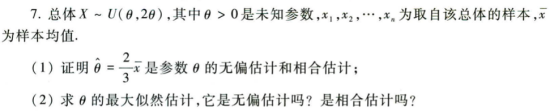
7.总体 sim U(0,2theta ) 其中 theta gt 0 是未知参数,x1,x2 ,···,xn为取自该总体的样本,x-|||-为样本均值.-|||-(1)证明 hat (theta )=dfrac (2)(3)overline (x) 是参数θ的无偏估计和相合估计;-|||-(2)求θ的最大似然估计,它是无偏估计吗?是相合估计吗?
题目解答
答案
解析
步骤 1:计算总体均值和方差
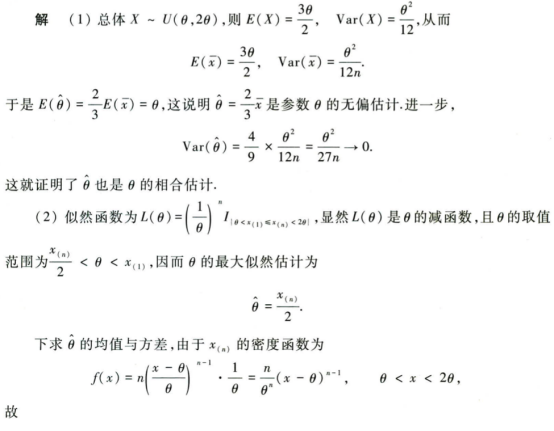
总体 $X\sim U(0,2\theta )$ ,则 $E(X)=\dfrac {3\theta }{2}$, $Var(X)=\dfrac {{\theta }^{2}}{12}$, 从而 $E(\overline {x})=\dfrac {3\theta }{2}$ . $Var(\overline {x})=\dfrac {{\theta }^{2}}{12n}$ 。
步骤 2:证明 $\hat {\theta }=\dfrac {2}{3}\overline {x}$ 是参数θ的无偏估计
$E(\hat {\theta })=\dfrac {2}{3}E(\overline {x})=\theta $ 这说明 $\hat {\theta }=\dfrac {2}{3}\overline {x}$ 是参数θ的无偏估计。
步骤 3:证明 $\hat {\theta }=\dfrac {2}{3}\overline {x}$ 是参数θ的相合估计
$V\arccos (\theta )=\dfrac {4}{9}\times \dfrac {{\theta }^{2}}{12n}=\dfrac {{\theta }^{2}}{27n}\rightarrow 0$ 这就证明了θ也是θ的相合估计。
步骤 4:求θ的最大似然估计
似然函数为 $L(\theta )={(\dfrac {1}{\theta })}^{n}{I}_{(\theta \lt {x}_{(1)}}{x}_{(n)}\lt 2\theta 1$ ,显然L(θ)是θ的减函数,且θ的取值 范围为 $\dfrac {{x}_{(n)}}{2}\lt \theta \lt {x}_{(1)}$ ,因而θ的最大似然估计为 $\hat {\theta }=\dfrac {{x}_{(n)}}{2}$。
步骤 5:计算θ的均值与方差
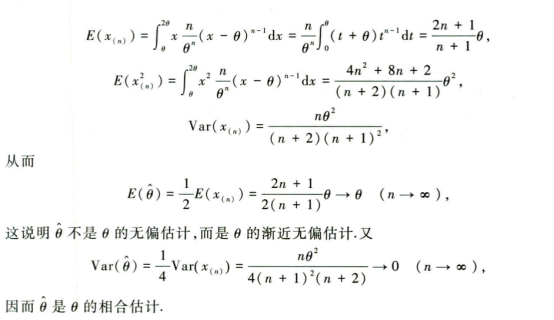
由于x0,的密度函数为 $f(x)=n{(\dfrac {x-\theta }{\theta })}^{n-1}\cdot \dfrac {1}{\theta }=\dfrac {n}{{\theta }^{n}}{(x-\theta )}^{n-1}$ . $\theta \lt x\lt 2\theta $, $E(x(n)={\int }_{0}^{\infty }\times \dfrac {n}{{\theta }^{n}}{(x-\theta )}^{n-1}dx=\dfrac {n}{{\theta }^{n}}{\int }_{0}^{n}(1+\theta ){r}^{n-1}du=\dfrac {2n+1}{n+1$ $V\arccos ({x}_{(n)})=\dfrac {n{\theta }^{2}}{(n+2){(n+1)}^{2}}$ 从而 $E(\hat {\theta })=\dfrac {1}{2}E({x}_{(n)})=\dfrac {2n+1}{2(n+1)}\theta (\theta \rightarrow \infty )$ 这说明θ不是θ的无偏估计,而是θ的渐近无偏估计。又 ${V}_{n(n)}(\dfrac {1}{2})(n-1)(n+\infty )$ 因而θ是θ的相合估计。
总体 $X\sim U(0,2\theta )$ ,则 $E(X)=\dfrac {3\theta }{2}$, $Var(X)=\dfrac {{\theta }^{2}}{12}$, 从而 $E(\overline {x})=\dfrac {3\theta }{2}$ . $Var(\overline {x})=\dfrac {{\theta }^{2}}{12n}$ 。
步骤 2:证明 $\hat {\theta }=\dfrac {2}{3}\overline {x}$ 是参数θ的无偏估计
$E(\hat {\theta })=\dfrac {2}{3}E(\overline {x})=\theta $ 这说明 $\hat {\theta }=\dfrac {2}{3}\overline {x}$ 是参数θ的无偏估计。
步骤 3:证明 $\hat {\theta }=\dfrac {2}{3}\overline {x}$ 是参数θ的相合估计
$V\arccos (\theta )=\dfrac {4}{9}\times \dfrac {{\theta }^{2}}{12n}=\dfrac {{\theta }^{2}}{27n}\rightarrow 0$ 这就证明了θ也是θ的相合估计。
步骤 4:求θ的最大似然估计
似然函数为 $L(\theta )={(\dfrac {1}{\theta })}^{n}{I}_{(\theta \lt {x}_{(1)}}{x}_{(n)}\lt 2\theta 1$ ,显然L(θ)是θ的减函数,且θ的取值 范围为 $\dfrac {{x}_{(n)}}{2}\lt \theta \lt {x}_{(1)}$ ,因而θ的最大似然估计为 $\hat {\theta }=\dfrac {{x}_{(n)}}{2}$。
步骤 5:计算θ的均值与方差
由于x0,的密度函数为 $f(x)=n{(\dfrac {x-\theta }{\theta })}^{n-1}\cdot \dfrac {1}{\theta }=\dfrac {n}{{\theta }^{n}}{(x-\theta )}^{n-1}$ . $\theta \lt x\lt 2\theta $, $E(x(n)={\int }_{0}^{\infty }\times \dfrac {n}{{\theta }^{n}}{(x-\theta )}^{n-1}dx=\dfrac {n}{{\theta }^{n}}{\int }_{0}^{n}(1+\theta ){r}^{n-1}du=\dfrac {2n+1}{n+1$ $V\arccos ({x}_{(n)})=\dfrac {n{\theta }^{2}}{(n+2){(n+1)}^{2}}$ 从而 $E(\hat {\theta })=\dfrac {1}{2}E({x}_{(n)})=\dfrac {2n+1}{2(n+1)}\theta (\theta \rightarrow \infty )$ 这说明θ不是θ的无偏估计,而是θ的渐近无偏估计。又 ${V}_{n(n)}(\dfrac {1}{2})(n-1)(n+\infty )$ 因而θ是θ的相合估计。