题目
设总体x的概率密度函数为f(x,θ)=dfrac (1)(2theta )(e)^-dfrac (|x|{theta )},一∞<x<+∞,其中θ>0是未知参数,X1,X2,…,Xn是取自总体X的简单随机样本.dfrac (1)(2theta )(e)^-dfrac (|x|{theta )}
设总体x的概率密度函数为f(x,θ)= ,一∞<x<+∞,其中θ>0是未知参数,X1,X2,…,Xn是取自总体X的简单随机样本.
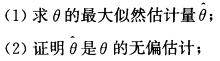
,一∞<x<+∞,其中θ>0是未知参数,X1,X2,…,Xn是取自总体X的简单随机样本.
题目解答
答案
解析
步骤 1:求似然函数
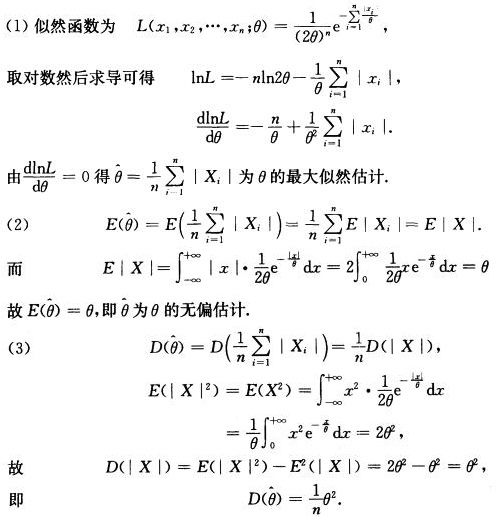
似然函数为 $L({x}_{1},{x}_{2},\cdots ,{x}_{n},\theta )=\dfrac {1}{{(2\theta )}^{n}}{e}^{-\dfrac {1}{\theta }\sum _{i=1}^{n}|{x}_{i}|}$
步骤 2:取对数并求导
取对数然后求导可得 $\ln L=-n\ln 2\theta -\dfrac {1}{\theta }\sum _{i=1}^{n}|{x}_{i}|$ $\dfrac {d\ln L}{d\theta }=-\dfrac {n}{\theta }+\dfrac {1}{{\theta }^{2}}\sum _{i=1}^{n}|{x}_{i}|$
步骤 3:求最大似然估计量
由 $\dfrac {d\ln L}{d\theta }=0$ 得 $\hat {\theta }=\dfrac {1}{n}\sum _{i=1}^{n}|{X}_{i}|$ 为θ的最大似然估计.
步骤 4:证明无偏性
$E(\hat {\theta })=E(\dfrac {1}{n}\sum _{i=1}^{n}|{X}_{i}|)=\dfrac {1}{n}\sum _{i=1}^{n}E|{X}_{i}|=E|X|$ 而 $E|X|={\int }_{-\infty }^{+\infty }|x|\cdot \dfrac {1}{2\theta }{e}^{-\dfrac {|x|}{\theta }}dx=2{\int }_{0}^{+\infty }\dfrac {1}{2\theta }x{e}^{-\dfrac {x}{\theta }}dx=\theta $ 故 $E(\hat {\theta })=\theta $, 即θ为θ的无偏估计.
似然函数为 $L({x}_{1},{x}_{2},\cdots ,{x}_{n},\theta )=\dfrac {1}{{(2\theta )}^{n}}{e}^{-\dfrac {1}{\theta }\sum _{i=1}^{n}|{x}_{i}|}$
步骤 2:取对数并求导
取对数然后求导可得 $\ln L=-n\ln 2\theta -\dfrac {1}{\theta }\sum _{i=1}^{n}|{x}_{i}|$ $\dfrac {d\ln L}{d\theta }=-\dfrac {n}{\theta }+\dfrac {1}{{\theta }^{2}}\sum _{i=1}^{n}|{x}_{i}|$
步骤 3:求最大似然估计量
由 $\dfrac {d\ln L}{d\theta }=0$ 得 $\hat {\theta }=\dfrac {1}{n}\sum _{i=1}^{n}|{X}_{i}|$ 为θ的最大似然估计.
步骤 4:证明无偏性
$E(\hat {\theta })=E(\dfrac {1}{n}\sum _{i=1}^{n}|{X}_{i}|)=\dfrac {1}{n}\sum _{i=1}^{n}E|{X}_{i}|=E|X|$ 而 $E|X|={\int }_{-\infty }^{+\infty }|x|\cdot \dfrac {1}{2\theta }{e}^{-\dfrac {|x|}{\theta }}dx=2{\int }_{0}^{+\infty }\dfrac {1}{2\theta }x{e}^{-\dfrac {x}{\theta }}dx=\theta $ 故 $E(\hat {\theta })=\theta $, 即θ为θ的无偏估计.