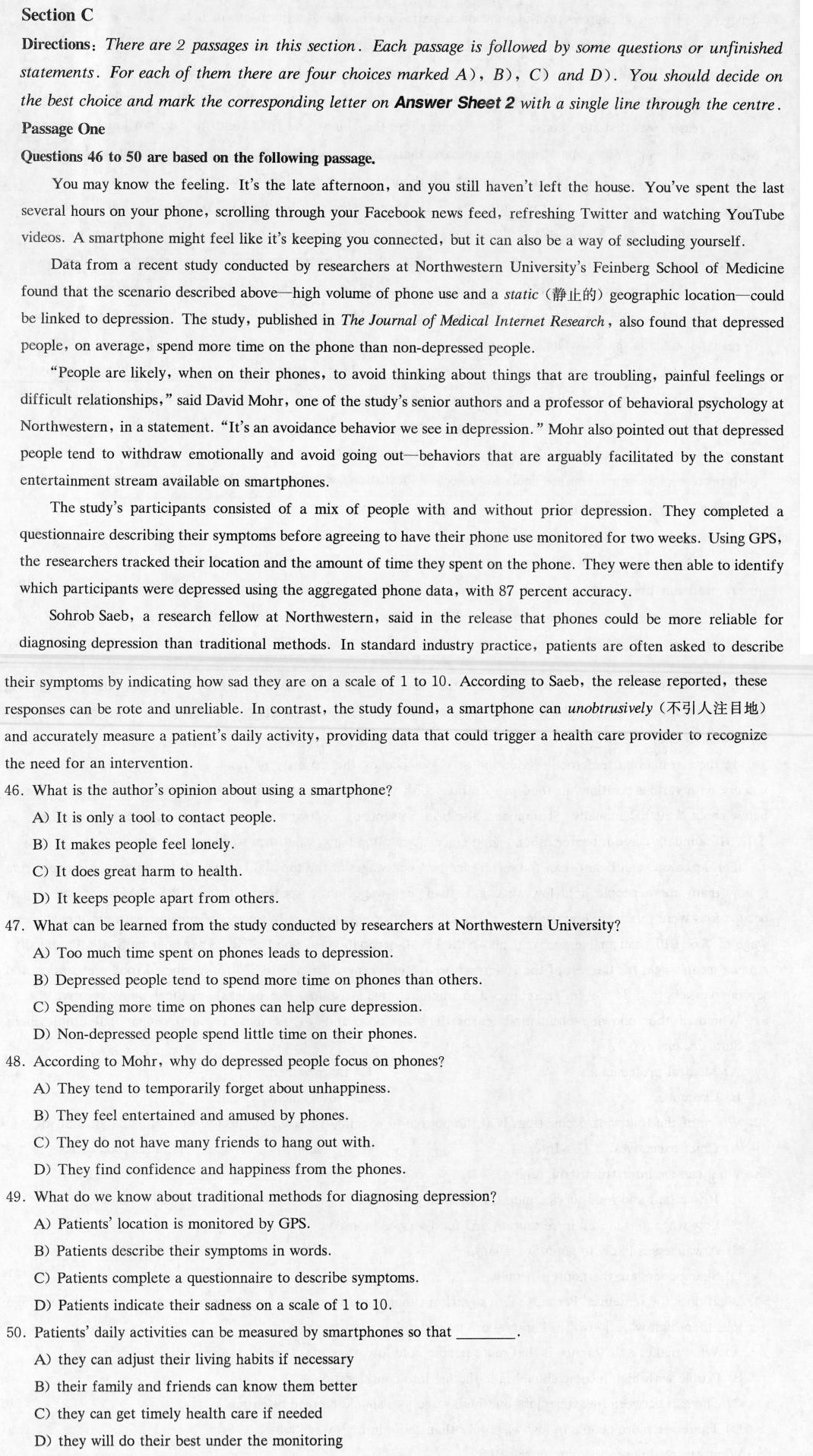
Section C-|||-Directions: There are 2 passages in this section. Each passage is followed by some questions or unfinished-|||-statements. For each of them there are four choices marked A),B),C)and D).You should decide on-|||-the best choice and mark the corresponding letter on Answer Sheet 2 with a single line through the centre.-|||-Passage One-|||-Questions 46 to 50 are based on the following passage.-|||-You may know the feeling.It`s the late afternoon,and you still haven`t left the house. You`ve spent the last-|||-several hours on your phone, scrolling through your Facebook news feed, refreshing Twitter and watching YouTube-|||-videos.A smartphone might feel like it`s keeping you connected,but it can also be a way of secluding yourself.-|||-Data from a recent study conducted by researchers at Narthwestem Linersity`s F School of Medicine-|||-found that the scenario described above-high volume of phone use and a sutic(静止的)geonaphiclocati could-|||-be linked to depression. The study,published in The Journal of Medical Internet Research,also found that depressed-|||-pcople,on average,spend more time on the phone than non-depressed people.-|||-"People are likely,when on their phones,to avoid thinking about things that are troubling,painful feelings or-|||-difficult relationships,"David Mohr,one of the study`s senior authors and a professor of behavioral psychology at-|||-Northwestern,in a statement."It`s an avoidance behavior we see in depression."Mohr also pointed out that depressed-|||-people tend to withdraw emotionally and avoid going out-behaviors that are arguably facilitated by the constant-|||-cntertiinment straam avai on smartphones.-|||-The study`s participants consisted of a mix of people with and without prior depression. They completed a-|||-questionnaire describing symptoms before agreeing to have their phone use monitored for two weeks.Using GPS,-|||-the researchers tracked their location and the amount of time they spent on the phone.They were then able to identify-|||-which participants were depressed using the aggregated phone data,with 87 percent accuracy.-|||-Sohrob Saeb,a research fellow at Northwestern,said in the release that phones could be more reliable for-|||-diagnosing depression tha traditional methods.In standard industry practic patients are often asked to describe-|||-their symptoms by indicating how sad they are on a scale of 1 to 10.According to Saeb,the release reported, these-|||-responses can be rote and unreliable.In contrast,the study found,a smartphone can unobtrusis (不引人注目地)-|||-and accurately measure a patient`s daily activity,providing data that could trigger a health care provider to recognize-|||-the need for an intervention.-|||-46.What is the author`s opinion about using a smartphone?-|||-A)It is only a tool to contact people.-|||-B)It makes people feel loncly.-|||-C)It does great harm to health.-|||-D)It keeps people apart from others.-|||-47.What can be learned from the study conducted by researchers at Northwestern University?-|||-A)Too much time spent on phones leads to depression.-|||-B)Depressed people tend to spend more time on phones than others.-|||-C)Spending more time on phones can help cure depression.-|||-D)Non-depressed pcople spend little time on their phones.-|||-48.According to Mohr,why do depressed people focus on phones?-|||-A)They tend to temporarily forget about unhappiness.-|||-B)They feel entertained and amused by phones.-|||-C)They do not have many friends to hang out with.-|||-D)They find confidence and happincss from the phones.-|||-49.What do we know about traditional methods for diagnosing depression?-|||-A)Patients`location is monitored by GPS.-|||-B)Patients describe their symptoms in words.-|||-C)Patients complete a questionnaire to describe symptoms.-|||-D) Patients indicate their sadness on a scale of 1 to 10.-|||-50.Patients`daily activities can be measured by smartphones so that __-|||-A)they can adjust their living habits if necessary-|||-B)their family and friends can know them better-|||-C) they can get timely health care if needed-|||-D)they will do their best under the monitoringSection C Directions:There are 2 passages in this section.Each pas age is followed by some questions or unfinished statements.For each of them there are four choices marked A),B),C)and D). You should decide on the best choice and mark the corresponding letter on Answer Sheet 2 with a single line through the centre. Passage One Questions 46 to 50 are based on the following passage. You may know the fecling,It's the late afternoon,and you still haven't left the house.You've spent the last severa! hours on your phone,scrolling through your Facebook news feed,refreshing Twitter and watching YouTube videos. A smartphone might feel like it's keeping you connected,but it can also be a way of secluding yourself. Data from a recent study conducted by researchers at Northwestern University's Feinberg School of Medicine found that the scenario described above-high volune of phone usc and a siatic(静止的)geographic location-could be linked to depression.'The study, published in The Journal of Medical Internet Res arch,also found that depressed people,on average,spend more time on the phone than non-depressed people. "People are likely, when on their phones, to avoid thinking about things that are troubling,painful feelings or difficult relationships," said David Mohr, one of the study's senior authors and a profesor of behavioral psychology at Northwestern,in a statement."It's an avoidance behavior we sce in depression." Mohr also pointed out that depressed people tend to withdraw emotionally and avoid going out-behaviors that are arguably facilitated by the constant cntertainment stream available on smartphones. The study's participants consisted of a mix of people with and without prior depression. They completed a questionnaire describing their symptoms before agrecing to have their phone use monitored for two weeks. Using GPS, the researchers tracked their iocation and the amount of time they spent on the phone. They were then able to identify which participants were depressed using the aggregated phone data, with 87 percent accuracy. Sohrob Sacb,a research fellow at Northwestern,said in the release that phones could be more reliable for diagnosing depression than traditional methods. In standard industry practice,patients are often asked to deseribe their symptoms by indicating how sad they are on a scale of l to 10.According to Saeb, the release reported,these responses can be rote and unreliable.In contrast, the study found, a smartphone can wnobtrusively (不引人注目地) and accurately measure a patient's daily activity,providing data that could trigger a health care provider to recognizc the need for an intervention. 46.What is the author's opinion about using a smartphone? A) It is only a tool to contact people. B)It makes people feel loncly, c) It does great harm to health. D) It keeps people apart from others. 47. What can be learned from the study conducted by researchers at Northwestern University? A) Too much time spent on phones leads to depression. B)Depresscd pcople tend to spend more time on phones than others. c) Spending more time on phoncs can help cure depression. D)Non-depresscd people spend little time on their phones. 48.According to Mohr, why do depressed people focus on phones? A) They tend to temporarily forget about unhappincss. B)They feel entertained and amused by phones. c) They do not have many friends to hang out with. D) They find confidence and happiness from the phones. 49.What do we know about traditional methods for diagnosing depression? A) Patients' location is monitored by GPS. B)Patients describe their symptoms in words. C)Patients complete a questionnaire to describe symptoms. D)Patients indicate their sadness on a scale of 1 to 10. 50.Patients' daily activities can be measured by smartphones so that _A) they can adjust their living habits if necessary B)their family and friends can know them better c)they can get timely health care if needed D)they will do their best under the monitoring
题目解答
答案

解析
考查要点:本题为阅读理解题,主要考查学生对学术类英文文章的阅读理解能力,包括主旨概括、细节推理、观点判断等。文章围绕“智能手机使用与抑郁症的关系”展开,需结合上下文理解作者态度、研究结论及对比传统诊断方法。
解题核心思路:
- 定位关键句:通过问题关键词(如“author's opinion”“study conducted by Northwestern University”)快速定位原文对应段落。
- 区分因果关系:注意文章中“linked to depression”是相关性而非因果性,避免过度推断。
- 对比选项差异:如选项B(抑郁者手机使用时间更长)与选项A(手机导致抑郁)需结合原文数据判断。
46. What is the author's opinion about using a smartphone?
关键句:第一段末尾“A smartphone might feel like it's keeping you connected, but it can also be a way of secluding yourself.”
解析:作者指出手机虽让人感觉“连接”,但可能成为“自我孤立”的工具,暗示过度使用会疏远人际关系,对应选项D。
47. What can be learned from the study conducted by Northwestern University?
关键句:第二段“depressed people, on average, spend more time on the phone than non-depressed people.”
解析:研究明确指出抑郁者手机使用时间更长,但未说明因果关系(如选项A“手机导致抑郁”错误),故选B。
48. According to Mohr, why do depressed people focus on phones?
关键句:第三段“People are likely... to avoid thinking about things that are troubling, painful feelings or difficult relationships.”
解析:Mohr认为抑郁者通过手机暂时逃避负面情绪,对应选项A(暂时忘记不开心)。
49. What do we know about traditional methods for diagnosing depression?
关键句:倒数第二段“In standard industry practice, patients are often asked to describe their symptoms by indicating how sad they are on a scale of 1 to 10.”
解析:传统方法要求患者自我评分 sadness(1-10分),对应选项D。
50. Patients' daily activities can be measured by smartphones so that...
关键句:最后一段“provide data that could trigger a health care provider to recognize the need for an intervention.”
解析:监测数据的目的是及时触发医疗干预,对应选项C(获得及时医疗帮助)。