题目
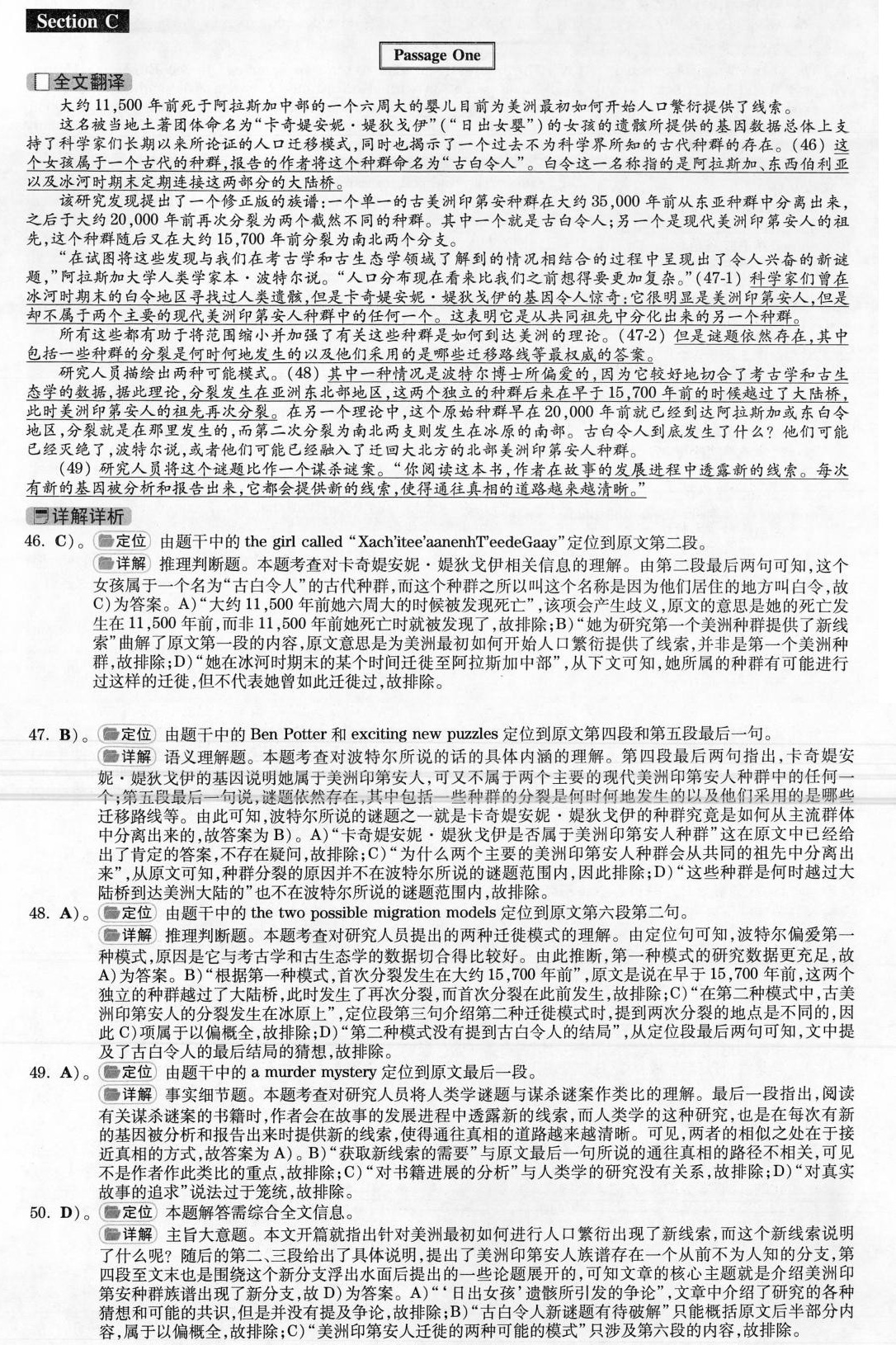
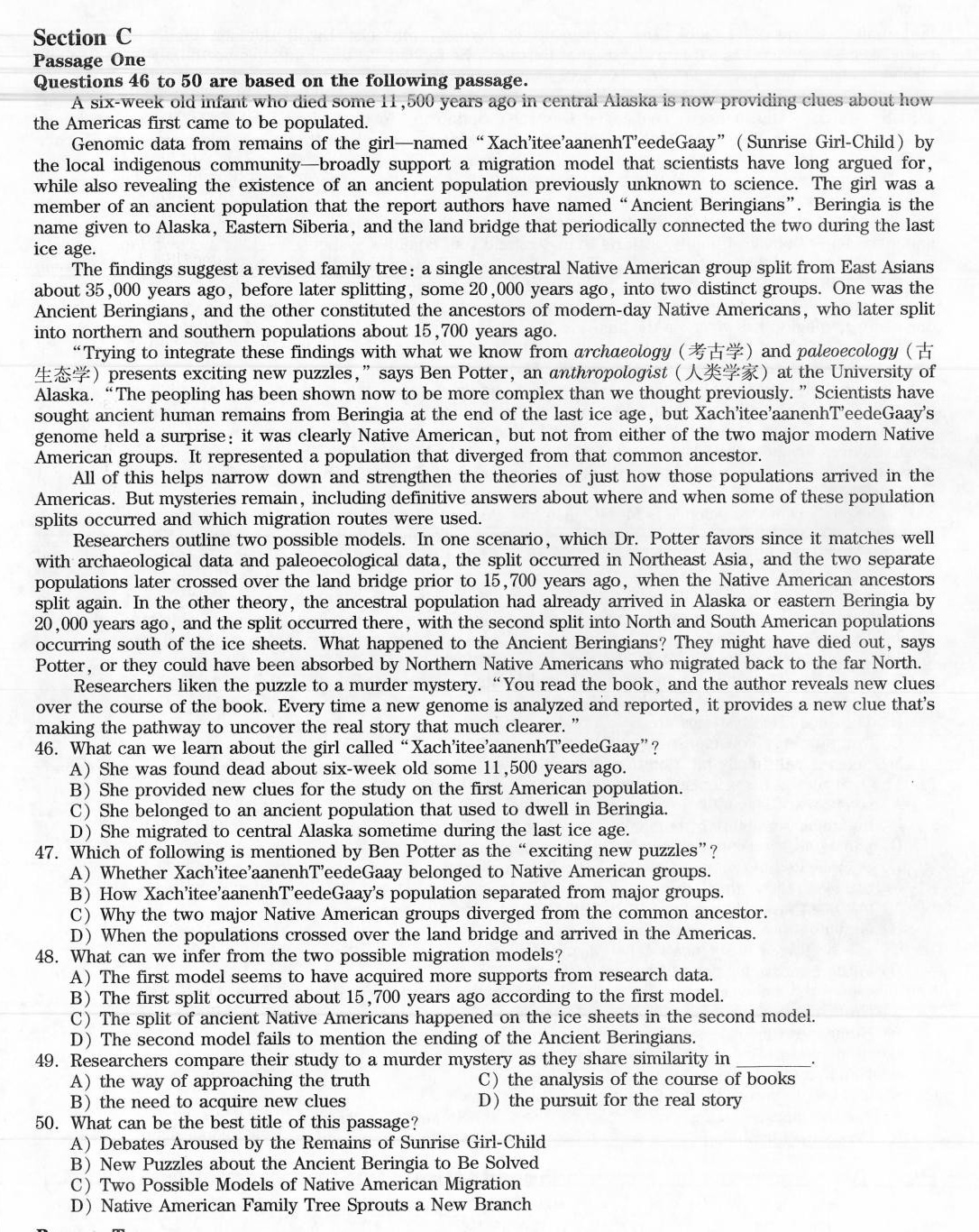
Section C-|||-Passage One-|||-Questions 46 to 50 are based on the following passage.-|||-A six-week old infant who died some 11,500 years ago in central Alaska is now providing clues about how-|||-the Americas first came to be populated.-|||-Genomic data from remains of the girl-named"Xach`itee aanenhTeedeGaay"(Sunrise Girl-Child) by-|||-the laal mogenos sommuly-support a migration model that scientists have long argued for,-|||-while also revealing the existence of an ancient population previously unknown to science. The girl was a-|||-member of an ancient population that the report authors have named "Ancient Beringians".Beringia tse-|||-name given to Alaska, Eastem siberia,an the land bridge that periodically connect the two during the last-|||-ice age.-|||-The findings suggest a revised family tree:a single ancestral Native American group split from East Asians-|||-about 35,000 years ago,before later splitting,some 20,000 years ago,into two distinct groups. One was the-|||-Ancient Beringians,and the other constituted the ancestors of moden-day Na Americans,who later split-|||-into northern and southem populations about 700 years ago.-|||-"Trying to integrate these findings with what we know fromanthaedlogy(考古学)and paleoecology(古-|||-生态学)presents exciting new puzzles,"says Ben poter,an anthepoulsig f(x at the University of-|||-Alaska."The peopling has been shown now to be more complex than we thought previously."Scientists have-|||-sought ancient human remains from Beringia at the end of the last ice age, but Xach`itee`aanenhT"eedeGaay`s-|||-genome held a surprise:it was clearly Native American,but not from either of the two major modern Native-|||-American groups.It represented a population diverged from that common ancestor.-|||-All of this helps narrow down and strengthen the theories of just how those populations arrived in the-|||-Americas. But mysteries renain, incholidding dein about where and when some of these population-|||-splits occurred and which migration routes were used.-|||-Researchers outline two possible models.In one scenario,which Dr. Potter favors since it matches well-|||-with archaeological data paleoecological data,the split occurred in Northeast Asia,and the two separate-|||-populations later crossed over the land bridge prior to 15,700 years ago,when the Native American ancestors-|||-split again.In the other theory,the ancestal popuation ha arrived in Alaska or eastern Beringia by-|||-20,000 years ago,and the split occurred there,with the second split into North and South American populations-|||-occurring south of the ice sheets.What happened to the Ancient Beringians?They might have died out, says-|||-Potter,or they could have been absorbed by Northern Native Americans who migrated back to the far North.-|||-Researchers liken the puzzle to a murder mystery."You read the book,and the author reveals new clues-|||-over the course of the book.Every time a new genome is analyzed and reported,it provides a new clue that`s-|||-making the pathway to uncover the real story that much clearer."-|||-46.What can we learn about the girl called"Xachitee anne eedeGaay"?-|||-A)She was found dead about six week old some 11,500 years ago.-|||-B)She provided new chues for the study on the first American population.-|||-C)She belonged to an ancient population tha used to dwell in Beringia.-|||-D)She migrated to central Alaska sometime during the last ice age.-|||-47.Which of following is mentioned by Ben Potter as the "exciting new puzzles"?-|||-A)Whether Xach`tee`anenhT `eedeGaay belonged to Native American groups.-|||-B)How Xach`tee`aanenhT "eedeGaay`s population separated from major groups.-|||-C)Why the two major Native American groups diverged from the common ancestor.-|||-D)Whenthe populations cross over the land bridge and arrived in the Americas.-|||-48.What can we infer from the two possible migration models?-|||-A)The first model seems to have acquired more supports from research data.-|||-B)The first split occurred about 15,700 years ago according to the first model.-|||-C)The split of ancient Native Americans happened on the ice sheets in the second model.-|||-D)The second model fails to mention the ending of the Ancient Beringians.-|||-49. Researchers compare their study to a murder mystery as they share similarity in __-|||-A)the way of approaching the truth C) the analysis of the course of books-|||-B)the need to acquire new clues D) the pursuit for the real story-|||-50.What can be the best title of this passage?-|||-A)Debates Aroused by the Remains of Sunrise Girl-Child-|||-B)New Puzzles about the Ancient Beringia to Be Solved-|||-C)TuRnilk Mind.lttedmatinSection C Passage One Questions 46 to 50 are based on the following passage. A six-week old infant who died some 11,500 years ago in central Alaska is now providing clues about how the Americas first came to be populated. Genomic data from remains of the girl -named"Xach'itee'aanenhT'eedeGaay"(Sunrise Girl-Child) by the local indigenous community-broadly support a migration model that scientists have long argued for, while also revealing the existence of an ancient population previously unknown to science. The girl was a member of an ancient population that the report authors have named"Ancient Beringians". Beringia is the name given to Alaska, Eastern Siberia, and the land bridge that periodically connected the two during the last ice age. The findings suggest a re vised family tree:a single ancestral Native American group split from East Asians about 35 ,000 years ago, before later splitting, some 20,000 years ago, into two distinct groups. One was the Ancient Beringians, and the other constituted the ancestors of modern-day Native Americans, who later split into northern and southern populations about 15,700 years ago. "Trying to integrate these findings with what we know from archaeology (考古学)and paleoecology (古 生态学)presents exciting new puzzles,"says Ben Potter, an anthropologist (人类学家)at the University of Alaska."The peopling has been shown now to be more complex than we thought previously."Scientists have sought ancient human remains from Beringia at the end of the last ice age,but Xach'itee'aanenhT'eedeGaay's genome neid a surprise:1 t was clearly Native American, but not from either of the two major modern Native American groups. It represented a population that diverged from that common ancestor. All of this helps narrow down and strengthen the theories of just how those populations arrived in the Americas. But mysteries remain, including definitive answers about where and when some of these population splits occurred and which migration routes were used. Researchers outline two possible models. In one scenario,which Dr. Potter favors since it matches well with archaeological data and paleoecological data, the split occurred in Northeast Asia,and the two separate s later crossed over the land bridge prior to 15,700 years ago, when the Native American ancestors populauons she other theory, the ancestral population had already arrived in Alaska or eastern berngia by split again. 1 20,000 years ago, and the split occurred there,with the second split into North and South American populations occurring south of the ice sheets. What happened to the Ancient Beringians? They might have died out,says Potter, or they could have been absorbed by Northern Native Americans who migrated back to the far North. Researchers li ken the puzzle to a murder mystery."You read the book, and the author reveals new clues over the course of the book. Every time a new genome is analyzed and reported,it provides a new clue that's making the pathway to uncover the real story that much clearer." 46. What can we learn about the girl called"Xach'itee'aanenhT'eedeGaay"? A) She was found dead about six-week old some 11,500 years ago. B)She provided new clues for the study on the first American population. C) She belonged to an ancient population that used to dwell in Beringia. D)She migrated to central Alaska sometime during the last ice age. 47. Which of following is mentioned by Ben Potter as the"exciting new puzzles"? A) Whether Xach'itee'aanenhT'eedeGaay belonged to Native American groups. B)How Xach'itee'aanenhT'eedeGaay's population separai ed from frc…A Hajor groups. C)Why the two major Native American groups diverged from the common ancestor. D)When the populations crossed over the land bridge and arrived in the Americas. 48. What can we infer from the two possible migration models? A) The first model seems to have acquired more supports from research data. B)The first split occurred about 15,700 years ago according to the first model. C)The split of ancient Native Americans happened on the ice sheets in the second model. g of the Ancient Beringians. D)The second model fails to mention the enate 49. Researchers compare their study to a murder mystery as they share similarity in _A)the way of approaching the truth C)the analysis of the course of books B)the need to acquire new clues D)the pursuit for the real story 50. What can be the best title of this passage? A) Debates Aroused by the Remains of Sunrise Girl-Child B)New Puzzles about the Ancient Beringia to Be Solved C) Two Possible Models of Native American Migration D)Native American Family Tree Sprouts a New Branch
Section C Passage One Questions 46 to 50 are based on the following passage. A six-week old infant who died some 11,500 years ago in central Alaska is now providing clues about how the Americas first came to be populated. Genomic data from remains of the girl -named"Xach'itee'aanenhT'eedeGaay"(Sunrise Girl-Child) by the local indigenous community-broadly support a migration model that scientists have long argued for, while also revealing the existence of an ancient population previously unknown to science. The girl was a member of an ancient population that the report authors have named"Ancient Beringians". Beringia is the name given to Alaska, Eastern Siberia, and the land bridge that periodically connected the two during the last ice age. The findings suggest a re vised family tree:a single ancestral Native American group split from East Asians about 35 ,000 years ago, before later splitting, some 20,000 years ago, into two distinct groups. One was the Ancient Beringians, and the other constituted the ancestors of modern-day Native Americans, who later split into northern and southern populations about 15,700 years ago. "Trying to integrate these findings with what we know from archaeology (考古学)and paleoecology (古 生态学)presents exciting new puzzles,"says Ben Potter, an anthropologist (人类学家)at the University of Alaska."The peopling has been shown now to be more complex than we thought previously."Scientists have sought ancient human remains from Beringia at the end of the last ice age,but Xach'itee'aanenhT'eedeGaay's genome neid a surprise:1 t was clearly Native American, but not from either of the two major modern Native American groups. It represented a population that diverged from that common ancestor. All of this helps narrow down and strengthen the theories of just how those populations arrived in the Americas. But mysteries remain, including definitive answers about where and when some of these population splits occurred and which migration routes were used. Researchers outline two possible models. In one scenario,which Dr. Potter favors since it matches well with archaeological data and paleoecological data, the split occurred in Northeast Asia,and the two separate s later crossed over the land bridge prior to 15,700 years ago, when the Native American ancestors populauons she other theory, the ancestral population had already arrived in Alaska or eastern berngia by split again. 1 20,000 years ago, and the split occurred there,with the second split into North and South American populations occurring south of the ice sheets. What happened to the Ancient Beringians? They might have died out,says Potter, or they could have been absorbed by Northern Native Americans who migrated back to the far North. Researchers li ken the puzzle to a murder mystery."You read the book, and the author reveals new clues over the course of the book. Every time a new genome is analyzed and reported,it provides a new clue that's making the pathway to uncover the real story that much clearer." 46. What can we learn about the girl called"Xach'itee'aanenhT'eedeGaay"? A) She was found dead about six-week old some 11,500 years ago. B)She provided new clues for the study on the first American population. C) She belonged to an ancient population that used to dwell in Beringia. D)She migrated to central Alaska sometime during the last ice age. 47. Which of following is mentioned by Ben Potter as the"exciting new puzzles"? A) Whether Xach'itee'aanenhT'eedeGaay belonged to Native American groups. B)How Xach'itee'aanenhT'eedeGaay's population separai ed from frc…A Hajor groups. C)Why the two major Native American groups diverged from the common ancestor. D)When the populations crossed over the land bridge and arrived in the Americas. 48. What can we infer from the two possible migration models? A) The first model seems to have acquired more supports from research data. B)The first split occurred about 15,700 years ago according to the first model. C)The split of ancient Native Americans happened on the ice sheets in the second model. g of the Ancient Beringians. D)The second model fails to mention the enate 49. Researchers compare their study to a murder mystery as they share similarity in _A)the way of approaching the truth C)the analysis of the course of books B)the need to acquire new clues D)the pursuit for the real story 50. What can be the best title of this passage? A) Debates Aroused by the Remains of Sunrise Girl-Child B)New Puzzles about the Ancient Beringia to Be Solved C) Two Possible Models of Native American Migration D)Native American Family Tree Sprouts a New Branch
题目解答
答案