题目
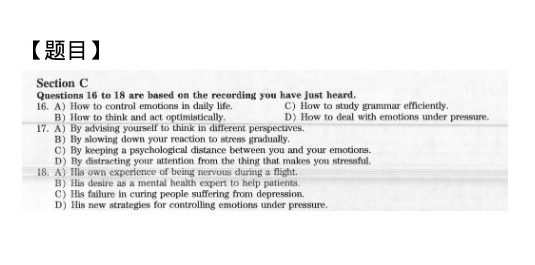
Section C-|||-Questions 16 to 18 are based on the recording you have just heard.-|||-16.A)How to control emotions in daily life. C)How to study grammar efficiently.-|||-B)How to think and act optimistically. D)How to deal with emotions under pressure.-|||-17.A)By advising yourself to think in different persp ctives.-|||-B) By slowing down your reaction to stress gradually.-|||-C)By keeping a psycho ological distance between you and your emotions.-|||-D)By distracting your attention from the thing that makes you stressful.-|||-18.A) HIs own experience of being nervous during a一-|||-C)His failure in curing people suffering from depression.-|||-D)His new strategies for controllin emotions under pressure.
题目解答
答案
解析
步骤 1:理解问题背景
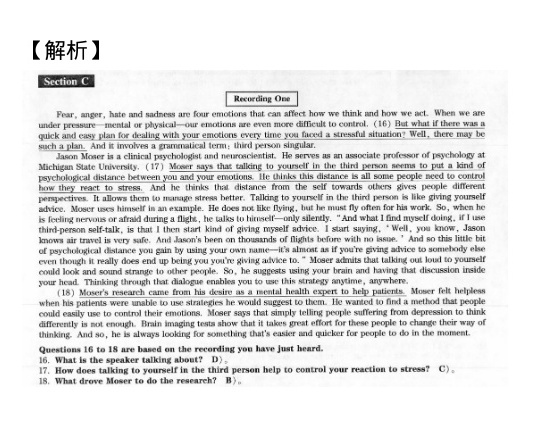
问题涉及听力材料中关于如何处理压力下情绪的讨论。听力材料中提到了Jason Moser,他是一位临床心理学家和神经科学家,他提出了一种通过第三人称自我对话来控制情绪的方法。
步骤 2:分析问题16
问题16询问的是演讲者讨论的主题。根据听力材料,演讲者讨论的是如何在压力下处理情绪,因此答案是D) How to deal with emotions under pressure.
步骤 3:分析问题17
问题17询问的是第三人称自我对话如何帮助控制对压力的反应。根据听力材料,Moser说这种方法可以创造一种心理距离,从而帮助人们更好地管理压力,因此答案是C) By keeping a psychological distance between you and your emotions.
步骤 4:分析问题18
问题18询问的是推动Moser进行研究的原因。根据听力材料,Moser的研究源于他作为心理健康专家帮助病人的愿望,因此答案是B) His own experience of being nervous during a flight.
问题涉及听力材料中关于如何处理压力下情绪的讨论。听力材料中提到了Jason Moser,他是一位临床心理学家和神经科学家,他提出了一种通过第三人称自我对话来控制情绪的方法。
步骤 2:分析问题16
问题16询问的是演讲者讨论的主题。根据听力材料,演讲者讨论的是如何在压力下处理情绪,因此答案是D) How to deal with emotions under pressure.
步骤 3:分析问题17
问题17询问的是第三人称自我对话如何帮助控制对压力的反应。根据听力材料,Moser说这种方法可以创造一种心理距离,从而帮助人们更好地管理压力,因此答案是C) By keeping a psychological distance between you and your emotions.
步骤 4:分析问题18
问题18询问的是推动Moser进行研究的原因。根据听力材料,Moser的研究源于他作为心理健康专家帮助病人的愿望,因此答案是B) His own experience of being nervous during a flight.