题目
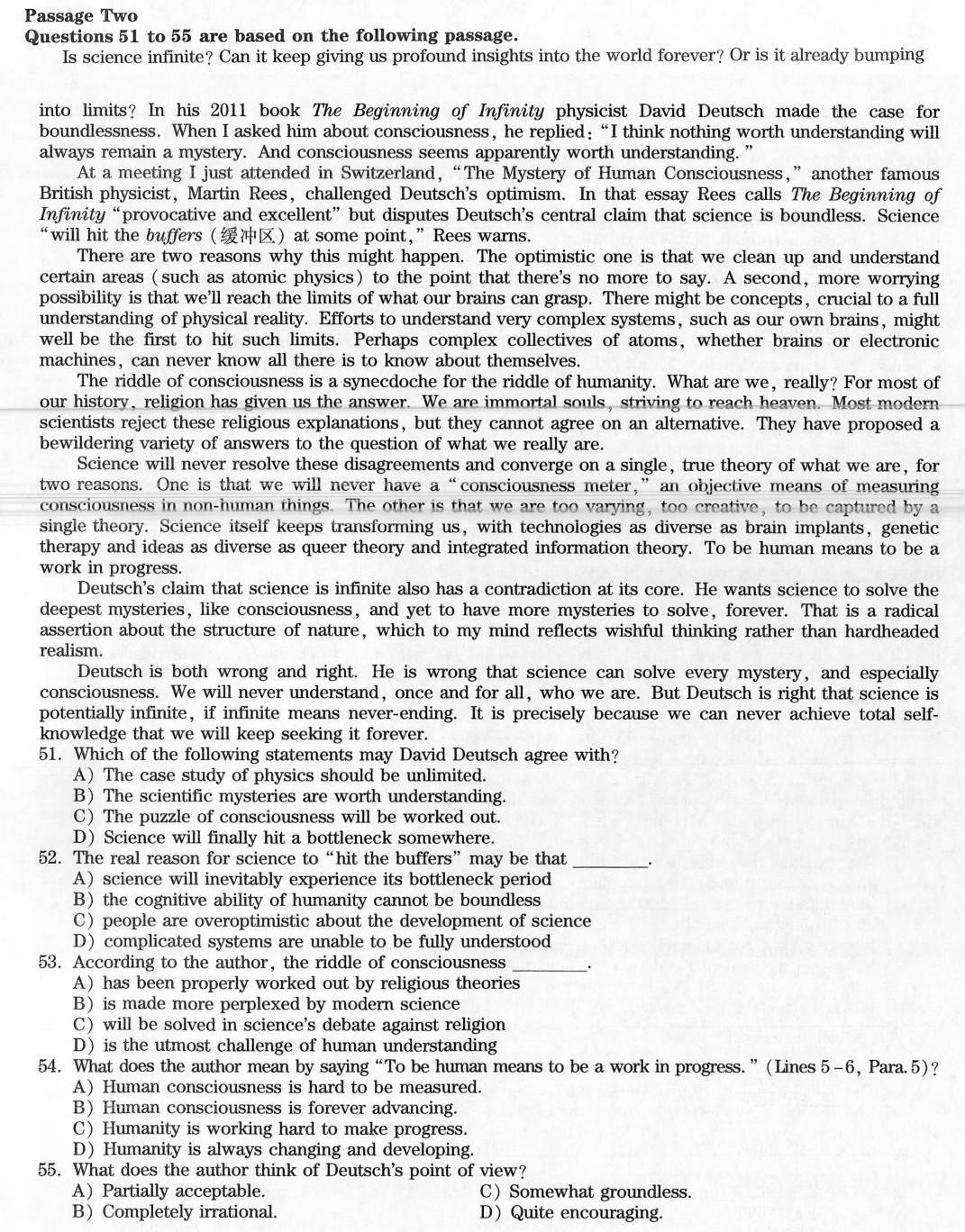
Passage Two-|||-Questions 51 to 55 are based on the following passage.-|||-Is science infinite?Can it keep giving us profound insights into the world forever? Or is it already bumping-|||-into limits? In his 2011 book The Beginning of Infinity physicist David Deutsch made the case for-|||-boundlessness.When I asked him about consciousness,he re think nothing worth understanding will-|||-always remain a mystery.And consciousness apems a understanding."-|||-At a meeting I just attended in Switzerland,"The Mystery of Human Consciousness,"anot famous-|||-British physicist,Martin Rees,challenged Deutsch`s optimism.In that essay Rees calls The Beginning of-|||-Infinity"provocative and excellent but disputes Deutsch`s central claim that science is boundless.Science-|||-will hit the buffers(缓冲区)at some point,"Rees warns.-|||-There are two reasons why this might happen. The optimistic one is that we clean up and understand-|||-certain areas (such as atomic physics)to the point that there`s no more to say.A second,more worrying-|||-possibility is that we`ll reach the limits of what our brains can grasp. There might be concepts,crucial to a full-|||-understanding of physical reality.Efforts to understand very complex systems,such as our own brains,might-|||-well be the first to hit such limits. Perhaps complex collectives of at whether brains or electronic-|||-machines,can never know all there is to know about themselves.-|||-The riddle of consciousness is a synecdoche for the riddle of humanity.What are we,really?For most of-|||-our history,religion has given us the answer.We are immortal souls,striving to reach heaven.Most modern-|||-scientists reject these religious explanations,bu they cannot agree on an alternative.They have proposed a-|||-bewildering variety of answers to the question of what we really are.-|||-Science will never resolv these disagreements and c on a single, true theory of what we are,for-|||-two reasons. One is that we will never have a"consciousness meter,"an objective means of measuring-|||-consciousness in non-huma things. The other is that we are too varying,too creative, to be captured by a-|||-single theory. Science itself keeps transforming with technologies as dive as brain implants,genetic-|||-therapy and ideas as diverse as queer theory and integrated information th To be human means to be a-|||-work in progress.-|||-Deutsch`s claim that science is infinite also has a contradiction at its core.He wants science to solve the-|||-deepest mysteries, like consciousness,and yet to have more mysteries to solve,forever.That is a radical-|||-assertion about the structure of nature,which to my mind reflects wishful thinking rather than hardheaded-|||-realism.-|||-Deutsch is both wrong and right.He is wrong that science can solve every mystery,and especially-|||-consciousness.We will never understand,once and for all,who we are.But Deutsch is right that science is-|||-potentially infinite, if infinite means -ending is precisely because we can never achieve total self-|||-knowledge that we will keep seeking it forever.-|||-51.Which of the following statements may David Deutsch agree with?-|||-A)The case study of physics should be unlimited.-|||-B)The scientific mysteries are worth understanding.-|||-C)The puzzle of consciousness will be worked out.-|||-D)Science will finally hit a bottleneck somewhere.-|||-52.The real reason for science to"hit the buffers"may be that __ _.-|||-A)science will inevitably experience its bottleneck period-|||-B)the cognitive ability of humanity cannot be boundless-|||-C)people are overoptimist about the development of science-|||-D)complicated systems are unable to be fully understood-|||-53.According to the author,the riddle of consciousness __ --|||-A)has been properly worked out by religious theories-|||-B)is made more perplexed by modern science-|||-C)will be solved in science`s debate again religion-|||-D)is the utmost challenge of human understanding-|||-54.What does the author mean by saying"To be human means to be a work in progress." (IIees5-6,Para,5)?-|||-A)Human consciousness is hard to be measured.-|||-B)Human consciousness is fo advancing.-|||-C)Humanity is working hard to make progress.-|||-D)Humanity is always changi developing.-|||-55.What does the author think of Deutsch`s point of view?-|||-B)Completely irrational. D)Quite encouraging.-|||-A)Partially acceptable. C)Somewhat groundless.
题目解答
答案
解析
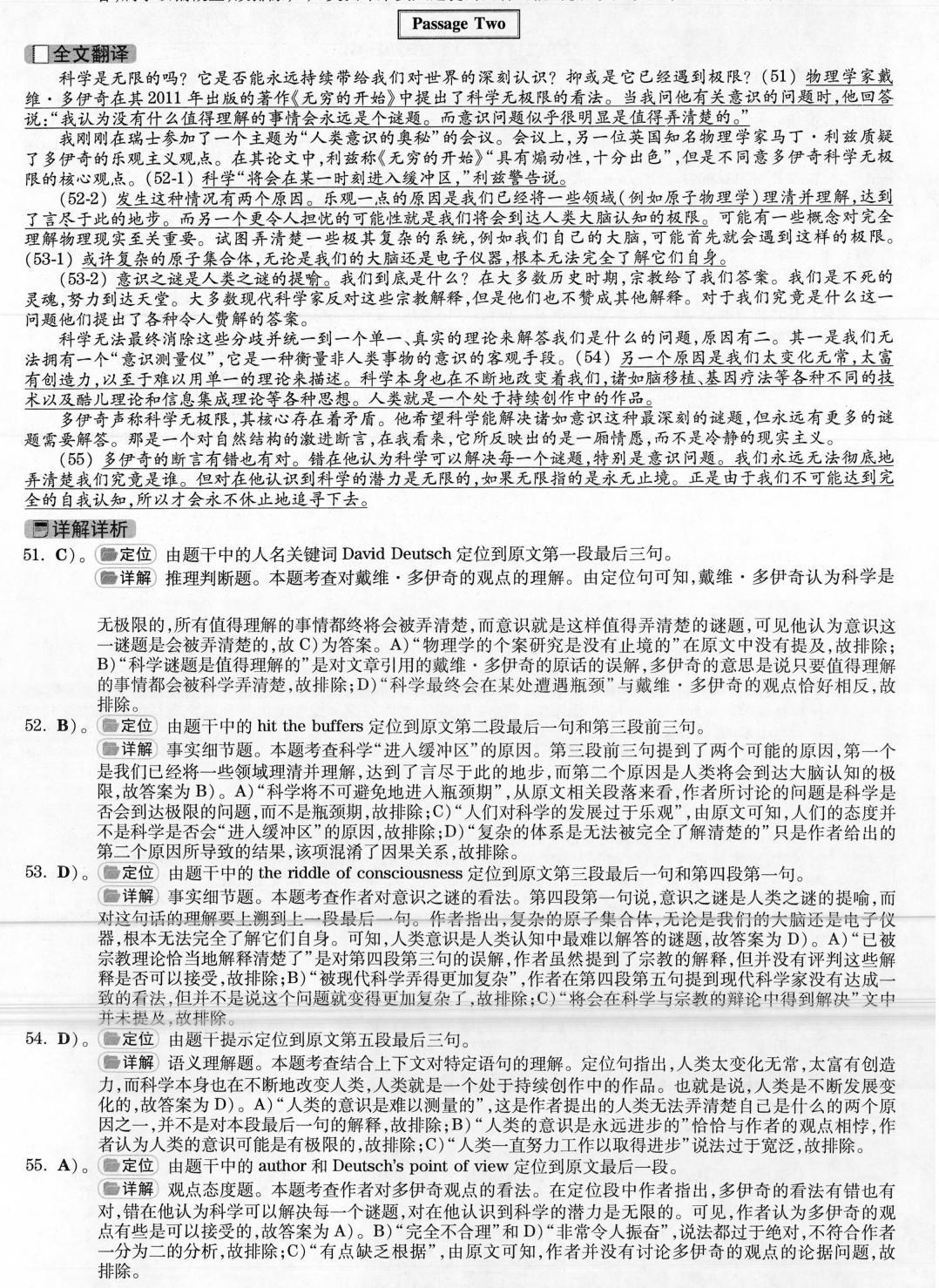
本文围绕科学的无限性、意识之谜等话题展开,探讨了大卫·多伊奇(David Deutsch)与马丁·里斯(Martin Rees)对科学发展的不同观点,以及意识之谜对人类自我认知的挑战。
51. 大卫·多伊奇可能同意的观点
定位到第一段:大卫·多伊奇认为“没有什么值得理解的事情会永远是个谜,意识显然值得理解”,暗含意识之谜终将被解决。
- A:未提及物理学“个案研究无限制”,排除;
- B:曲解原文,多伊奇强调“值得理解的会被解开”,而非“谜题值得理解”本身,排除;
- C:符合其“意识值得理解且终将被解决”的观点,正确;
- D:是马丁·里斯的观点,与多伊奇相反,排除。
52. 科学“进入缓冲区”的真正原因
定位到第二段和第三段:里斯指出两个原因,“更令人担忧的可能性”是人类大脑认知能力有限。
- A:“瓶颈期”非核心原因,排除;
- B:“人类认知能力无界”的否定,即认知有限,符合“大脑极限”的核心原因,正确;
- C:“过度乐观”非直接原因,排除;
- D:“复杂系统无法完全理解”是认知极限的结果,非原因,排除。
53. 作者对“意识之谜”的看法
定位到第三段和第四段:意识之谜是“人类之谜的提喻”,复杂系统(如大脑)可能无法自我完全理解,是人类认知的终极挑战。
- A:宗教解释未被作者认可为“恰当解决”,排除;
- B:现代科学未“加剧困惑”,只是未达成共识,排除;
- C:未提及“科学与宗教辩论解决”,排除;
- D:“人类理解的终极挑战”符合“提喻人类之谜”的表述,正确。
54. “人类是未完成的作品”的含义
定位到第五段:人类“太变化无常、太有创造力”,科学不断改变人类,故“持续发展变化”。
- A:“意识难测量”是另一原因,非此句含义,排除;
- B:“意识永远进步”与作者“意识可能有极限”矛盾,排除;
- C:“努力进步”过于宽泛,未体现“变化创造性”,排除;
- D:“不断变化发展”符合文意,正确。
55. 作者对多伊奇观点的态度
定位到最后一段:“多伊奇有错也有对——错在‘科学解决所有谜题’,对在‘科学潜力无限(永无止境)’”,即部分认可。
- A:“部分可接受”符合“有错有对”,正确;
- B:“完全不合理”与“有对”矛盾,排除;
- C:“缺乏根据”未提及,排除;
- D:“非常令人振奋”未体现,排除。