题目
Intelligence makes for better leaders - from undergraduates to managers to presidents - according to multiple studies. It certainly makes sense that handling a market shift or anything alike require intelligence. But new research on leadership suggests that, at a certain point, having a higher IQ stops helping and starts hurting. Although previous research has shown that groups with smarter leaders perform better by objective measures, some studies have suggested that followers might subjectively view leaders with extremely high intellect as less effective. Decades ago, Dean Simonton, a psychologist from the University of California, Davis, proposed that brilliant leaders' words may simply go over people's heads, their solutions could be more complicated to carry out and followers might find it harder to relate to them. Now Simonton and two colleagues have finally tested that idea, publishing their results in the July 2017 issue of the Journal of Applied Psychology. The researchers looked at 379 male and female business leaders in 30 countries across fields including banking, retail and technology. The managers took IQ tests and each was rated on leadership style and effectiveness by an average of eight co-workers. IQ positively correlated(和……正相关) with ratings of leader effectiveness, strategy formation, vision and several other characteristics - up to a point. The ratings peaked at an IQ of around 120, which is higher than roughly 80 percent of office workers. Beyond that, the ratings declined. The researchers suggest the "ideal" IQ could be higher or lower in various fields, to 140 or 100, depending on whether technical or social skills are more valued in a given work culture. "It's an interesting and thoughtful paper," says Paul Sackett, a management professor at University of Minnesota, who was not involved in the research. "To me. the right interpretation of the work would be that it highlights a need to understand what high-IQ leaders do that leads to lower understanding by followers," he says. "The wrong interpretation would be, 'Don't hire high-IQ leaders.'" The study's lead author, John Antonakis, a psychologist at the University of Lausanne in Switzerland, suggests leaders should use their intelligence to use creative language that will persuade and inspire others - the way former U.S. President Barack Obama did. "I think the only way a smart person can signal their intelligence properly and still connect with the people," Antonakis says, "is to speak in charming ways."(1)The reason why those with high IQs are viewed as worse leaders is probably that ____ .A. followers think of their leaders to be effectiveB. their IQ has a positive correlation with leader effectivenessC. they are hard to get their schemes across to followersD. their social skills can't be recognized in some work culture(2)Which of the following graphs shows the correct relationship between IQ points and leadership qualities? ____ IQ points IQ points-|||-A. 120 B. 120 - --|||-100 100-|||-Leadership qualities Leadership qualities-|||-IQ points IQ points-|||-C. 120 D. 120 --|||-100 100-|||-Leadership qualities Leadership qualities(3)To improve their leadership, high-IQ leaders can ____ .A. interpret the work they are involved inB. use inspiring and accessible languageC. take a course in leader effectivenessD. communication more with their followers(4)What could be the best title for the passage? ____ A. A way to success for high-IQ leadersB. The latest research on intelligenceC. Choose to be a leader of low intelligenceD. Does a high IQ advance your leadership
Intelligence makes for better leaders - from undergraduates to managers to presidents - according to multiple studies. It certainly makes sense that handling a market shift or anything alike require intelligence. But new research on leadership suggests that, at a certain point, having a higher IQ stops helping and starts hurting.
Although previous research has shown that groups with smarter leaders perform better by objective measures, some studies have suggested that followers might subjectively view leaders with extremely high intellect as less effective. Decades ago, Dean Simonton, a psychologist from the University of California, Davis, proposed that brilliant leaders' words may simply go over people's heads, their solutions could be more complicated to carry out and followers might find it harder to relate to them. Now Simonton and two colleagues have finally tested that idea, publishing their results in the July 2017 issue of the Journal of Applied Psychology.
The researchers looked at 379 male and female business leaders in 30 countries across fields including banking, retail and technology. The managers took IQ tests and each was rated on leadership style and effectiveness by an average of eight co-workers. IQ positively correlated(和……正相关) with ratings of leader effectiveness, strategy formation, vision and several other characteristics - up to a point. The ratings peaked at an IQ of around 120, which is higher than roughly 80 percent of office workers. Beyond that, the ratings declined. The researchers suggest the "ideal" IQ could be higher or lower in various fields, to 140 or 100, depending on whether technical or social skills are more valued in a given work culture.
"It's an interesting and thoughtful paper," says Paul Sackett, a management professor at University of Minnesota, who was not involved in the research. "To me. the right interpretation of the work would be that it highlights a need to understand what high-IQ leaders do that leads to lower understanding by followers," he says. "The wrong interpretation would be, 'Don't hire high-IQ leaders.'"
The study's lead author, John Antonakis, a psychologist at the University of Lausanne in Switzerland, suggests leaders should use their intelligence to use creative language that will persuade and inspire others - the way former U.S. President Barack Obama did. "I think the only way a smart person can signal their intelligence properly and still connect with the people," Antonakis says, "is to speak in charming ways."
(1)The reason why those with high IQs are viewed as worse leaders is probably that ____ .
A. followers think of their leaders to be effective
B. their IQ has a positive correlation with leader effectiveness
C. they are hard to get their schemes across to followers
D. their social skills can't be recognized in some work culture
(2)Which of the following graphs shows the correct relationship between IQ points and leadership qualities? ____
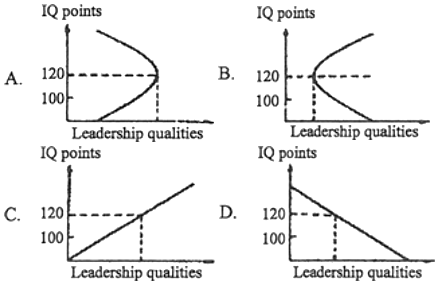
(3)To improve their leadership, high-IQ leaders can ____ .
A. interpret the work they are involved in
B. use inspiring and accessible language
C. take a course in leader effectiveness
D. communication more with their followers
(4)What could be the best title for the passage? ____
A. A way to success for high-IQ leaders
B. The latest research on intelligence
C. Choose to be a leader of low intelligence
D. Does a high IQ advance your leadership
Although previous research has shown that groups with smarter leaders perform better by objective measures, some studies have suggested that followers might subjectively view leaders with extremely high intellect as less effective. Decades ago, Dean Simonton, a psychologist from the University of California, Davis, proposed that brilliant leaders' words may simply go over people's heads, their solutions could be more complicated to carry out and followers might find it harder to relate to them. Now Simonton and two colleagues have finally tested that idea, publishing their results in the July 2017 issue of the Journal of Applied Psychology.
The researchers looked at 379 male and female business leaders in 30 countries across fields including banking, retail and technology. The managers took IQ tests and each was rated on leadership style and effectiveness by an average of eight co-workers. IQ positively correlated(和……正相关) with ratings of leader effectiveness, strategy formation, vision and several other characteristics - up to a point. The ratings peaked at an IQ of around 120, which is higher than roughly 80 percent of office workers. Beyond that, the ratings declined. The researchers suggest the "ideal" IQ could be higher or lower in various fields, to 140 or 100, depending on whether technical or social skills are more valued in a given work culture.
"It's an interesting and thoughtful paper," says Paul Sackett, a management professor at University of Minnesota, who was not involved in the research. "To me. the right interpretation of the work would be that it highlights a need to understand what high-IQ leaders do that leads to lower understanding by followers," he says. "The wrong interpretation would be, 'Don't hire high-IQ leaders.'"
The study's lead author, John Antonakis, a psychologist at the University of Lausanne in Switzerland, suggests leaders should use their intelligence to use creative language that will persuade and inspire others - the way former U.S. President Barack Obama did. "I think the only way a smart person can signal their intelligence properly and still connect with the people," Antonakis says, "is to speak in charming ways."
(1)The reason why those with high IQs are viewed as worse leaders is probably that ____ .
A. followers think of their leaders to be effective
B. their IQ has a positive correlation with leader effectiveness
C. they are hard to get their schemes across to followers
D. their social skills can't be recognized in some work culture
(2)Which of the following graphs shows the correct relationship between IQ points and leadership qualities? ____
(3)To improve their leadership, high-IQ leaders can ____ .
A. interpret the work they are involved in
B. use inspiring and accessible language
C. take a course in leader effectiveness
D. communication more with their followers
(4)What could be the best title for the passage? ____
A. A way to success for high-IQ leaders
B. The latest research on intelligence
C. Choose to be a leader of low intelligence
D. Does a high IQ advance your leadership
题目解答
答案
1. C 细节理解题.根据倒数第二段"To me, the right interpretation of the work would be that it highlights a need to understand what high-IQ leaders do that leads to lower understanding by followers," he says. "The wrong interpretation would be, "Don′t hire high-IQ leaders.'""对我来说,对这项工作的正确解释是,它强调了一种需要,即理解高智商的领导者所做的事情会导致追随者的理解力下降."错误的解释是,"不要雇佣高智商的领导者."可知他们很难让追随者了解他们的计划.故选C.
2. A 推理判断题.根据第三段"The ratings peaked at an IQ of around 120, which is higher than roughly 80 percent of office workers. Beyond that, the ratings declined. The researchers suggest the "ideal" IQ could be higher or lower in various fields, to 140 or 100, depending on whether technical or social skills are more valued in a given work culture.智商在120左右评级达到顶峰,高于大约80%的上班族.除此之外,评级也有所下降.研究人员认为,理想的智商在各个领域可能会更高或更低,达到140或100,这取决于在特定的工作文化中,技术或社交技能是否更受重视."可知在120时领导能力达到顶峰,所以B,C,D都错误.故选A.
3. B 细节理解题.根据倒数第二段"To me, the right interpretation of the work would be that it highlights a need to understand what high-IQ leaders do that leads to lower understanding by followers," he says. "The wrong interpretation would be, "Don′t hire high-IQ leaders.'""对我来说,对这项工作的正确解释是,它强调了一种需要,即理解高智商的领导者所做的事情会导致追随者的理解力下降."错误的解释是,"不要雇佣高智商的领导者."可知高智商的领导者为了提高领导能力,需要熟一些通俗易懂的语言,让员工能理解.故选B.
4. D 文章题目.阅读全文可知本文是一篇科教类阅读,属于说明文,主要讲述了领导的高智商对于团队效率的影响,所以D项"Does a high IQ advance your leadership高智商能提升你的领导力吗"作为题目最合适.故选D.
2. A 推理判断题.根据第三段"The ratings peaked at an IQ of around 120, which is higher than roughly 80 percent of office workers. Beyond that, the ratings declined. The researchers suggest the "ideal" IQ could be higher or lower in various fields, to 140 or 100, depending on whether technical or social skills are more valued in a given work culture.智商在120左右评级达到顶峰,高于大约80%的上班族.除此之外,评级也有所下降.研究人员认为,理想的智商在各个领域可能会更高或更低,达到140或100,这取决于在特定的工作文化中,技术或社交技能是否更受重视."可知在120时领导能力达到顶峰,所以B,C,D都错误.故选A.
3. B 细节理解题.根据倒数第二段"To me, the right interpretation of the work would be that it highlights a need to understand what high-IQ leaders do that leads to lower understanding by followers," he says. "The wrong interpretation would be, "Don′t hire high-IQ leaders.'""对我来说,对这项工作的正确解释是,它强调了一种需要,即理解高智商的领导者所做的事情会导致追随者的理解力下降."错误的解释是,"不要雇佣高智商的领导者."可知高智商的领导者为了提高领导能力,需要熟一些通俗易懂的语言,让员工能理解.故选B.
4. D 文章题目.阅读全文可知本文是一篇科教类阅读,属于说明文,主要讲述了领导的高智商对于团队效率的影响,所以D项"Does a high IQ advance your leadership高智商能提升你的领导力吗"作为题目最合适.故选D.
解析
步骤 1:理解问题背景
文章讨论了高智商领导者在团队中的表现。虽然高智商领导者在客观上能提高团队表现,但研究发现,当智商超过一定水平时,团队成员可能会主观上认为领导者的效果较差。这可能是因为高智商领导者的想法和解决方案过于复杂,难以被团队成员理解。
步骤 2:分析问题
问题(1)询问为什么高智商领导者被认为效果较差。根据文章,这可能是因为高智商领导者的想法和解决方案过于复杂,难以被团队成员理解。
问题(2)询问哪个图正确地显示了智商点与领导能力之间的关系。根据文章,智商与领导能力正相关,但当智商超过120时,领导能力开始下降。
问题(3)询问高智商领导者如何提高领导能力。根据文章,高智商领导者应该使用创造性的语言来说服和激励他人。
问题(4)询问文章的最佳标题。根据文章,文章讨论了高智商是否能提升领导力的问题。
步骤 3:得出答案
根据以上分析,可以得出以下答案。
文章讨论了高智商领导者在团队中的表现。虽然高智商领导者在客观上能提高团队表现,但研究发现,当智商超过一定水平时,团队成员可能会主观上认为领导者的效果较差。这可能是因为高智商领导者的想法和解决方案过于复杂,难以被团队成员理解。
步骤 2:分析问题
问题(1)询问为什么高智商领导者被认为效果较差。根据文章,这可能是因为高智商领导者的想法和解决方案过于复杂,难以被团队成员理解。
问题(2)询问哪个图正确地显示了智商点与领导能力之间的关系。根据文章,智商与领导能力正相关,但当智商超过120时,领导能力开始下降。
问题(3)询问高智商领导者如何提高领导能力。根据文章,高智商领导者应该使用创造性的语言来说服和激励他人。
问题(4)询问文章的最佳标题。根据文章,文章讨论了高智商是否能提升领导力的问题。
步骤 3:得出答案
根据以上分析,可以得出以下答案。