A We've considered several ways of paying to cut in line: hiring line standers, buying tickets from scalpers (票贩子), or purchasing line-cutting privileges directly from, say, an airline or an amusement park. Each of these deals replaces the morals of the queue (waiting your turn) with the morals of the market (paying a price for faster service). Markets and queues—paying and waiting--are two different ways of allocating things, and each is appropriate to different activities. The morals of the queue, " First come, first served, have an equalitarian (平等主义的) appeal. They tell us to ignore privilege, power, and deep pockets. " The principle seems right on playgrounds and at bus stops. But the morals of the queue do not govern all occasions. If I put my house up for sale, I have no duty to accept the first offer that comes along, simply because it's the first. Selling my house and waiting for a bus are different activities, properly governed by different standards. Sometimes standards change, and it is unclear which principle should apply. Think of the recorded message you hear, played over and over, as you wait on hold when calling your bank: "Your call will be answered in the order in which it was received. " This is essential for the morals of the queue. It's as if the company is trying to ease our impatience with fairness. But don't take the recorded message too seriously. Today, some people's calls are answered faster than others. Call center technology enables companies to "score" incoming calls and to give faster service to those that come from rich places. You might call this telephonic queue jumping. Of course, markets and queues are not the only ways of allocating things. Some goods we distribute by value, others by need, still others by chance. However, the tendency of markets to replace queues, and other non-market ways of allocating goods is so common in modern life that we scarcely notice it anymore. It is striking that most of the paid queue-jumping schemes we've considered—at airports and amusement parks, in call centers, doctors' offices, and national parks--are recent developments, scarcely imaginable three decades ago. The disappearance of the queues in these places may seem an unusual concern, but these are not the only places that markets have entered.【小题】(1) According to the author, which of the following seems governed by the principle "First come, first served" ?A.Taking buses.B.uying houses.C.Flying with an airline.D.Visiting amusement parks.【小题】(2) The example of the recorded message in Paragraphs 4 and 5 showsA.the necessity of patience in queuingB.the advantage of modern technologyC.the uncertainty of allocation principleD.the fairness of telephonic services【小题】(3) The passage is meant to________.A.prove paying for faster servicesB.discuss the morals of allocating thingsC.analyze the reason for standing in lineD.blame the behavior of queue jumping B With alarming regularity, we read about oil tankers (油轮) having accidents near land and the terrible consequences of the oil leaking on people, nature, and the environment. Millions of dollars have been used in developing special chemicals to help dismiss the spills (溢出) and to clean up the animals, beaches, and land ruined by the oil. Unfortunately, when many of these chemicals are used, more damage is caused to the environment, especially to lives in the sea. Of all of today's environmental disasters, an oil spill may actually be one of the least serious. Although oil is poisonous, it is a natural material. In the end, it breaks down naturally. There are, of course, long-term effects, but it is usually more serious in the short term. Nature by itself works better than chemical materials, but when there is a spill we demand that governments act immediately with as much hi-tech knowledge as possible. In 1967 the tanker Torrey Canyon sank off the Scilly Isles near the coast of England and spilled 120,000 tons of oil into the ocean. If you go there today, you will find it hard to see any sign that it ever happened. Governments seem to accept the risk of transporting millions of tons of oil by ship every day so that we can fill up our cars and drive around and cause even more environmental damage. Interestingly, the biggest companies in the world produce cars, and the next biggest supply the gasoline to make them run! We should be thinking more about reducing our dependency on oil. Governments should be encouraging research into new technologies, such as cars run by solar power, electricity, hydrogen, and so on. Much of this research has, in the past, been held back by the oil, gas, and coal. If the world's millions of cars were 10% more efficient—and the industry could easily produce cars at least twice as efficient —we would need many fewer tankers crossing the oceans each year. If this happened, the risks of oil spills would be reduced, and the air we breathe would be cleaner and fresher, too.【小题】(4) What is the passage mainly talking about?A.Oil spills pollution.B.What oil pollution is.C.Oil tanker accidents.D.How to reduce oil pollution.【小题】(5) How does the author support the idea that oil spills are not as serious as people believe?A.By giving a description.B.y making an argument.C.By giving an example.D.By drawing a diagram.【小题】(6) What does the underlined word "risk" in Paragraph 5 refer to?A.Transportation depending more on oil.B.Poisonous oil breaking down naturally.C.Millions of tons of oil spilling into the sea.D.More environmental damage being caused.【小题】(7) Which suggestion is made for reducing oil tanker accidents according to the passage?A.We should build safer oil tankers in the near future.B.We should develop new technologies to cut oil use.C.Tankers should not be allowed to sail near the coastlines.D.Countries should build more oil pipelines under the sea. C By now, we are all aware that social media has had a powerful influence on our culture, in business, on the world-at-large. Social media websites revolutionized the way people communicate and socialize on the Web. However, aside from seeing your friends' new baby on Facebook, or reading about Justin Bieber's latest conflict with the law on Twitter, what are some of the real influences? Social networks offer the opportunity for people to re- connect with their old friends and acquaintances, make new friends, share ideas and pictures, and many other activities. Users can keep pace with the latest global and local developments, and participate in campaigns and activities of their choice. Professionals use social media sites like Linked In to improve their career and business development. Students can work together with their contemporaries to improve their academic and communication skills. Unfortunately, there are a few downsides too to social networking. If you are not careful, immoral people can target you for cyber bullying(网络欺凌) and disturbance on social sites. School children, young girls, and women can fall victim to online attacks which can create tension and suffering. If you are a victim of cyber bullying, do not take it lying down, but try to take appropriate legal action against the attacker. Many companies have blocked social networks as addicted employees can distract themselves on such sites, instead of focusing on work. In fact, studies show that British companies have lost billions of dollars per year in productivity because of social media addiction among employees. Also, what you carelessly post on the Net can come back to trouble you. Leaking personal information on social sites can make users easily harmed to crimes like identity theft, stalking(尾随犯罪) , etc. Many companies perform a background check on the Web before hiring an employee. If a potential employee has posted something embarrassing on social media, it can greatly affect their chances of getting the job. The same holds true for our relationships too, as our loved ones and friends may get to know if we post something undesirable on social networks. Social media has its advantages and drawbacks as each coin has two sides. It is up to each user to use social sites wisely to improve their professional and social life, and exercise caution to ensure they do not fall victim to online dangers.【小题】(8) Paragraph 2 mainly shows that social networks________.A.benefit users in various waysB.offer professionals good chancesC.guide users to make right choicesD.help students finish their homework【小题】(9) Faced with problems caused by social media, some companies________.A.take legal action against the attackersB.avoid posting embarrassing informationC.refuse to hire potential addicted employeesD.forbid the use of social networks during work time【小题】(10) The main purpose of this passage is to________.A.share experiences in using social mediaB.provide some advice on social problemsC.raise public awareness of social problemsD.remind people to wisely use social media【小题】(11) Which of the following shows the development of ideas in this passage?A.bigcirc (1)-|||-bigcirc (91) bigcirc (12) bigcirc (13) bigcirc (14)-|||-(c)B.bigcirc (1)-|||-bigcirc (91) bigcirc (12) bigcirc (13) bigcirc (14)-|||-(c)C.bigcirc (1)-|||-bigcirc (91) bigcirc (12) bigcirc (13) bigcirc (14)-|||-(c)D.bigcirc (1)-|||-bigcirc (91) bigcirc (12) bigcirc (13) bigcirc (14)-|||-(c)I: Introduction P: Point Sp: Sub-point (次要点) C: Conclusion D While Jennifer was at home taking an online exam for her business law class, a monitor (监控器) a few hundred miles away was watching her every move. Using a web camera equipped in Jennifer's Los Angeles apartment, the monitor in Phoenix tracked how frequently her eyes moved from the computer screen and listened for the secret sounds of a possible helper in the room. Her Internet access was locked—remotely—to prevent Internet searches, and her typing style was analyzed to make sure she was who she said she was: Did she enter her student number at the same speed as she had in the past? Or was she slowing down? In the battle against cheating, this is the cutting edge and a key to encourage honesty in the booming field of online education. The technology gives trust to the entire system, to the institution and to online education in general. Only with solid measures against cheating, experts say, can Internet universities show that their exams and diplomas are valid-that students haven' t just searched the Internet to get the right answers. Although online classes have existed for more than a decade, the concern over cheating has become sharper in the last year with the growth of "open online courses. " Private colleges, public universities and corporations are jumping into the online education field, spending millions of dollars to attract potential students, while also taking steps to help guarantee honesty at a distance. Aside from the web cameras, a number of other high-tech methods are becoming increasingly popular. Among them are programs that check students' identities using personal information, such as the telephone number they once used.【小题】(12) Why was Jennifer watched in an online exam?A.To correct her typing mistakes.B.To find her secrets in the room.C.To prevent her from slowing down.D.To keep her from dishonest behaviors.【小题】(13) The underlined expression "cutting edge" in Paragraph 3 is closest in meaning to________.A.advanced techniqueB.sharpening toolC.effective ruleD.dividing line【小题】(14) For internet universities, exams and diplomas will be valid if________.A.they can attract potential studentsB.they can defeat academic cheatingC.they offer students online helpD.they offer many online courses【小题】(15) Which of the following is the best title of this passage?A.The Advantages of Online ExamsB.The High-tech Methods in Online CoursesC.The Fight against Cheating in Online EducationD.The War against the Booming of Online Education
A
We've considered several ways of paying to cut in line: hiring line standers, buying tickets from scalpers (票贩子), or purchasing line-cutting privileges directly from, say, an airline or an amusement park. Each of these deals replaces the morals of the queue (waiting your turn) with the morals of the market (paying a price for faster service).
Markets and queues—paying and waiting--are two different ways of allocating things, and each is appropriate to different activities. The morals of the queue, " First come, first served, have an equalitarian (平等主义的) appeal. They tell us to ignore privilege, power, and deep pockets. "
The principle seems right on playgrounds and at bus stops. But the morals of the queue do not govern all occasions. If I put my house up for sale, I have no duty to accept the first offer that comes along, simply because it's the first. Selling my house and waiting for a bus are different activities, properly governed by different standards.
Sometimes standards change, and it is unclear which principle should apply. Think of the recorded message you hear, played over and over, as you wait on hold when calling your bank: "Your call will be answered in the order in which it was received. " This is essential for the morals of the queue. It's as if the company is trying to ease our impatience with fairness.
But don't take the recorded message too seriously. Today, some people's calls are answered faster than others. Call center technology enables companies to "score" incoming calls and to give faster service to those that come from rich places. You might call this telephonic queue jumping.
Of course, markets and queues are not the only ways of allocating things. Some goods we distribute by value, others by need, still others by chance. However, the tendency of markets to replace queues, and other non-market ways of allocating goods is so common in modern life that we scarcely notice it anymore. It is striking that most of the paid queue-jumping schemes we've considered—at airports and amusement parks, in call centers, doctors' offices, and national parks--are recent developments, scarcely imaginable three decades ago. The disappearance of the queues in these places may seem an unusual concern, but these are not the only places that markets have entered.【小题】(1) According to the author, which of the following seems governed by the principle "First come, first served" ?A.Taking buses.B.uying houses.C.Flying with an airline.D.Visiting amusement parks.【小题】(2) The example of the recorded message in Paragraphs 4 and 5 showsA.the necessity of patience in queuingB.the advantage of modern technologyC.the uncertainty of allocation principleD.the fairness of telephonic services【小题】(3) The passage is meant to________.A.prove paying for faster servicesB.discuss the morals of allocating thingsC.analyze the reason for standing in lineD.blame the behavior of queue jumping B With alarming regularity, we read about oil tankers (油轮) having accidents near land and the terrible consequences of the oil leaking on people, nature, and the environment. Millions of dollars have been used in developing special chemicals to help dismiss the spills (溢出) and to clean up the animals, beaches, and land ruined by the oil. Unfortunately, when many of these chemicals are used, more damage is caused to the environment, especially to lives in the sea. Of all of today's environmental disasters, an oil spill may actually be one of the least serious. Although oil is poisonous, it is a natural material. In the end, it breaks down naturally. There are, of course, long-term effects, but it is usually more serious in the short term. Nature by itself works better than chemical materials, but when there is a spill we demand that governments act immediately with as much hi-tech knowledge as possible. In 1967 the tanker Torrey Canyon sank off the Scilly Isles near the coast of England and spilled 120,000 tons of oil into the ocean. If you go there today, you will find it hard to see any sign that it ever happened. Governments seem to accept the risk of transporting millions of tons of oil by ship every day so that we can fill up our cars and drive around and cause even more environmental damage. Interestingly, the biggest companies in the world produce cars, and the next biggest supply the gasoline to make them run! We should be thinking more about reducing our dependency on oil. Governments should be encouraging research into new technologies, such as cars run by solar power, electricity, hydrogen, and so on. Much of this research has, in the past, been held back by the oil, gas, and coal. If the world's millions of cars were 10% more efficient—and the industry could easily produce cars at least twice as efficient —we would need many fewer tankers crossing the oceans each year. If this happened, the risks of oil spills would be reduced, and the air we breathe would be cleaner and fresher, too.【小题】(4) What is the passage mainly talking about?A.Oil spills pollution.B.What oil pollution is.C.Oil tanker accidents.D.How to reduce oil pollution.【小题】(5) How does the author support the idea that oil spills are not as serious as people believe?A.By giving a description.B.y making an argument.C.By giving an example.D.By drawing a diagram.【小题】(6) What does the underlined word "risk" in Paragraph 5 refer to?A.Transportation depending more on oil.B.Poisonous oil breaking down naturally.C.Millions of tons of oil spilling into the sea.D.More environmental damage being caused.【小题】(7) Which suggestion is made for reducing oil tanker accidents according to the passage?A.We should build safer oil tankers in the near future.B.We should develop new technologies to cut oil use.C.Tankers should not be allowed to sail near the coastlines.D.Countries should build more oil pipelines under the sea. C By now, we are all aware that social media has had a powerful influence on our culture, in business, on the world-at-large. Social media websites revolutionized the way people communicate and socialize on the Web. However, aside from seeing your friends' new baby on Facebook, or reading about Justin Bieber's latest conflict with the law on Twitter, what are some of the real influences? Social networks offer the opportunity for people to re- connect with their old friends and acquaintances, make new friends, share ideas and pictures, and many other activities. Users can keep pace with the latest global and local developments, and participate in campaigns and activities of their choice. Professionals use social media sites like Linked In to improve their career and business development. Students can work together with their contemporaries to improve their academic and communication skills. Unfortunately, there are a few downsides too to social networking. If you are not careful, immoral people can target you for cyber bullying(网络欺凌) and disturbance on social sites. School children, young girls, and women can fall victim to online attacks which can create tension and suffering. If you are a victim of cyber bullying, do not take it lying down, but try to take appropriate legal action against the attacker. Many companies have blocked social networks as addicted employees can distract themselves on such sites, instead of focusing on work. In fact, studies show that British companies have lost billions of dollars per year in productivity because of social media addiction among employees. Also, what you carelessly post on the Net can come back to trouble you. Leaking personal information on social sites can make users easily harmed to crimes like identity theft, stalking(尾随犯罪) , etc. Many companies perform a background check on the Web before hiring an employee. If a potential employee has posted something embarrassing on social media, it can greatly affect their chances of getting the job. The same holds true for our relationships too, as our loved ones and friends may get to know if we post something undesirable on social networks. Social media has its advantages and drawbacks as each coin has two sides. It is up to each user to use social sites wisely to improve their professional and social life, and exercise caution to ensure they do not fall victim to online dangers.【小题】(8) Paragraph 2 mainly shows that social networks________.A.benefit users in various waysB.offer professionals good chancesC.guide users to make right choicesD.help students finish their homework【小题】(9) Faced with problems caused by social media, some companies________.A.take legal action against the attackersB.avoid posting embarrassing informationC.refuse to hire potential addicted employeesD.forbid the use of social networks during work time【小题】(10) The main purpose of this passage is to________.A.share experiences in using social mediaB.provide some advice on social problemsC.raise public awareness of social problemsD.remind people to wisely use social media【小题】(11) Which of the following shows the development of ideas in this passage?A.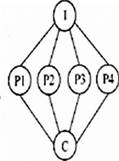 B.
B.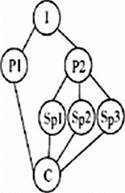 C.
C.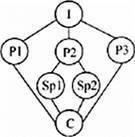 D.
D.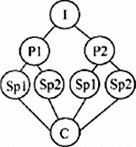 I: Introduction P: Point Sp: Sub-point (次要点) C: Conclusion D While Jennifer was at home taking an online exam for her business law class, a monitor (监控器) a few hundred miles away was watching her every move. Using a web camera equipped in Jennifer's Los Angeles apartment, the monitor in Phoenix tracked how frequently her eyes moved from the computer screen and listened for the secret sounds of a possible helper in the room. Her Internet access was locked—remotely—to prevent Internet searches, and her typing style was analyzed to make sure she was who she said she was: Did she enter her student number at the same speed as she had in the past? Or was she slowing down? In the battle against cheating, this is the cutting edge and a key to encourage honesty in the booming field of online education. The technology gives trust to the entire system, to the institution and to online education in general. Only with solid measures against cheating, experts say, can Internet universities show that their exams and diplomas are valid-that students haven' t just searched the Internet to get the right answers. Although online classes have existed for more than a decade, the concern over cheating has become sharper in the last year with the growth of "open online courses. " Private colleges, public universities and corporations are jumping into the online education field, spending millions of dollars to attract potential students, while also taking steps to help guarantee honesty at a distance. Aside from the web cameras, a number of other high-tech methods are becoming increasingly popular. Among them are programs that check students' identities using personal information, such as the telephone number they once used.【小题】(12) Why was Jennifer watched in an online exam?A.To correct her typing mistakes.B.To find her secrets in the room.C.To prevent her from slowing down.D.To keep her from dishonest behaviors.【小题】(13) The underlined expression "cutting edge" in Paragraph 3 is closest in meaning to________.A.advanced techniqueB.sharpening toolC.effective ruleD.dividing line【小题】(14) For internet universities, exams and diplomas will be valid if________.A.they can attract potential studentsB.they can defeat academic cheatingC.they offer students online helpD.they offer many online courses【小题】(15) Which of the following is the best title of this passage?A.The Advantages of Online ExamsB.The High-tech Methods in Online CoursesC.The Fight against Cheating in Online EducationD.The War against the Booming of Online Education
题目解答
答案
【答案】
| 【小题1】A | 【小题2】C | 【小题3】B | 【小题4】A | 【小题5】C |
| 【小题6】D | 【小题7】B | 【小题8】A | 【小题9】D | 【小题10】D |
| 【小题11】B | 【小题12】D | 【小题13】A | 【小题14】B | 【小题15】C |