题目
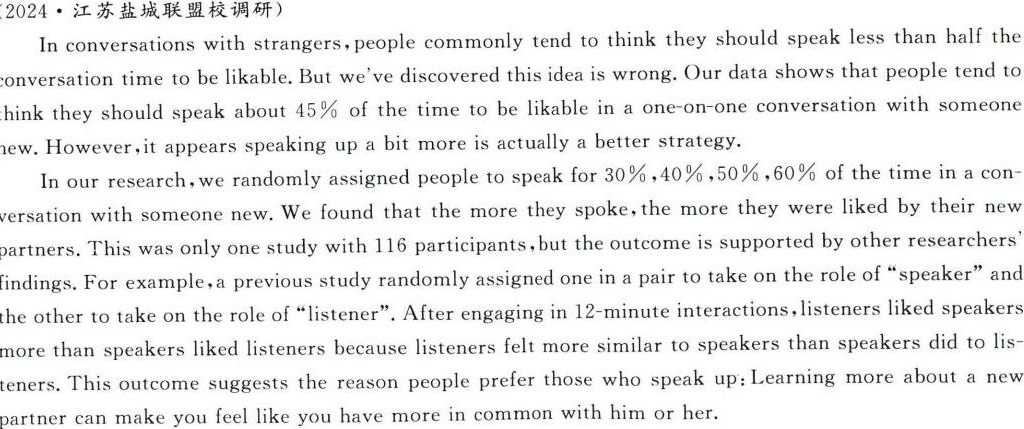
2024·江苏盐城联盟校调研)-|||-In conversations with strangers,people commonly tend to think they should speak less than half the-|||-onversation time to be likable.But we've discovered this idea is wrong.Our data shows that people tend to-|||-hink they should speak about 45 %of the time to be likable in a one-on-one conversation with someone-|||-ew.However,it appears speaking up a bit more is actually a better strategy.-|||-In our research,we randomly assigned people to speak for 30%,40%,50 %,60%of the time in a con--|||-versation with someone new.We found that the more they spoke,the more they were liked by their new-|||-partners.This was only one study with 116 participants,but the outcome is supported by other researchers'-|||-findings.For example,a previous study randomly assigned one in a pair to take on the role of "speaker"and-|||-the other to take on the role of"listener".After engaging in 12-minute interactions listeners liked speakers-|||-more than speakers liked listeners because listeners felt more similar to speakers than speakers did to lis--|||-teners.This outcome suggests the reason people prefer those who speak up:Learning more about a new-|||-partner can make you feel like you have more in common with him or her.2024·江苏盐城联盟校调研)-|||-In conversations with strangers,people commonly tend to think they should speak less than half the-|||-onversation time to be likable.But we've discovered this idea is wrong.Our data shows that people tend to-|||-hink they should speak about 45 %of the time to be likable in a one-on-one conversation with someone-|||-ew.However,it appears speaking up a bit more is actually a better strategy.-|||-In our research,we randomly assigned people to speak for 30%,40%,50 %,60%of the time in a con--|||-versation with someone new.We found that the more they spoke,the more they were liked by their new-|||-partners.This was only one study with 116 participants,but the outcome is supported by other researchers'-|||-findings.For example,a previous study randomly assigned one in a pair to take on the role of "speaker"and-|||-the other to take on the role of"listener".After engaging in 12-minute interactions listeners liked speakers-|||-more than speakers liked listeners because listeners felt more similar to speakers than speakers did to lis--|||-teners.This outcome suggests the reason people prefer those who speak up:Learning more about a new-|||-partner can make you feel like you have more in common with him or her.
题目解答
答案


解析
步骤 1:理解问题背景
文章讨论了在与陌生人交谈时,人们普遍认为应该少说话以显得更讨人喜欢,但研究发现,实际上多说话会更受欢迎。研究通过让参与者在交谈中分别占据30%、40%、50%、60%的说话时间,发现说话时间越长,越受欢迎。
步骤 2:分析问题9
问题9询问关于与陌生人交谈的普遍信念。根据文章,人们普遍认为应该少说话以显得更讨人喜欢,但研究发现,实际上多说话会更受欢迎。因此,选项A(Speaking a little less is preferred.)符合文章内容。
步骤 3:分析问题10
问题10询问研究是如何进行的。文章提到,研究通过让参与者在交谈中分别占据30%、40%、50%、60%的说话时间,发现说话时间越长,越受欢迎。因此,选项B(By making comparisons.)符合文章内容。
步骤 4:分析问题11
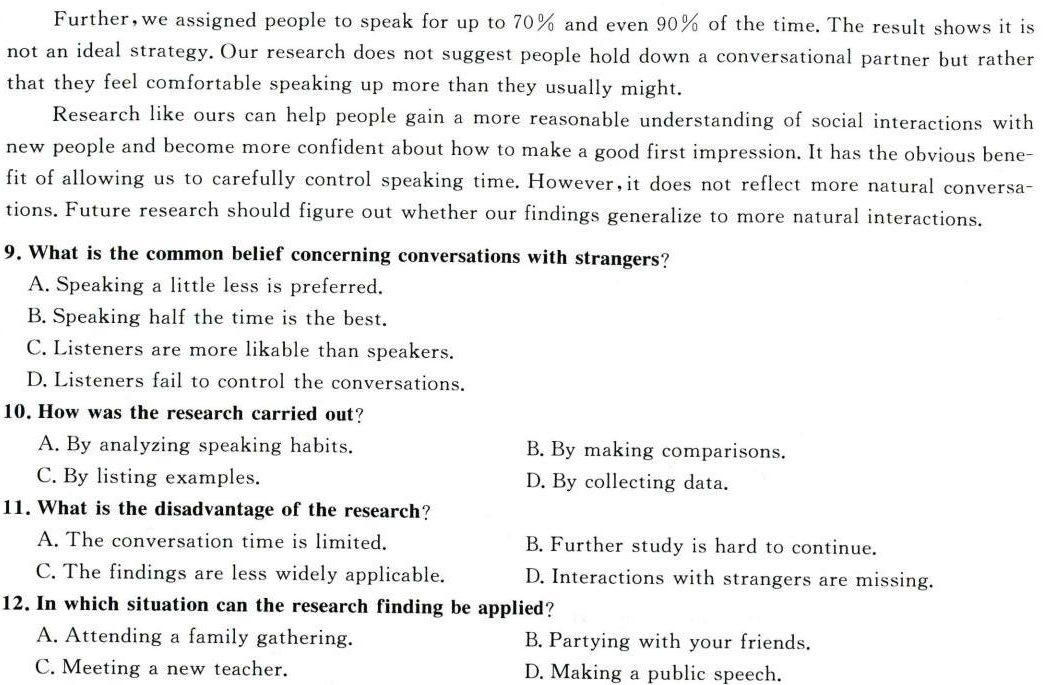
问题11询问研究的缺点。文章提到,研究结果不适用于更自然的互动。因此,选项C(The findings are less widely applicable.)符合文章内容。
步骤 5:分析问题12
问题12询问研究结果可以应用于哪种情况。文章提到,研究结果可以帮助人们更好地理解与新朋友的社交互动。因此,选项C(Meeting a new teacher.)符合文章内容。
文章讨论了在与陌生人交谈时,人们普遍认为应该少说话以显得更讨人喜欢,但研究发现,实际上多说话会更受欢迎。研究通过让参与者在交谈中分别占据30%、40%、50%、60%的说话时间,发现说话时间越长,越受欢迎。
步骤 2:分析问题9
问题9询问关于与陌生人交谈的普遍信念。根据文章,人们普遍认为应该少说话以显得更讨人喜欢,但研究发现,实际上多说话会更受欢迎。因此,选项A(Speaking a little less is preferred.)符合文章内容。
步骤 3:分析问题10
问题10询问研究是如何进行的。文章提到,研究通过让参与者在交谈中分别占据30%、40%、50%、60%的说话时间,发现说话时间越长,越受欢迎。因此,选项B(By making comparisons.)符合文章内容。
步骤 4:分析问题11
问题11询问研究的缺点。文章提到,研究结果不适用于更自然的互动。因此,选项C(The findings are less widely applicable.)符合文章内容。
步骤 5:分析问题12
问题12询问研究结果可以应用于哪种情况。文章提到,研究结果可以帮助人们更好地理解与新朋友的社交互动。因此,选项C(Meeting a new teacher.)符合文章内容。