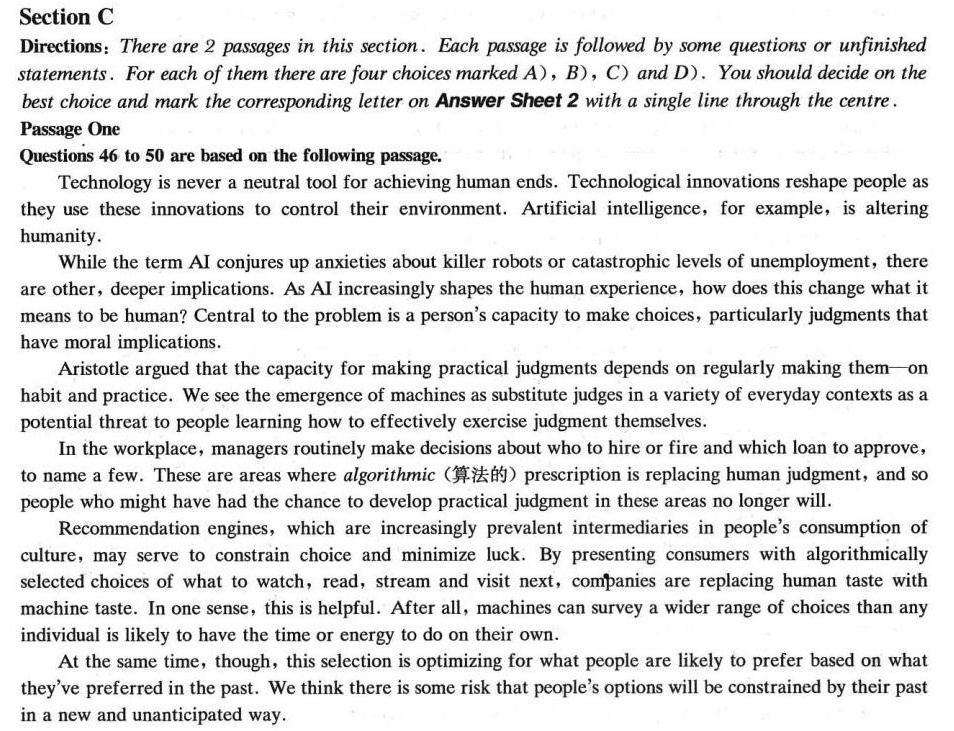
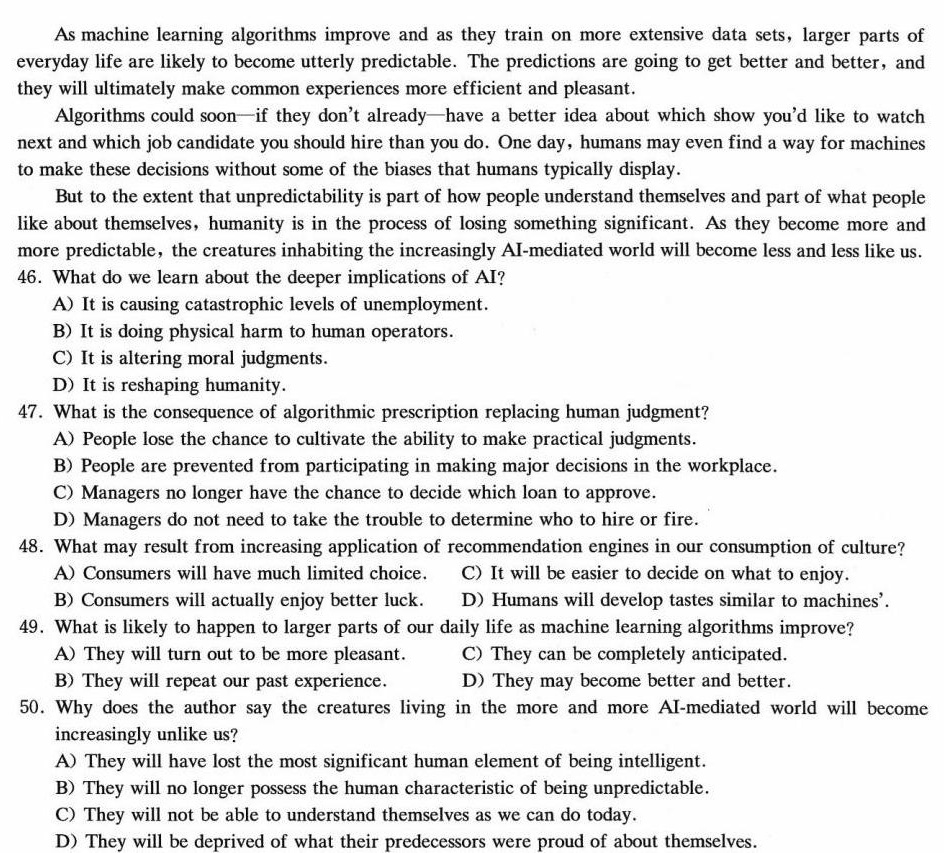
Section C-|||-Directions: There are 2 passages in this section. Each passage is followed by some questions or unfinished-|||-statements. For each of them there are four choices marked A),B),C)and D).You should decide on the-|||-best choice and mark the corresponding letter on Answer Sheet 2 with a single line through the centre.-|||-Passage One-|||-Questions 46 to 50 are based on the following passage.-|||-Technology is never a neutral tool for achieving human ends.Technologicalimnowat reshape people as-|||-they use these innovations to control their environment. Artifi intelligence, for example is altering-|||-humanity.-|||-While the term AI conjures up anxieties about killer robots or catastrophic levels of unemployment,there-|||-are other,deeper implications.As AI increasingly shapes the human experience, how does this change what it-|||-means to be human?Central to the problem is a person`s capacity to make choices,particularly judgments th-|||-have moral implications.-|||-Aristotle argued that the capacity for making practical judgment depends on regularly making them-on-|||-habit and practice.We see the emergence of machines as substitute judges in a variety of everyday contexts as a-|||-potential threat to people learning how to effectively exercise judgment themselves.-|||-In the workplace,managers routinely make decisions about who to hire or fire and which loan to approve,-|||-to name a few.These are areas where algorithmic算法的)prescription is replacing human judgment, and so-|||-people who might have had the chance to develop practical judgment in these areas no longer will.-|||-Recommendation engines, w are increasingly prevalen intermediaries in people`consumption of-|||-culture,may serve to constrain choice and minimize luck.By presenting consumers with algorithmically-|||-selected choices of what to watch,read,stream and visit next, companies are replacing human taste with-|||-machine taste.In one sense,this is helpful. After all,machines can survey a wider range of choices than any-|||-individual is likely to have the time or energy to do on their own.-|||-At the same time,though,this selection is optimizing for what people are likely to prefer based on what-|||-they`ve prererred in the past.We think there is some risk that people`s options will be constrained by their past-|||-in a new and unanticipated way.Section C-|||-Directions: There are 2 passages in this section. Each passage is followed by some questions or unfinished-|||-statements. For each of them there are four choices marked A),B),C)and D).You should decide on the-|||-best choice and mark the corresponding letter on Answer Sheet 2 with a single line through the centre.-|||-Passage One-|||-Questions 46 to 50 are based on the following passage.-|||-Technology is never a neutral tool for achieving human ends.Technologicalimnowat reshape people as-|||-they use these innovations to control their environment. Artifi intelligence, for example is altering-|||-humanity.-|||-While the term AI conjures up anxieties about killer robots or catastrophic levels of unemployment,there-|||-are other,deeper implications.As AI increasingly shapes the human experience, how does this change what it-|||-means to be human?Central to the problem is a person`s capacity to make choices,particularly judgments th-|||-have moral implications.-|||-Aristotle argued that the capacity for making practical judgment depends on regularly making them-on-|||-habit and practice.We see the emergence of machines as substitute judges in a variety of everyday contexts as a-|||-potential threat to people learning how to effectively exercise judgment themselves.-|||-In the workplace,managers routinely make decisions about who to hire or fire and which loan to approve,-|||-to name a few.These are areas where algorithmic算法的)prescription is replacing human judgment, and so-|||-people who might have had the chance to develop practical judgment in these areas no longer will.-|||-Recommendation engines, w are increasingly prevalen intermediaries in people`consumption of-|||-culture,may serve to constrain choice and minimize luck.By presenting consumers with algorithmically-|||-selected choices of what to watch,read,stream and visit next, companies are replacing human taste with-|||-machine taste.In one sense,this is helpful. After all,machines can survey a wider range of choices than any-|||-individual is likely to have the time or energy to do on their own.-|||-At the same time,though,this selection is optimizing for what people are likely to prefer based on what-|||-they`ve prererred in the past.We think there is some risk that people`s options will be constrained by their past-|||-in a new and unanticipated way.
题目解答
答案



解析
考查要点:本题为英语阅读理解题,主要考查学生对文章主旨、细节理解及推理判断的能力。文章讨论人工智能(AI)对人类判断力和生活方式的深远影响,需结合上下文准确捕捉关键信息。
解题思路:
- 定位关键句:通过问题关键词(如“deeper implications”“algorithmic prescription”)快速定位相关段落。
- 区分干扰项:注意文章中作者的隐含观点,如AI虽提高效率但可能削弱人类判断力,避免被表面利益迷惑。
- 逻辑推断:结合AI技术特性(如可预测性)与人类特征(如不可预测性),理解作者对人性未来演变的隐忧。
第46题
关键句:第一段末句指出AI“altering humanity”(改变人性),第二段首句强调“how does this change what it means to be human”(如何改变人类本质)。
干扰项排除:选项D“reshaping humanity”(重塑人性)与原文核心观点一致,而选项C“altering moral judgments”(改变道德判断)仅是AI影响的一个方面,非深层含义。
第47题
关键句:第三段“people who might have had the chance to develop practical judgment in these areas no longer will”(人们将失去培养实践判断力的机会)。
逻辑推断:算法取代人类决策直接导致判断力退化,选项A“lose the chance to cultivate the ability”(失去培养能力的机会)最贴合文意。
第48题
关键句:第四段“recommendation engines... constrain choice and minimize luck”(推荐引擎限制选择,减少偶然性)。
深层含义:推荐系统看似便利,实则通过算法“窄化”用户选择范围,选项A“much limited choice”(选择受限)符合作者隐含担忧。
第49题
关键句:第六段“larger parts of everyday life are likely to become utterly predictable”(日常生活将完全可预测)。
逻辑推断:算法优化的核心是“anticipate preferences”(预判偏好),选项C“completely anticipated”(完全可预期)最准确。
第50题
关键句:最后一段“humanity is in the process of losing something significant... creatures... less and less like us”(人类正在失去重要特征,AI生物越来越不像人类)。
核心观点:人类区别于AI的关键在于“unpredictability”(不可预测性),选项B“no longer possess the human characteristic of being unpredictable”(失去不可预测性)直击文意。