题目
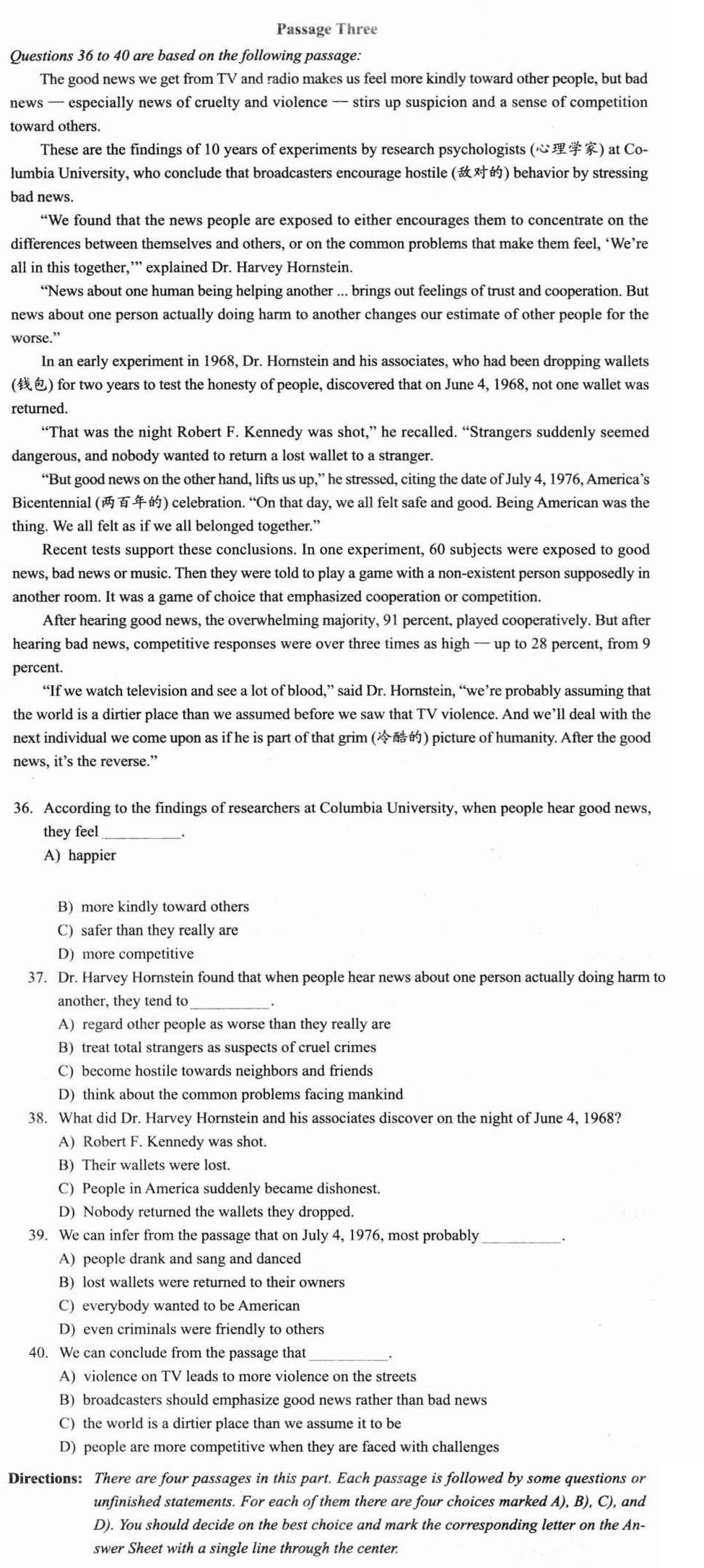
Passage Three-|||-Questions 36 to 40 are based on the following passage:-|||-The good news we get from TV and radio makes us feel more kindly toward other people,but bad-|||-news - especially news of cruelty and violence -stirs up suspicion and a sense of competition-|||-toward others.-|||-These are the findings of 10 years of experiments by research psychologists (心理学家)atCo--|||-lumbia University,who conclude that broadcaster encourage hostile(敌对的)behavior by stressing-|||-bad news.-|||-"We found that the news people are exposed to either encourages them to concentrate on the-|||-differences betweenthemse and others,or on the common problems that make them feel, "We`re-|||-all in this together,""explained Dr.Harvey Hornstein.-|||-"News about one human being helping another...brings out feelings of trust and cooperation.But-|||-news about one person actually doing harm to another changes our estimate of other people for the-|||-worse."-|||-In an early experiment in 1968,Dr.Hornstein and his associates,who had been dropping wallets-|||-(钱包)for two years to test the honesty of people,discovered that on June 4,1968,not one wallet was-|||-returned.-|||-"That was the night Robert F.Kennedy was shot,"he recalled."Strangers suddenly seemed-|||-dangerous, and nobody wanted to return a lost wallet to a stranger.-|||-"But good news on the other hand,lifts us up,"he stressed,citing the date fJuly 4,1976,America`s-|||-Bicentennial(两百年的)celebration."On that day,we all felt safe and good.Being American was the-|||-thing.We all felt as if we all belonged together."-|||-Recent tests support these conclusions.In one experiment,60 subjects were exposed to good-|||-news,bad news or music.Then they were told to play a game with a non -cxistent person supposed in-|||-another room.It was a game of choice that emphasized cooperation or competition.-|||-After hearing good news,the overwhelming majority,91 percent,played cooperatively.But after-|||-hearing bad news,competitive responses wer over three times as high -up to 28 percent,from 9-|||-percent.-|||-"If we watch television and see a lot of blood,"said Dr.Homstein,"we`re probably assuming that-|||-the world is a dirtier place than we assumed before we saw that TV violence.And we`ll deal with the-|||-next individual we come upon as if he is part of that grim (冷酷的)picture of humanity.After the good-|||-news,it`s the reverse."-|||-36.According to the findings of researchers at Columbia University,when people hear good news,-|||-they feel __ _.-|||-A) happier-|||-B)more kindly toward others-|||-C) safer than they really are-|||-D) more competitive-|||-37.Dr.Harvey Hornstein found that when people hear news about one person actually doing harm to-|||-another,they tend to __-|||-A) regard other people as worse than they really are-|||-B) treat total strangers as suspects of cruel crimes-|||-C) become hostile towards neighbors and friends-|||-D) think about the common problems facing mankind-|||-38.What did Dr.Harvey Hornstein and his associates discover on the night of June 4,1968?-|||-A) Robert F.Kennedy was shot.-|||-B)Their wallets were lost.-|||-C) People in America suddenly became dishonest.-|||-D)Nobody returned the wallets they dropped.-|||-39.We can infer from the passage that on July 4,1976,most probably __-|||-A) people drank and sang and danced-|||-B) lost wallets were returned to their owners-|||-C) everybody wanted to be American-|||-D) even criminals were friendly to others-|||-40.We can conclude from the passage that __-|||-A) violence on TV leads to more violence on the streets-|||-B) broadcasters should emphasize good news rather than bad news-|||-C) the world is a dirtier place than we assume it to be-|||-D) people are more competitive when they are faced with challenges-|||-Direetions: There are four passages in this part.Each passage is followed by some questions or-|||-unfinished statements.For each of them there are four choices marked A),B),C),and-|||-D).You should decide on the best choice and mark the corresponding letter on the An--|||-swer Sheet with a single line through the center.
题目解答
答案

解析
步骤 1:理解问题背景
文章讨论了哥伦比亚大学的研究人员通过10年的实验发现,人们从电视和广播中听到的好消息和坏消息对他们的行为和态度的影响。好消息使人们更友善,而坏消息尤其是暴力和残忍的新闻则会引发怀疑和竞争感。
步骤 2:分析每个问题
36. 根据哥伦比亚大学研究人员的发现,当人们听到好消息时,他们感觉如何?
文章中提到好消息使人们更友善,因此答案是B) more kindly toward others。
37. Dr. Harvey Hornstein发现,当人们听到一个人对另一个人造成伤害的新闻时,他们倾向于如何?
文章中提到坏消息会改变人们对其他人的负面估计,因此答案是A) regard other people as worse than they really are。
38. Dr. Harvey Hornstein和他的同事在1968年6月4日发现了什么?
文章中提到在1968年6月4日,没有人归还他们丢失的钱包,因此答案是D) Nobody returned the wallets they dropped。
39. 我们可以推断出在1976年7月4日,最有可能发生什么?
文章中提到在1976年7月4日,人们感到安全和良好,因此答案是B) lost wallets were returned to their owners。
40. 我们可以从文章中得出什么结论?
文章中提到广播公司通过强调坏消息来鼓励敌对行为,因此答案是B) broadcasters should emphasize good news rather than bad news。
文章讨论了哥伦比亚大学的研究人员通过10年的实验发现,人们从电视和广播中听到的好消息和坏消息对他们的行为和态度的影响。好消息使人们更友善,而坏消息尤其是暴力和残忍的新闻则会引发怀疑和竞争感。
步骤 2:分析每个问题
36. 根据哥伦比亚大学研究人员的发现,当人们听到好消息时,他们感觉如何?
文章中提到好消息使人们更友善,因此答案是B) more kindly toward others。
37. Dr. Harvey Hornstein发现,当人们听到一个人对另一个人造成伤害的新闻时,他们倾向于如何?
文章中提到坏消息会改变人们对其他人的负面估计,因此答案是A) regard other people as worse than they really are。
38. Dr. Harvey Hornstein和他的同事在1968年6月4日发现了什么?
文章中提到在1968年6月4日,没有人归还他们丢失的钱包,因此答案是D) Nobody returned the wallets they dropped。
39. 我们可以推断出在1976年7月4日,最有可能发生什么?
文章中提到在1976年7月4日,人们感到安全和良好,因此答案是B) lost wallets were returned to their owners。
40. 我们可以从文章中得出什么结论?
文章中提到广播公司通过强调坏消息来鼓励敌对行为,因此答案是B) broadcasters should emphasize good news rather than bad news。