题目
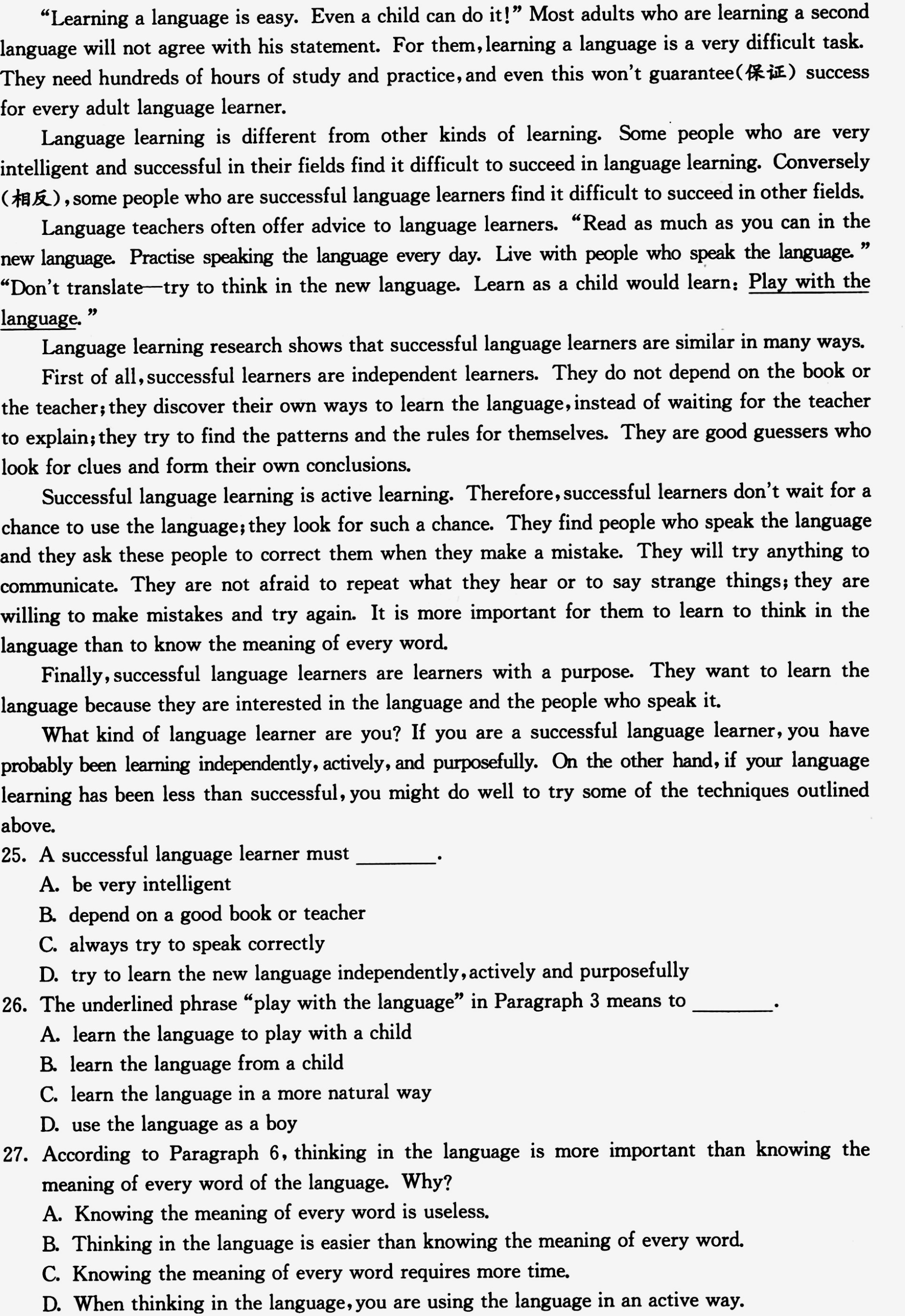
Language learning is different from other kinds of learning.Some people who are very-|||-intelligent and successful in their fields find it difficult to succeed in language learning.Conversely-|||-(相反),some people who are successful language learners find it difficult to succeed in other fields.-|||-Language teachers often offer advice to language learners."Read as much as you can in the-|||-new language Practise speaking the language every day.Live with people who speak the language."-|||-"Don't translate-try to think in the new language.Learn as a child would learn:Play with the-|||-language."-|||-Language learning research shows that successful language learners are similar in many ways.-|||-First of all,successful learners are independent learners. They do not depend on the book or-|||-the teacher;they discover their own ways to learn the language,instead of waiting for the teacher-|||-to explain;they try to find the patterns and the rules for themselves. They are good guessers who-|||-look for clues and form their own conclusions.-|||-Successful language learning is active learning. Therefore,successful learners don't wait for a-|||-chance to use the language;they look for such a chance. They find people who speak the language-|||-and they ask these people to correct them when they make a mistake.They will try anything to-|||-communicate. They are not afraid to repeat what they hear or to say strange things;they are-|||-willing to make mistakes and try again.It is more important for them to learn to think in the-|||-language than to know the meaning of every word.-|||-Finally,successful language learners are learners with a purpose. They want to learn the-|||-language because they are interested in the language and the people who speak it.-|||-What kind of language learner are you?If you are a successful language learner, you have-|||-probably been learning independently,actively,and purposefully. On the other hand,if your language-|||-learning has been less than successful,you might do well to try some of the techniques outlined-|||-above.-|||-25.A successful language learner must __ _。-|||-A.be very intelligent-|||-B.depend on a good book or teacher-|||-C.always try to speak correctly-|||-D.try to learn the new language independently,actively and purposefully-|||-26.The underlined phrase"play with the language"in Paragraph 3 means to __ _-|||-A.learn the language to play with a child-|||-B.learn the language from a child-|||-C.learn the language in a more natural way-|||-D.use the language as a boy-|||-27.According to Paragraph 6,thinking in the language is more important than knowing the-|||-meaning of every word of the language.Why?-|||-A.Knowing the meaning of every word is useless.-|||-B.Thinking in the language is easier than knowing the meaning of every word.-|||-C.Knowing the meaning of every word requires more time.-|||-D.When thinking in the language,you are using the language in an active way.
题目解答
答案
解析
本题主要考查对文章内容的理解,包括对成功语言学习者特点的把握、词义猜测以及对文中观点原因的推理。
第25题
本题考查对成功语言学习者特点的理解。解题思路是在文章中找到描述成功语言学习者特征的相关内容,然后与各个选项进行对比。
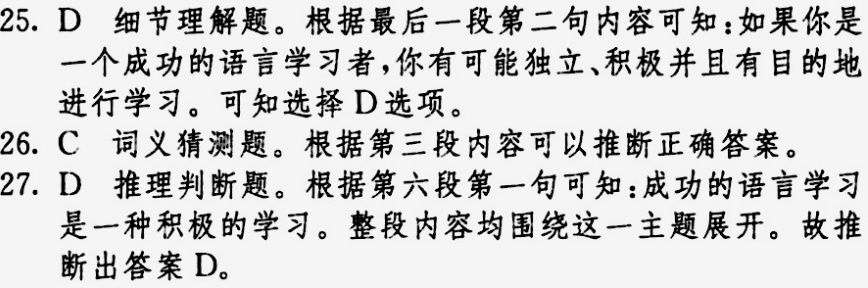
文章最后一段提到 “If you are a successful language learner, you have probably been learning independently, actively, purposefully.”,明确指出成功的语言学习者是独立、积极且有目的地学习。
- A选项 “be very intelligent”,文中提到有些聪明且在其他领域成功的人在语言学习上却很困难,所以成功的语言学习者不一定非常聪明,A选项错误。
- B选项 “depend on a good book or teacher”,文中说成功的学习者是独立学习者,不依赖书本或老师,B选项错误。
- C选项 “always try to speak correctly”,文中强调成功的学习者愿意犯错并再次尝试,并非总是力求说得正确,C选项错误。
- D选项 “try to learn the new language independently, actively and purposefully” 与文章描述相符,D选项正确。
第26题
本题考查对短语 “play with the language” 含义的猜测。解题思路是结合上下文语境来推断该短语的意思。
文章第三段提到 “Learn as a child would learn: Play with the language.”,意思是像孩子学习语言的方式去学习,孩子学习语言是一种自然、轻松的方式。
- A选项 “learn the language to play with a child” 意思是为了和孩子一起玩而学习语言,与原文意思不符,A选项错误。
- B选项 “learn the language from a child” 是从孩子那里学习语言,并非像孩子一样学习语言,B选项错误。
- C选项 “learn the language in a more natural way” 符合孩子学习语言的自然方式,C选项正确。
- D选项 “use the language as a boy” 表述不准确,没有体现出像孩子学习语言的自然方式,D选项错误。
第27题
本题考查对文中观点原因的推理。解题思路是根据文章中关于成功语言学习是积极学习这一主题,分析思考语言和知道每个单词意思之间的关系。
文章第六段提到 “Successful language learning is active learning.”,整段围绕这一主题展开,说明成功的语言学习是积极的。
- A选项 “Knowing the meaning of every word is useless”,知道每个单词的意思并非无用,只是思考语言更重要,A选项错误。
- B选项 “Thinking in the language is easier than knowing the meaning of every word”,文中未提及思考语言比知道每个单词意思更容易,B选项错误。
- C选项 “Knowing the meaning of every word requires more time”,文中没有提到知道每个单词意思需要更多时间,C选项错误。
- D选项 “When thinking in the language, you are using the language in an active way”,因为成功的语言学习是积极的,思考语言是一种积极使用语言的方式,所以比知道每个单词意思更重要,D选项正确。