题目
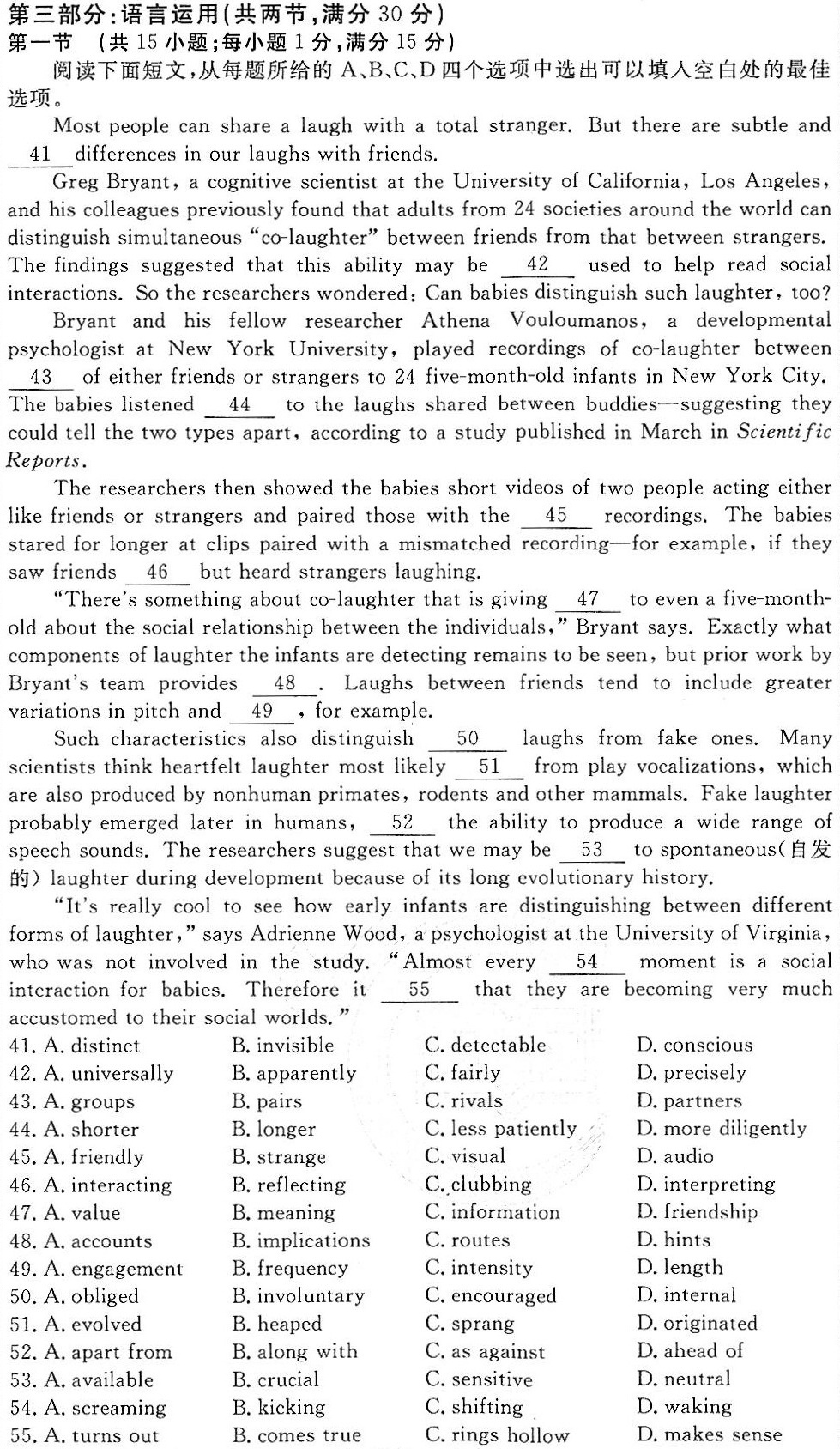
第三部分:语言运用(共两节,满分30分)-|||-第一节(共15小题;每小题1分,满分15分)-|||-阅读下面短文,从每题所给的A、B、C、D四个选项中选出可以填入空白处的最佳-|||-选项。-|||-Most people can share a laugh with a total stranger.But there are subtle and-|||- 41 differences in our laughs with friends.-|||-Greg Bryant,a cognitive scientist at the University of California,Los Angeles,-|||-and his colleagues previously found that adults from 24 societies around the world can-|||-distinguish simultaneous"between friends from that between strangers.-|||-The findings suggested that this ability may be 42 used to help read social-|||-interactions.So the researchers wondered:Can babies distinguish such laughter,too?-|||-Bryant and his fellow researcher Athena Vouloumanos, a developmen-|||-psychologist at New York University,played recordings of co-laughter between-|||- 43 of either friends or strangers to 24 five-month-old infants in New York City.-|||-The babies listened 44 to the laughs shared between buddies suggesting they-|||-could tell the two types apart,according to a study published in March in Scientific-|||-Reports.-|||-The researchers then showed the babies short videos of two people acting either-|||-like friends or strangers and paired those with the 45 recordings. The babies-|||-stared for longer at clips paired with a mismatched recording-for example,if they-|||-saw friends 46 but heard strangers laughing.-|||-"There`s something about co-laughter that is giving 47 to even a five month--|||-old about the social relationship betwe the individuals,"Bryant says.Exactly what-|||-components of laughter the infants are detecting remains to be seen,but prior work by-|||-Bryant`s team provides 48 Laughs between friends tend to include greater-|||-variations in pitch and 49 for example.-|||-Such characteristics also distinguish 50 laughs from fake ones. Many-|||-scientists think heartfel laughter most likely 51 from play vocalizations,which-|||-are also produced by nonhuman primates,rodents and other mammals.Fake laughter-|||-probably emerged later in humans, 52 the ability to produce a wide range of-|||-speech sounds. The researchers suggest that we may be 53 to spontaneous(自发-|||-的)laughter during development because of its long evolutionary history.-|||-"It`s really cool to see how early infants are distinguishing between di-|||-forms of laughter,"says Adrienne Wood,a psychologist at the University of Virginia,-|||-who was not involved in the study."Almost every 54 moment is a social-|||-interaction for babies.Therefore it 55 that they are becoming very much-|||-accustomed to their social worlds."-|||-41.A.distinct B.invisible C.dectetable D.conscious-|||-42.A.universally B.apparently C.fairly D.precisely-|||-43.A.groups B.pairs C.rivals D.partners-|||-44.A.shorter B.longer C.less patiently D.more diligently-|||-45.A.friendly B.strange C.visual D.audio-|||-46.A.interacting B.reflecting C.clubbing D.interpreting-|||-47.A.value B.meaning C.information D.friendship-|||-48.A.accounts B.implications C.routes D.hints-|||-49.A.engagement B.frequency C.intensity D.length-|||-50.A.obliged B.involuntary C.encouraged D.internal-|||-51.A.evolved B.heaped C.sprang D.originated-|||-52.A.apart from B.along with C.as against D.ahead of-|||-53.A.available B.crucial C.sensitive D.neutral-|||-54.A.screaming B.kicking C.shifting D.waking-|||-55.A.turns out B.comes true C.rings hollow D.makes sense
题目解答
答案
41~45 CABBD
46~50 ACDCB
51~55 ABCDD