Section B-|||-Directions: Read the following three passages.Each passage is followed by several questions or-|||-unfinished statements. Fo each of them there are four choices marked A,B,C and D.Choose-|||-the one that fits best according to the information given in the passage you have read.-|||-(A)-|||-War may be a natural expression of biological instincts and drives toward aggression in the-|||-human species. Natural impulses of anger,hostility, and territoria地盘性)are expressed-|||-through acts of violence. These are all qualities that humans share with animals. Aggression is a-|||-kind of innate( 天生的)survival mechanism,an instinct for self-preservation that allows animals-|||-to defend themselves from threats to their existences. But on the other hand,human violence-|||-shows evidence of being a learned behaviour.In the case of human aggression, violence cann-|||-be simply reduced to an instinct.The many expressions of human violence are always-|||-conditioned by social conventions that give shape to aggressive behaviour. In human societies-|||-violence has a social function.It is a strategy for creating or destroying forms of social order.-|||-Religious traditions have taken a leading role in directing the powers of violence. We will look-|||-at the ritual and ethical patterns within which human violence has been directed.-|||-The violence within a society is controlled through instit of law. The more developed-|||-a legal system becomes,the more society takes responsibil for the discovery,control,and-|||-punishment of violent acts.In most tribal societies,the only means to deal with an act of-|||-violence is revenge.Each family group may have the responsibility for person carrying out-|||-judgment and punishment upon the person who committed the offense. But in legal systems,the-|||-responsibility for reveng becomes depersonalizeed a diffused. The society assumes the-|||-responsibility for protec individuals from violence In cases where they cannot be protected,-|||-the society is responsible for imposing punishment. In a state-controlled legal system,-|||-individuals are removed from the cycle of revenge motivated by acts of violence, and the state-|||-assumes the responsibilit for their protection.-|||-The other side of a state legal apparatus is a state military apparatus. While the one-|||-protects the individual from violence,the other sacrifices the individual to violence in the-|||-interests of the state.In war the state affirms its supreme power over the individuals within-|||-its own borders.War is not simply a trial by combating to settle disputes between states;it-|||-is the moment when the state makes its most powerful demands upon its people for their-|||-commitment,allegiance, an supreme sacrifice. Times of war test a community`s deepest-|||-religious and ethical commitments.-|||-() 56.Human violence shows evidence of being a learned behaviour in that __ 一-|||-A.it threatens the existing social systems-|||-B.it is influenced by society-|||-C.it has roots in religious conflicts-|||-D.it is directed against institut of law-|||-() 57.The function of legal systems,according to the passage,is __-|||-A.to control violence within a society-|||-B.to protect the world from chaos-|||-C.to free society from the idea of revenge-|||-D.to give the government absolute power-|||-() 58.The underlined word" allegiance"in the last paragraph is closest in meaning to-|||-__-|||-A.loyalty B.objective C.survival D.motive-|||-() 59.What can we learn from the last paragraph?-|||-A.Governments tend to abuse their supreme power in times of war.-|||-B.In times of war,governments may extend their power across national borders.-|||-C.In times of war,governments impose high religious and ethical standards on their-|||-people.-|||-D.Governments may sacrifice individuals in the interests of the state in times of war.Section B Directions:Read the following three passages.Each passage is followed by several questions or unfnished statements. For each of them there are four choices marked A,B,C and D. Choose the one that fus best according to the information given in the passage you have read. (A) War may be a natural expression of biological instincts and drives toward aggression in the human species. Natural impulses of anger,hostility, and territoriality( 地盘性)are expressed through acts of violence. These are all qualities that humans share with animals. Aggression is a kind of innate(_天生的)survival mechanism,an instinct for self-prescrvation that allows animals to defend themsclves from threats to their existences. But on the other hand,human violence shows evidence of being a learned behaviour. In the case of human aggression,violence cannot be simply reduced to an instinct. The many expressions of human violence are always conditioned by social conventions that give shape to aggressive behaviour. In human societies iolence has a sociaì function. It is a strategy for creating or destroying forms of social order. Religious traditions have taken a leading role in directing the powers of viclence.We will look at the ritual and ethical patterns within which human violence has been directed. The viclence within a society is controlled through institutions of law.The more developed a legal system becomes,the more society takes responsibility for the discovery, control,and punishment of violent acts. In most tribal societies,the only means to deal with an act of violence is revenge.Each family group may have the responsibility for personally carrying out judgment and punishment upon the person who committed the offense. But in legal systems,the responsibility for revenge becomes depersonalized and diffused. The society assumes the responsibility for protecting individuals from violence. In cases where they cannot be protcctcd, the society is responsible for imposing punishment. In a state-controlled legal system, individuals are removed from the cycle of revenge motivated by acts of violence.And the state assumes the responsibility for their protection. The other side of a state legal apparatus is a state military apparatus. While the one protects the individual from violence,the other sacrifices the individual to violence in the interests of the state.In war the state affir ms its supreme power over the individuals within its own borders. War is not simply a trial by combating to settle disputes hetween states;it is the moment when the state makes its most powerful demands upon its people lor theit commitment,_allegiance,and supreme saerifice. Times of war test a community's deepest religious and cthical comnitments. )56. Human violence shows evidence of being a learned behaviour in that_- A. it threatens the existing socia! systems B.t is influenced by society C.it has roots in religious conflicts D.it is directed against institutions of law ( )57.The function of legal systems, according to the passage, is_- A. to control violence within a society B.to protect the world from chaos C. to free socicty from the idea of revenge D. to give the government absolute power ( )58.The underlined word" allegiance" in the last paragraph is closest in meaning to _. A. loyalty B. Objective C. Survival D.Motive ( )59,What can we leam from the last paragraph? A.Governments tend to abuse their supreme power in times of war. B.In times of war,governments may extend their power across national borders. C. In times of war,governments impose high religious and ethical standards on their people. D.Governments may sacrifice indivicuats in the interests of the state in times of war.
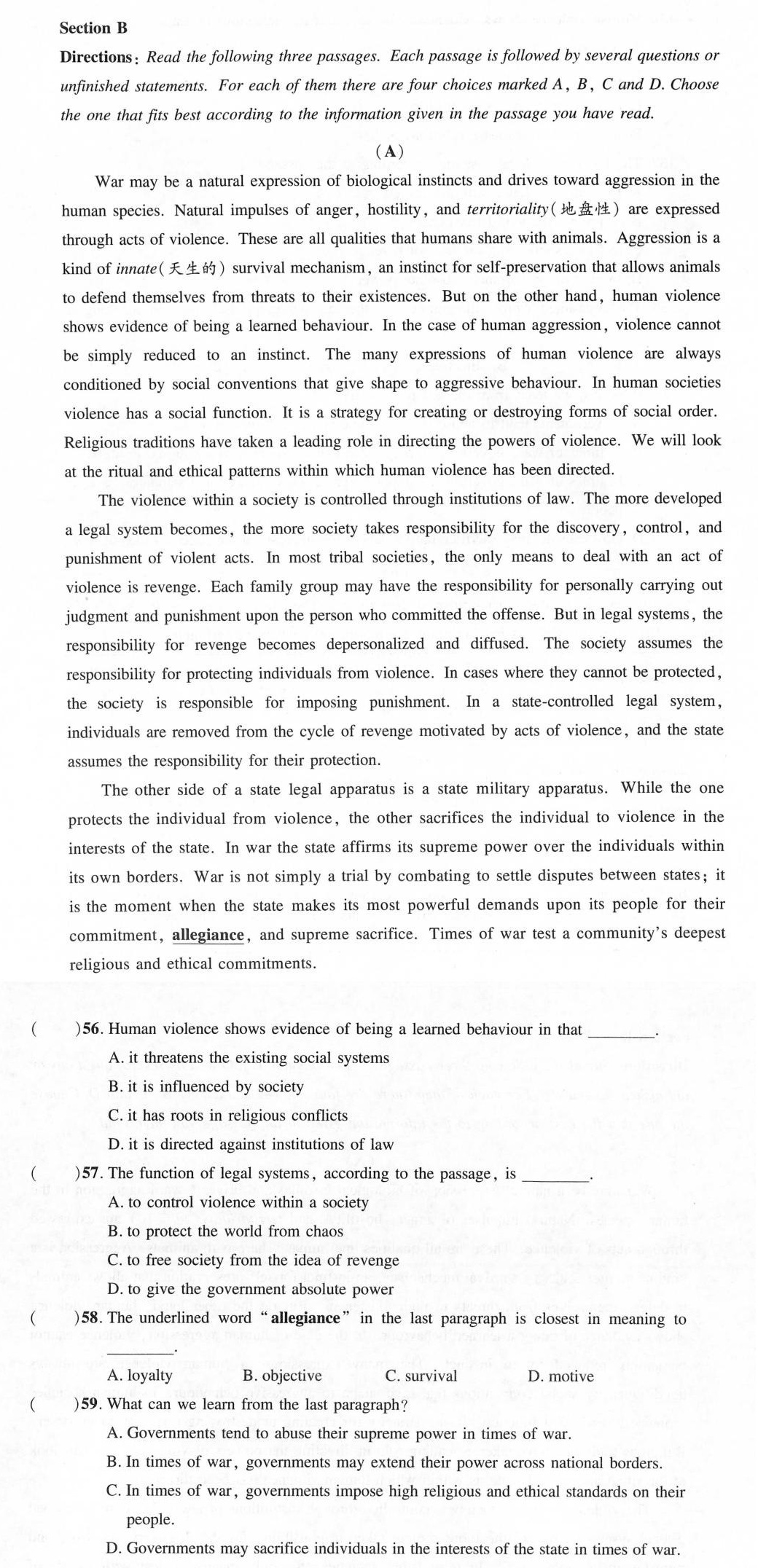
Section B Directions:Read the following three passages.Each passage is followed by several questions or unfnished statements. For each of them there are four choices marked A,B,C and D. Choose the one that fus best according to the information given in the passage you have read. (A) War may be a natural expression of biological instincts and drives toward aggression in the human species. Natural impulses of anger,hostility, and territoriality( 地盘性)are expressed through acts of violence. These are all qualities that humans share with animals. Aggression is a kind of innate(_天生的)survival mechanism,an instinct for self-prescrvation that allows animals to defend themsclves from threats to their existences. But on the other hand,human violence shows evidence of being a learned behaviour. In the case of human aggression,violence cannot be simply reduced to an instinct. The many expressions of human violence are always conditioned by social conventions that give shape to aggressive behaviour. In human societies iolence has a sociaì function. It is a strategy for creating or destroying forms of social order. Religious traditions have taken a leading role in directing the powers of viclence.We will look at the ritual and ethical patterns within which human violence has been directed. The viclence within a society is controlled through institutions of law.The more developed a legal system becomes,the more society takes responsibility for the discovery, control,and punishment of violent acts. In most tribal societies,the only means to deal with an act of violence is revenge.Each family group may have the responsibility for personally carrying out judgment and punishment upon the person who committed the offense. But in legal systems,the responsibility for revenge becomes depersonalized and diffused. The society assumes the responsibility for protecting individuals from violence. In cases where they cannot be protcctcd, the society is responsible for imposing punishment. In a state-controlled legal system, individuals are removed from the cycle of revenge motivated by acts of violence.And the state assumes the responsibility for their protection. The other side of a state legal apparatus is a state military apparatus. While the one protects the individual from violence,the other sacrifices the individual to violence in the interests of the state.In war the state affir ms its supreme power over the individuals within its own borders. War is not simply a trial by combating to settle disputes hetween states;it is the moment when the state makes its most powerful demands upon its people lor theit commitment,_allegiance,and supreme saerifice. Times of war test a community's deepest religious and cthical comnitments. )56. Human violence shows evidence of being a learned behaviour in that_- A. it threatens the existing socia! systems B.t is influenced by society C.it has roots in religious conflicts D.it is directed against institutions of law ( )57.The function of legal systems, according to the passage, is_- A. to control violence within a society B.to protect the world from chaos C. to free socicty from the idea of revenge D. to give the government absolute power ( )58.The underlined word" allegiance" in the last paragraph is closest in meaning to _. A. loyalty B. Objective C. Survival D.Motive ( )59,What can we leam from the last paragraph? A.Governments tend to abuse their supreme power in times of war. B.In times of war,governments may extend their power across national borders. C. In times of war,governments impose high religious and ethical standards on their people. D.Governments may sacrifice indivicuats in the interests of the state in times of war.
题目解答
答案

优质解答
解析
考查要点:
- 人类暴力的本质:区分生物本能与社会规范对暴力行为的影响。
- 法律系统的功能:理解法律如何取代个人复仇,维护社会秩序。
- 词汇理解:通过上下文推断“allegiance”的含义。
- 段落推断:结合最后一段分析战争对国家权力的影响。
解题核心:
- 第56题:抓住“learned behaviour”与“social conventions”的关联。
- 第57题:明确法律系统的核心作用是控制暴力,而非其他表面功能。
- 第58题:通过“commitment”和“supreme sacrifice”推断“allegiance”的语境义。
- 第59题:结合“sacrifices the individual to violence in the interests of the state”理解国家在战争中的行为逻辑。
第56题
关键句:
The many expressions of human violence are always conditioned by social conventions that give shape to aggressive behaviour.
解析:
人类的暴力行为并非单纯本能,而是受社会规范塑造。选项B(“受社会影响”)直接对应“social conventions”的作用,其他选项与原文无关。
第57题
关键句:
The more developed a legal system becomes, the more society takes responsibility for the discovery, control, and punishment of violent acts.
解析:
法律系统的功能是控制社会中的暴力。选项A明确对应“control violence”,其他选项(如“保护世界”“赋予政府绝对权力”)属于过度推断。
第58题
关键句:
the state makes its most powerful demands upon its people for their commitment, allegiance, and supreme sacrifice.
解析:
“allegiance”与“commitment”并列,指国家在战争中要求人民的忠诚(loyalty)。选项A(“忠诚”)最符合语境。
第59题
关键句:
In war the state affirms its supreme power over the individuals... the other sacrifices the individual to violence in the interests of the state.
解析:
战争中,国家为自身利益可能要求个体牺牲(如参战或奉献)。选项D(“牺牲个体利益”)直接对应“sacrifices the individual”。