题目
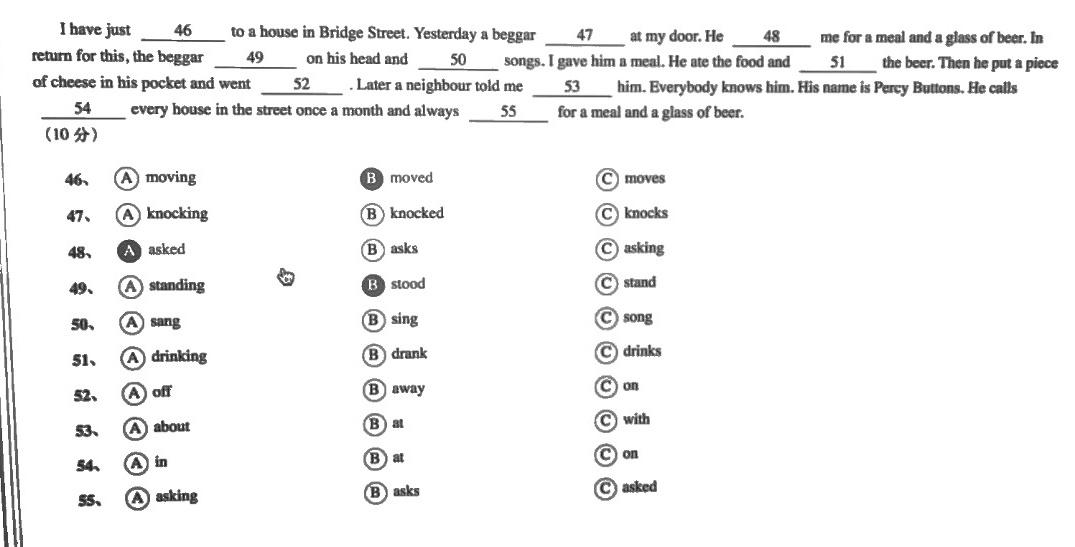
I have just 46 to a house in Bridge Street.Yesterday a beggar 47 at my door.He 48 me for a meal and a glass of beer.In-|||-return for this,the beggar 49 on his head and 50 songs.I gave him a meal.He ate the food and 51 the beer. Then he put a piece-|||-of cheese in his pocket and went 52 Later a neighbour told me 53 him.Everybody knows him.His name is Percy Buttons.He calls-|||- 54 every house in the street once a month and always 55 for a meal and a glass of beer.-|||-10分)-|||- A moving B moved C moves-|||-47、 A knocking bigcirc (1)kmocked knocks-|||-48、 bigcirc (8)aks C asking-|||- bigcirc (A)sin alpha sin beta stood stand-|||-50、 bigcirc (A)sin B bigcirc (B)sin B song-|||- A drinking bigcirc (B)dmn drinks-|||- bigcirc (A)OE ⑧away on-|||-53、 about bigcirc (13)a C with-|||-54、 bigcirc (A)m bigcirc (13)a on-|||- bigcirc (A) cos ksin B bigcirc (13)asks bigcirc (C) askcd
题目解答
答案
解析
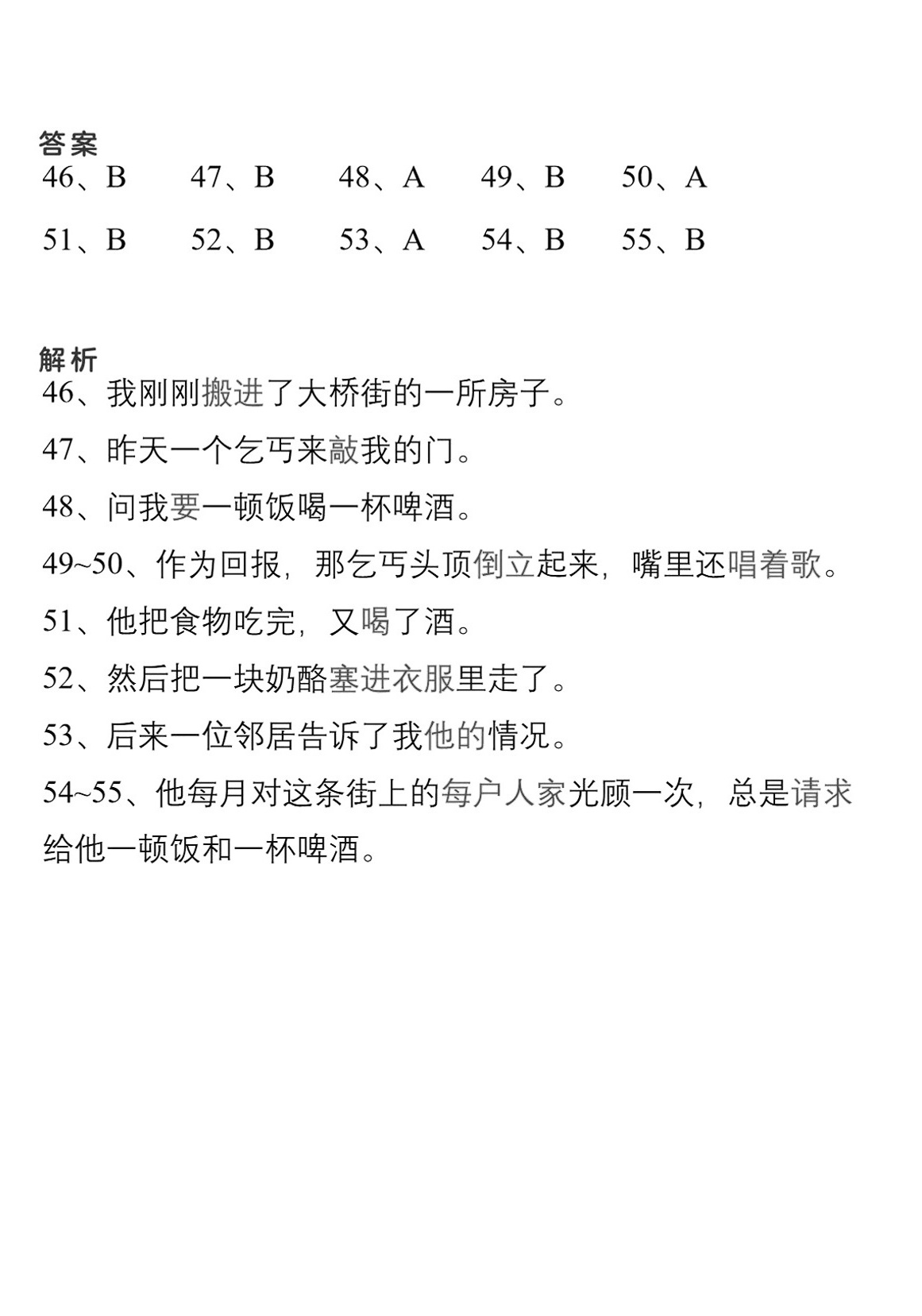
步骤 1:理解句子结构和时态
- 句子描述的是过去发生的事情,因此需要使用过去时态。
- 例如,"I have just moved to a house in Bridge Street." 这里使用了现在完成时,表示动作发生在过去,但与现在有联系。
步骤 2:选择正确的动词形式
- 根据句子的时态和语境,选择正确的动词形式。
- 例如,"Yesterday a beggar knocked at my door." 这里使用了过去时态,表示昨天发生的事情。
步骤 3:理解动词短语和固定搭配
- 例如,"He asked me for a meal and a glass of beer." 这里使用了动词短语 "ask for",表示请求。
步骤 4:理解动词的时态和语态
- 例如,"I gave him a meal." 这里使用了过去时态,表示过去发生的动作。
步骤 5:理解动词的时态和语态
- 例如,"He ate the food and drank the beer." 这里使用了过去时态,表示过去发生的动作。
步骤 6:理解动词的时态和语态
- 例如,"He put a piece of cheese in his pocket and went away." 这里使用了过去时态,表示过去发生的动作。
步骤 7:理解动词的时态和语态
- 例如,"Later a neighbour told me about him." 这里使用了过去时态,表示过去发生的动作。
步骤 8:理解动词的时态和语态
- 例如,"He calls at every house in the street once a month." 这里使用了一般现在时态,表示经常性或习惯性的动作。
步骤 9:理解动词的时态和语态
- 例如,"He always asks for a meal and a glass of beer." 这里使用了一般现在时态,表示经常性或习惯性的动作。
- 句子描述的是过去发生的事情,因此需要使用过去时态。
- 例如,"I have just moved to a house in Bridge Street." 这里使用了现在完成时,表示动作发生在过去,但与现在有联系。
步骤 2:选择正确的动词形式
- 根据句子的时态和语境,选择正确的动词形式。
- 例如,"Yesterday a beggar knocked at my door." 这里使用了过去时态,表示昨天发生的事情。
步骤 3:理解动词短语和固定搭配
- 例如,"He asked me for a meal and a glass of beer." 这里使用了动词短语 "ask for",表示请求。
步骤 4:理解动词的时态和语态
- 例如,"I gave him a meal." 这里使用了过去时态,表示过去发生的动作。
步骤 5:理解动词的时态和语态
- 例如,"He ate the food and drank the beer." 这里使用了过去时态,表示过去发生的动作。
步骤 6:理解动词的时态和语态
- 例如,"He put a piece of cheese in his pocket and went away." 这里使用了过去时态,表示过去发生的动作。
步骤 7:理解动词的时态和语态
- 例如,"Later a neighbour told me about him." 这里使用了过去时态,表示过去发生的动作。
步骤 8:理解动词的时态和语态
- 例如,"He calls at every house in the street once a month." 这里使用了一般现在时态,表示经常性或习惯性的动作。
步骤 9:理解动词的时态和语态
- 例如,"He always asks for a meal and a glass of beer." 这里使用了一般现在时态,表示经常性或习惯性的动作。