Part Ⅲ (O)_(2)mgrerehemsi0m (40minutes)-|||-Section A-|||-Directions: In this section,there is a passage with ten blanks. You are required to select one word-|||-for each blank from a list of choices given in a word bank following the passage. Read the-|||-passage through carefully before making your choices. Each choice in the bank is-|||-identified by a letter. Please mark the corresponding letter for each item on Answer-|||-Sheet 2 with a single line through the centre.You may not use any of the words in the-|||- once..-|||-The persistent haze over many of our cities is a reminder of the polluted air that we breathe.Over-|||-80% of the world`s urban population is breathing air that fails to meet World Health Organisation-|||-guidelines,and an estimated 4.5 million people died 26 from outdoor air pollution in 2015. __-|||-Globally,urban population are expected to double in the next 40 years,and an extra 2 billion-|||-people will need new places to live,as well as services and ways to move around their cities.What is-|||-more important,the decisions that we make now about the design of our cities will 27 the everyday-|||-lives and health of the coming generations. So what would a smog-free,or at least low-pollution,city-|||- iike??-|||-Traffic has become 28 with air pollution,and many countries intend to ban the sale of new-|||-petrol and diesel cars in the next two decades.But simply 29 to electric cars will not mean-|||-bot utiOn-free CiiieS. The level of emissions they cause will depend on how the electricity to run them is-|||- 30 while brakes, tyres and roads all create tiny airborne 31 as they wear out.-|||-Across the developed world,car use is in decline as more people move to city centres,while-|||-young people especially are 32 for other means of travel. Researchers are already asking if motor-|||-vehicle use has reached its 33 and will decline,but transport planners have yet to catch up with-|||-this 34 instead of laying new roads to tackle traffic jams.As users of London`s orbital M25-|||-motorway will know,new roads rapidly fill with more traffic. In the US,studies have shown that-|||-doubling the size of a road can 35 double the traffic,taking us back to the starting point.-|||-)alternate I) particles-|||-B)crown J) peak-|||-)detemine K)prematurely-|||-D)generated L)simply-|||-) 10catsin g )SWitchig-|||-F)merged )Symonymols-|||-G)miniatures O)trend-|||-)OPtan theta Part lⅢ Reading Comprehension (40 minutes) Section Directions: In this section, there is a passage with ten blanks. You are required to select one word for each blank from a list of choices given in a word bank following the passage. Read the passage through carefully before making your choices. Each choice in the bank is identified by a letter. Please mark the corresponding letter for each item on Answer Sheet 2 with a single line through the centre. You may not use any of the words in the bank more than once. The persistent haze over many of our cities is a reminder of the polluted air that we breathe. Over 80% of the world's urban population is breathing air that fails to meet World Health Organisation guidelines, and an estimated 4.5 million people died _26 from outdoor air pollution in 2015. Globally, urban populations are expected to double in the next 40 years, and an extra 2 billion people will need new places to live, as well as services and ways to move around their cities. What is more important, the decisions that we make now about the design of our cities will 27_ the everyday lives and health of the coming generations. So what would a smog-free,or at least low-pollution, city be like? Traffic has become_ 28 with air pollution, and many countries intend to ban the sale of new petrol and diesel cars in the next two decades.But simply 29_ to electric cars will not mean pollution-free cities. The level of emissions they cause will depend on how the electricity to run them is _30 ,while brakes, tyres and roads all create tiny airborne 31_ as they wear out. Across the developed world, car use is in decline as more people move to city centres,while young people especially are_ 32 for other means of travel. Researchers are already asking if motor vehicle use has reached its 33_ and will decline,but transport planners have yet to catch up with this_ 34 ,instead of laying new roads to tackle traffic jams. As users of London's orbital M25 motorway will know, new roads rapidly fill with more traffic. In the US,studies have shown that doubling the size of a road can_ 35double the traffic,taking us back to the starting point. A) alternate I)particles B)crown J) peak C)determine K) prematurely D)generated L)simply E)locating M) switching F)merged N)synonymous G) miniatures О) trend H)opting
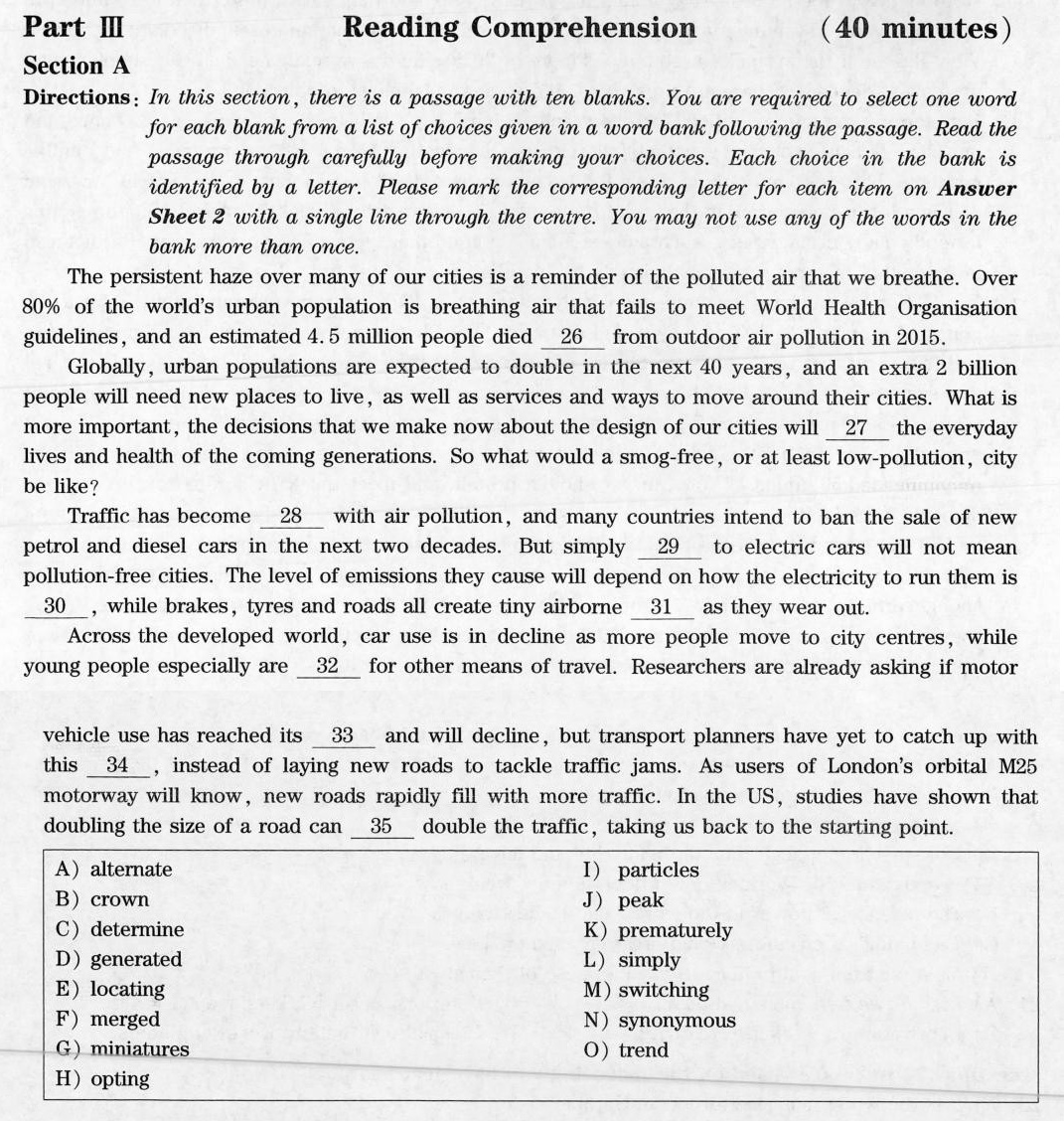
Part lⅢ Reading Comprehension (40 minutes) Section Directions: In this section, there is a passage with ten blanks. You are required to select one word for each blank from a list of choices given in a word bank following the passage. Read the passage through carefully before making your choices. Each choice in the bank is identified by a letter. Please mark the corresponding letter for each item on Answer Sheet 2 with a single line through the centre. You may not use any of the words in the bank more than once. The persistent haze over many of our cities is a reminder of the polluted air that we breathe. Over 80% of the world's urban population is breathing air that fails to meet World Health Organisation guidelines, and an estimated 4.5 million people died _26 from outdoor air pollution in 2015. Globally, urban populations are expected to double in the next 40 years, and an extra 2 billion people will need new places to live, as well as services and ways to move around their cities. What is more important, the decisions that we make now about the design of our cities will 27_ the everyday lives and health of the coming generations. So what would a smog-free,or at least low-pollution, city be like? Traffic has become_ 28 with air pollution, and many countries intend to ban the sale of new petrol and diesel cars in the next two decades.But simply 29_ to electric cars will not mean pollution-free cities. The level of emissions they cause will depend on how the electricity to run them is _30 ,while brakes, tyres and roads all create tiny airborne 31_ as they wear out. Across the developed world, car use is in decline as more people move to city centres,while young people especially are_ 32 for other means of travel. Researchers are already asking if motor vehicle use has reached its 33_ and will decline,but transport planners have yet to catch up with this_ 34 ,instead of laying new roads to tackle traffic jams. As users of London's orbital M25 motorway will know, new roads rapidly fill with more traffic. In the US,studies have shown that doubling the size of a road can_ 35double the traffic,taking us back to the starting point. A) alternate I)particles B)crown J) peak C)determine K) prematurely D)generated L)simply E)locating M) switching F)merged N)synonymous G) miniatures О) trend H)opting
题目解答
答案
优质解答