题目
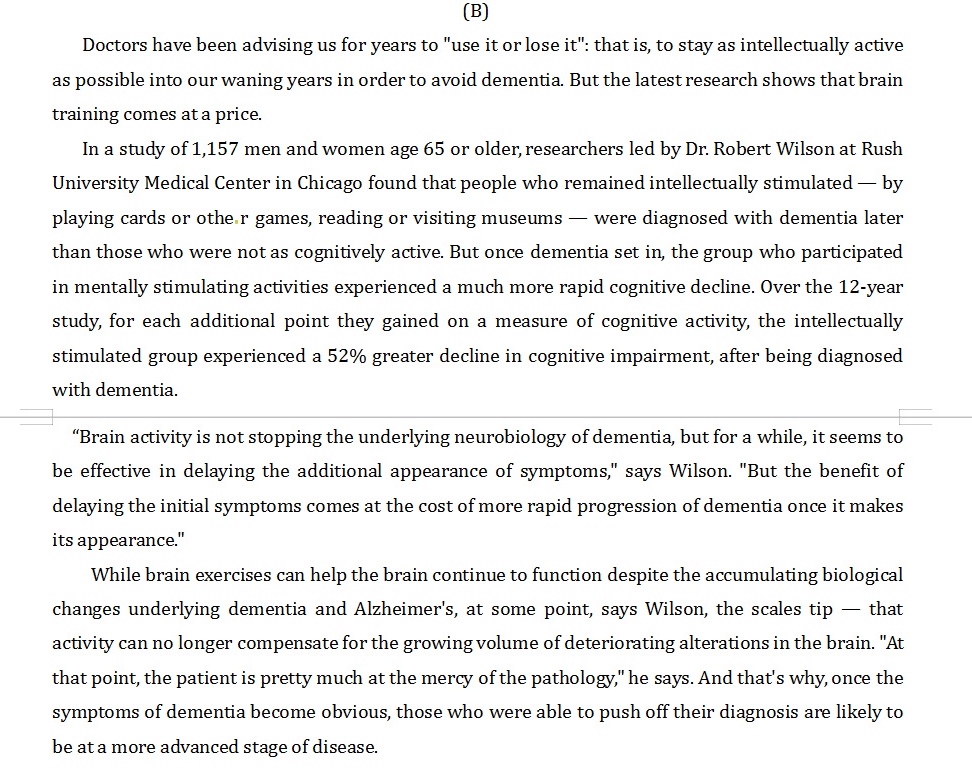
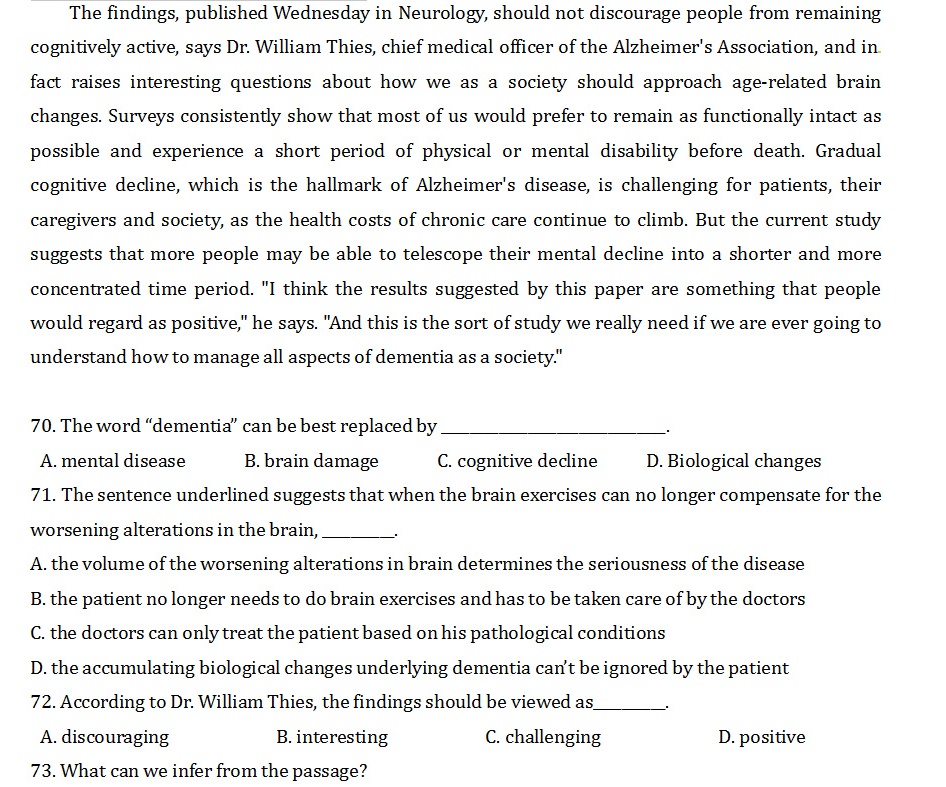
(B)-|||-Doctors have been advising us for years to "use it or lose it":that is,to stay as intellectually active-|||-as possible into our waning years in order to avoid dementia.But the latest research shows that brain-|||-training comes at a price.-|||-In a study of 1,157 men and women age 65 or older,researchers led by Dr.Robert Wilson at Rush-|||-University Medical Center in Chicago found that people who remained intellectually s -by-|||-playing cards or othe r games,reading or visiting museums-were diagnosed with dementia later-|||-than those who were not as cognitively active.But once dementia set in,the group who participated-|||-in mentally stimulating activities experienced a much more rapid cognitive decline.Over the 12-year-|||-study,for each additional point they gained on a measure of cognitive activity,the intellectual-|||-stimulated group experien a 52% greater decline in cognitive impairment,after being diagnosed-|||-with dementia.-|||-"Brain activity is not stopping the underlying neurobiology o but for a while,it seems to-|||-be effective in delaying the additional appearance of symptoms,"says Wilson."But the benefit of-|||-delaying the initial symptoms comes at the cost of more rapid progression of dementia once it makes-|||-its appearance."-|||-While brain exercises can help the brain continue to function despite the accumulating biological-|||-changes underlying dement and Alzheimer`s,at some point,says Wilson,the scales tip - that-|||-activity can no longer compensate for the growing volume of deteriorating alterati in the brain.`At-|||-that point,the patient is pretty much at the mercy of the pathology,"he says.And that`s why,once the-|||-symptoms of dementia become obvious,those who were able to push off their diagnosis are likely to-|||-be at a more advanced stage of f disease.(B)-|||-Doctors have been advising us for years to "use it or lose it":that is,to stay as intellectually active-|||-as possible into our waning years in order to avoid dementia.But the latest research shows that brain-|||-training comes at a price.-|||-In a study of 1,157 men and women age 65 or older,researchers led by Dr.Robert Wilson at Rush-|||-University Medical Center in Chicago found that people who remained intellectually s -by-|||-playing cards or othe r games,reading or visiting museums-were diagnosed with dementia later-|||-than those who were not as cognitively active.But once dementia set in,the group who participated-|||-in mentally stimulating activities experienced a much more rapid cognitive decline.Over the 12-year-|||-study,for each additional point they gained on a measure of cognitive activity,the intellectual-|||-stimulated group experien a 52% greater decline in cognitive impairment,after being diagnosed-|||-with dementia.-|||-"Brain activity is not stopping the underlying neurobiology o but for a while,it seems to-|||-be effective in delaying the additional appearance of symptoms,"says Wilson."But the benefit of-|||-delaying the initial symptoms comes at the cost of more rapid progression of dementia once it makes-|||-its appearance."-|||-While brain exercises can help the brain continue to function despite the accumulating biological-|||-changes underlying dement and Alzheimer`s,at some point,says Wilson,the scales tip - that-|||-activity can no longer compensate for the growing volume of deteriorating alterati in the brain.`At-|||-that point,the patient is pretty much at the mercy of the pathology,"he says.And that`s why,once the-|||-symptoms of dementia become obvious,those who were able to push off their diagnosis are likely to-|||-be at a more advanced stage of f disease.(B)-|||-Doctors have been advising us for years to "use it or lose it":that is,to stay as intellectually active-|||-as possible into our waning years in order to avoid dementia.But the latest research shows that brain-|||-training comes at a price.-|||-In a study of 1,157 men and women age 65 or older,researchers led by Dr.Robert Wilson at Rush-|||-University Medical Center in Chicago found that people who remained intellectually s -by-|||-playing cards or othe r games,reading or visiting museums-were diagnosed with dementia later-|||-than those who were not as cognitively active.But once dementia set in,the group who participated-|||-in mentally stimulating activities experienced a much more rapid cognitive decline.Over the 12-year-|||-study,for each additional point they gained on a measure of cognitive activity,the intellectual-|||-stimulated group experien a 52% greater decline in cognitive impairment,after being diagnosed-|||-with dementia.-|||-"Brain activity is not stopping the underlying neurobiology o but for a while,it seems to-|||-be effective in delaying the additional appearance of symptoms,"says Wilson."But the benefit of-|||-delaying the initial symptoms comes at the cost of more rapid progression of dementia once it makes-|||-its appearance."-|||-While brain exercises can help the brain continue to function despite the accumulating biological-|||-changes underlying dement and Alzheimer`s,at some point,says Wilson,the scales tip - that-|||-activity can no longer compensate for the growing volume of deteriorating alterati in the brain.`At-|||-that point,the patient is pretty much at the mercy of the pathology,"he says.And that`s why,once the-|||-symptoms of dementia become obvious,those who were able to push off their diagnosis are likely to-|||-be at a more advanced stage of f disease.

题目解答
答案