READING PASSAGE 2 You should spend about 20 minutes on Questions 1-13, which are based on Reading Passage 2 below.T H E FA L K IR K W H E E LA unique engineering achievementThe Falkirk Wheel in Scotland is the world's first and only rotating boat lift. Opened in 2002, it is central to the ambitious £84.5m Millennium Link project to restore navigability across Scotland by reconnecting the historic waterways of the Forth & Clyde and Union Canals.The major challenge of the project lay in the fact that the Forth & Clyde Canal is situated 35 metres below the level of the Union Canal. Historically, the two canals had been joined near the town of Falkirk by a sequence of 11 locks - enclosed sections of canal in which the water level could be raised or Iowered - that stepped down across a distance of 1.5 km. This had been dismantled in 1933, thereby breaking the link. When the project was launched in 1994, the British Waterways authority were keen to create a dramatic twenty-first century landmark which would not only be a fitting commemoration of the Millennium, but also a lasting symbol of the economic regeneration of the region.Numerous ideas were submitted for the project, including concepts ranging fromrolling eggs to tilting tanks, from giant seesaws to overhead monorails. The eventual winner was a plan for the huge rotating steel boat lift which was to become The Falkirk Wheel. The unique shape of the structure is claimed to have been inspired by various sources, both manmade and natural, most notably a Celtic double-headed axe, but also the vast turning propeller of a ship, the ribcage of a whale or the spine of a fish.The various parts of The Falkirk Wheel were all constructed and assembled, like one giant toy building set, at Butterley Engineering's Steelworks in Derbyshire, some 400 km from Falkirk. A team there carefully assembled the 1, 200 tonnes of steel, painstakingly fitting the pieces together to an accuracy of just 10 mm to ensure a perfect final fit. In the summer of 2001, the structure was then dismantled and transported on 35 lorries to Falkirk, before all being bolted back together again on the ground, and finally lifted into position in five large sections by crane. The Wheel would need to withstand immense and constantly changing stresses as it rotated, so to make the structure more robust, the steel sections were bolted rather than welded together. Over 45, 000 bolt holes were matched with their bolts, and each bolt was hand-tightened.The Wheel consists of two sets of opposing axe-shaped arms, attached about 25 metres apart to a fixed central spine. Two diametrically opposed water-filled "gondolas", each with a capacity of 360, 000 litres, are fitted between the ends of thearms. These gondolas always weigh the same, whether or not they are carrying boats. This is because, according to Archimedes' principle of displacement, floating objects displace their own weight in water. So when a boat enters a gondola, the amount of water leaving the gondola weighs exactly the same as the boat. This keeps the Wheel balanced and so, despite its enormous mass, it rotates through 180。in five and a half minutes while using very little power. It takes just 1.5 kilowatt-hours (5.4 MJ) of energy to rotate the Wheel-roughly the same as boiling eight small domestic kettles of water.Boats needing to be lifted up enter the canal basin at the level of the Forth & Clyde Canal and then enter the lower gondola of the Wheel. Two hydraulic steel gates are raised, so as to seal the gondola off from the water in the canal basin. The water between the gates is then pumped out. A hydraulic clamp, which prevents the arms of the Wheel moving while the gondola is docked, is removed, allowing the Wheel to turn. In the central machine room an array of ten hydraulic motors then begins to rotate the central axle. The axle connects to the outer arms of the Wheel, which begin to rotate at a speed of 1/8 of a revolution per minute. As the wheel rotates, the gondolas are kept in the upright position by a simple gearing system. Two eight-metre-wide cogs orbit a fixed inner cog of the same width, connected by two smaller cogs travelling in the opposite direction to the outer cogs-so ensuring that the gondolas always remain level. When the gondola reaches the top, the boat passes straight onto the aqueduct situated 24 metres above the canal basin.The remaining 11 metres of lift needed to reach the Union Canal is achieved by means of a pair of locks. The Wheel could not be constructed to elevate boats over the full 35-metre difference between the two canals, owing to the presence of the historically important Antonine Wall, which was built by the Romans in the second century AD. Boats travel under this wall via a tunnel, then through the locks, and finally on to the Union Canal.Do the following statements agree with the information given in Reading Passage 2? In boxes 1-6 on your answer sheet, writeTRUE if the statement agrees with the informationFALSE if the statement contradicts the informationNOT GIVEN if there is no information on this1.The Falkirk Wheel has linked the Forth & Clyde Canal with the Union Canal for the first time in their history.2.There was some opposition to the design of the Falkirk Wheel at first.3.The Falkirk Wheel was initially put together at the location where its components were manufactured.4.The Falkirk Wheel is the only boat lift in the world which has steel sections bolted together by hand.5.The weight of the gondolas varies according to the size of boat being carried.6.The construction of the Falkirk Wheel site took into account the presence of a nearby ancient monument.Label the diagram below.Choose ONE WORD from the passage for each answer.Write your answers in boxes 7-13 on your answer sheet.How a boat is lifted on the Falkirk WheelA pair of 7 are lifted in order to-|||-shut out water from canal basin-|||-A 8 is taken out,enabling Wheel to rotate-|||- 13 -|||-raise boat 11 m Hydraulic motors drive 9 -|||-to level of Union-|||-Canal-|||-。 Boat is raised,-|||-、 floating in one-|||-Boat travels 、 of Wheel's two-|||-through tunnel gondolas-|||-beneath Roman-|||- 12 -|||-Boat reaches top Wheel,then A range of different-sized 10 -|||-moves directly onto 11 ensures boat keeps upright
READING PASSAGE 2
You should spend about 20 minutes on Questions 1-13, which are based on Reading Passage 2 below.
T H E FA L K IR K W H E E L A unique engineering achievement The Falkirk Wheel in Scotland is the world's first and only rotating boat lift. Opened in 2002, it is central to the ambitious £84.5m Millennium Link project to restore navigability across Scotland by reconnecting the historic waterways of the Forth & Clyde and Union Canals. The major challenge of the project lay in the fact that the Forth & Clyde Canal is situated 35 metres below the level of the Union Canal. Historically, the two canals had been joined near the town of Falkirk by a sequence of 11 locks - enclosed sections of canal in which the water level could be raised or Iowered - that stepped down across a distance of 1.5 km. This had been dismantled in 1933, thereby breaking the link. When the project was launched in 1994, the British Waterways authority were keen to create a dramatic twenty-first century landmark which would not only be a fitting commemoration of the Millennium, but also a lasting symbol of the economic regeneration of the region. Numerous ideas were submitted for the project, including concepts ranging from rolling eggs to tilting tanks, from giant seesaws to overhead monorails. The eventual winner was a plan for the huge rotating steel boat lift which was to become The Falkirk Wheel. The unique shape of the structure is claimed to have been inspired by various sources, both manmade and natural, most notably a Celtic double-headed axe, but also the vast turning propeller of a ship, the ribcage of a whale or the spine of a fish. The various parts of The Falkirk Wheel were all constructed and assembled, like one giant toy building set, at Butterley Engineering's Steelworks in Derbyshire, some 400 km from Falkirk. A team there carefully assembled the 1, 200 tonnes of steel, painstakingly fitting the pieces together to an accuracy of just 10 mm to ensure a perfect final fit. In the summer of 2001, the structure was then dismantled and transported on 35 lorries to Falkirk, before all being bolted back together again on the ground, and finally lifted into position in five large sections by crane. The Wheel would need to withstand immense and constantly changing stresses as it rotated, so to make the structure more robust, the steel sections were bolted rather than welded together. Over 45, 000 bolt holes were matched with their bolts, and each bolt was hand-tightened. The Wheel consists of two sets of opposing axe-shaped arms, attached about 25 metres apart to a fixed central spine. Two diametrically opposed water-filled "gondolas", each with a capacity of 360, 000 litres, are fitted between the ends of the arms. These gondolas always weigh the same, whether or not they are carrying boats. This is because, according to Archimedes' principle of displacement, floating objects displace their own weight in water. So when a boat enters a gondola, the amount of water leaving the gondola weighs exactly the same as the boat. This keeps the Wheel balanced and so, despite its enormous mass, it rotates through 180。in five and a half minutes while using very little power. It takes just 1.5 kilowatt-hours (5.4 MJ) of energy to rotate the Wheel-roughly the same as boiling eight small domestic kettles of water. Boats needing to be lifted up enter the canal basin at the level of the Forth & Clyde Canal and then enter the lower gondola of the Wheel. Two hydraulic steel gates are raised, so as to seal the gondola off from the water in the canal basin. The water between the gates is then pumped out. A hydraulic clamp, which prevents the arms of the Wheel moving while the gondola is docked, is removed, allowing the Wheel to turn. In the central machine room an array of ten hydraulic motors then begins to rotate the central axle. The axle connects to the outer arms of the Wheel, which begin to rotate at a speed of 1/8 of a revolution per minute. As the wheel rotates, the gondolas are kept in the upright position by a simple gearing system. Two eight-metre-wide cogs orbit a fixed inner cog of the same width, connected by two smaller cogs travelling in the opposite direction to the outer cogs-so ensuring that the gondolas always remain level. When the gondola reaches the top, the boat passes straight onto the aqueduct situated 24 metres above the canal basin. The remaining 11 metres of lift needed to reach the Union Canal is achieved by means of a pair of locks. The Wheel could not be constructed to elevate boats over the full 35-metre difference between the two canals, owing to the presence of the historically important Antonine Wall, which was built by the Romans in the second century AD. Boats travel under this wall via a tunnel, then through the locks, and finally on to the Union Canal. |
Do the following statements agree with the information given in Reading Passage 2?
In boxes 1-6 on your answer sheet, write
TRUE if the statement agrees with the information
FALSE if the statement contradicts the information
NOT GIVEN if there is no information on this
1.
The Falkirk Wheel has linked the Forth & Clyde Canal with the Union Canal for the first time in their history.
2.
There was some opposition to the design of the Falkirk Wheel at first.
3.
The Falkirk Wheel was initially put together at the location where its components were manufactured.
4.
The Falkirk Wheel is the only boat lift in the world which has steel sections bolted together by hand.
5.
The weight of the gondolas varies according to the size of boat being carried.
6.
The construction of the Falkirk Wheel site took into account the presence of a nearby ancient monument.
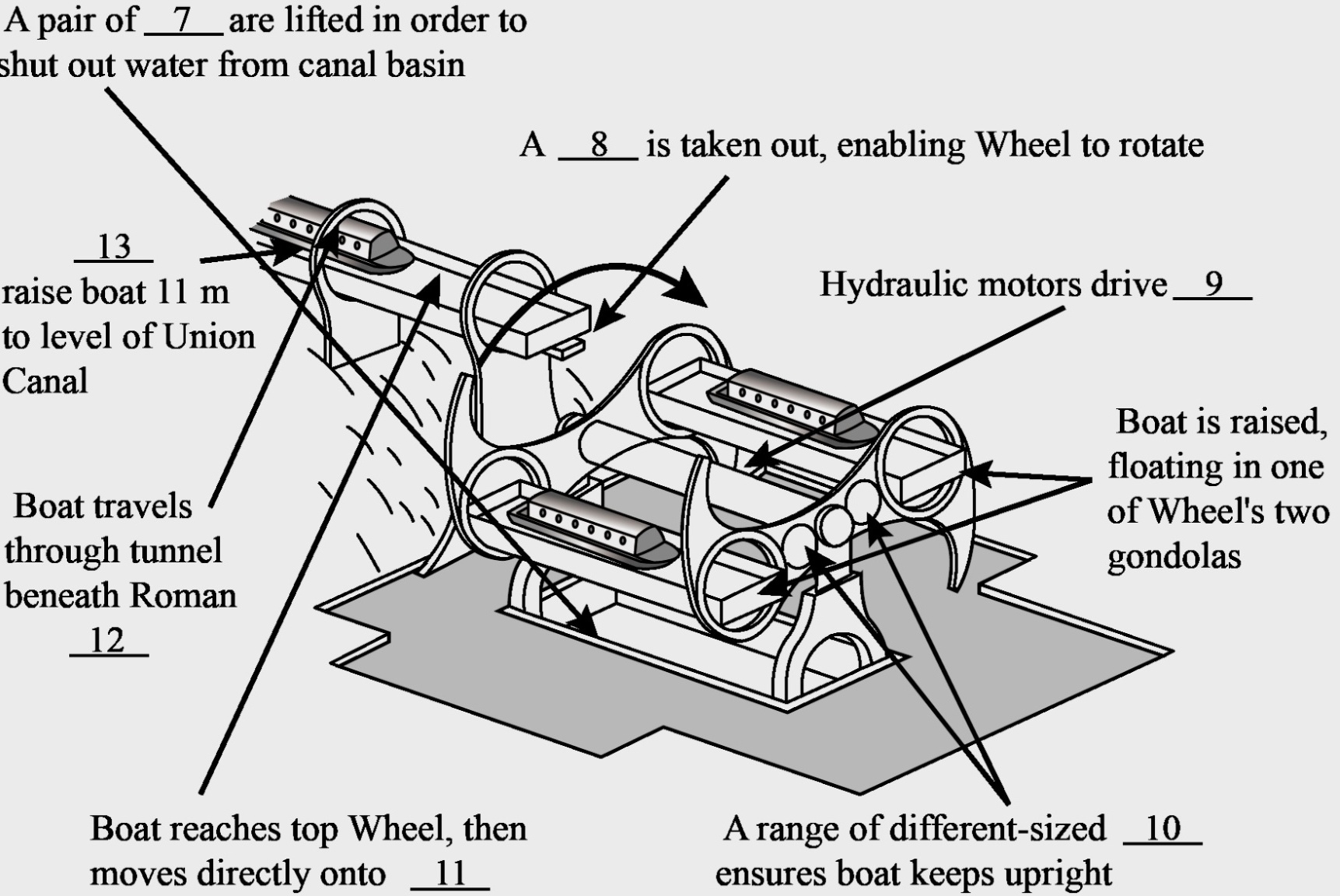
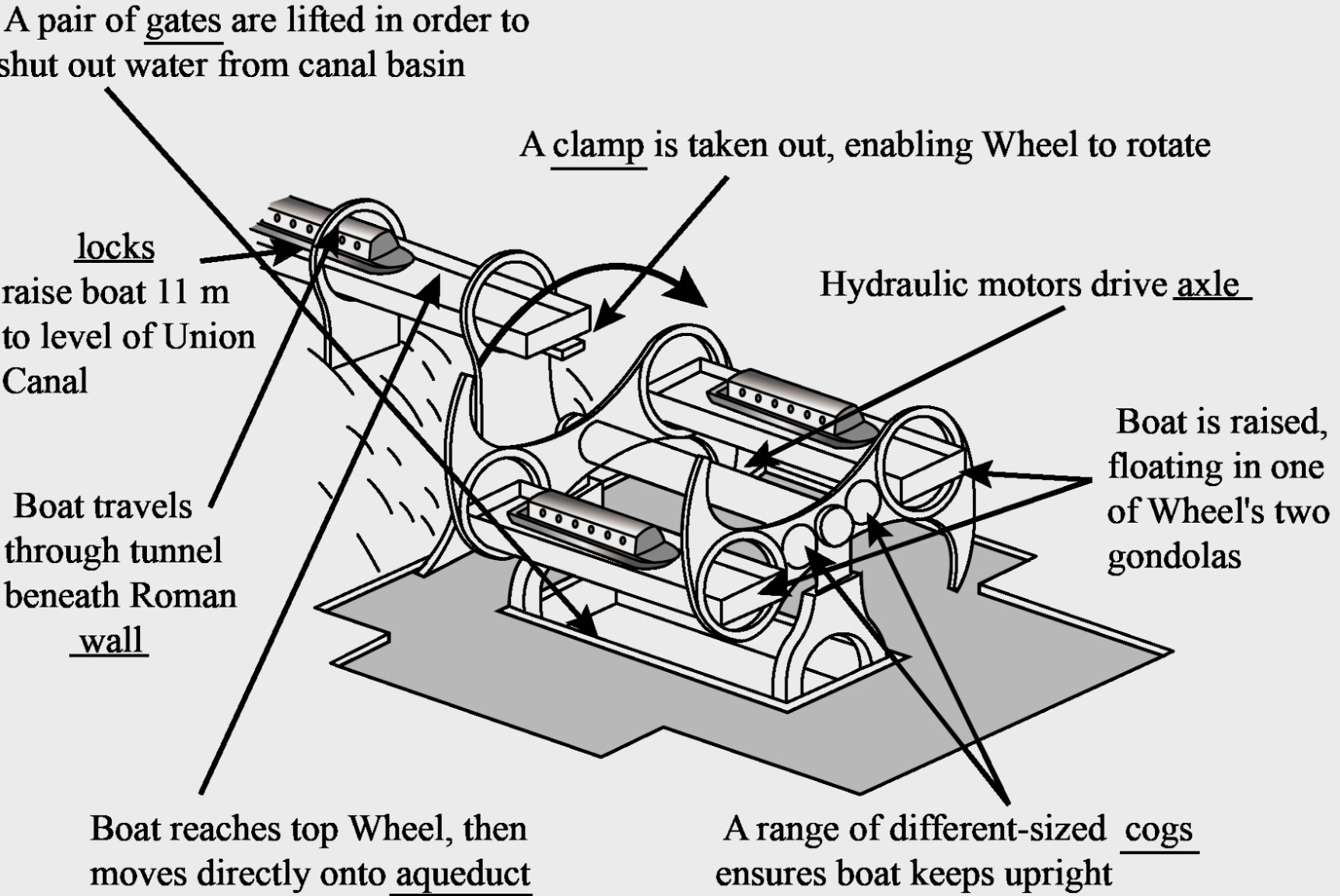
Label the diagram below.
Choose ONE WORD from the passage for each answer.
Write your answers in boxes 7-13 on your answer sheet.
How a boat is lifted on the Falkirk Wheel
题目解答
答案
- (1)FNTNFT
- (2)
解析
一、判断题(1-6题)
1. 题目:The Falkirk Wheel has linked the Forth & Clyde Canal with the Union Canal for the first time in their history.(福斯-克莱德运河和联合运河有史以来第一次通过福尔柯克轮连接。)
解析:原文第2段提到“Historically, the two canals had been joined near the town of Falkirk by a sequence of 11 locks... This had been dismantled in 1933”(历史上两条运河曾通过11个船闸连接,1933年被拆除),而福柯克轮是2002年启用的“reconnecting”(重新连接)项目。题目称“第一次连接”,与原文“重新连接”矛盾,故答案为FALSE。
2. 题目:There was some opposition to the design of the Falkirk Wheel at first.(一开始对福柯克轮的设计有反对意见。)
解析:原文第3段仅提到“Numerous ideas were submitted... The eventual winner was a plan for the huge rotating steel boat lift”(提交了众多想法,最终获胜的是旋转钢船 lift 计划),未提及任何反对意见,属于“无信息”,故答案为NOT GIVEN。
3. 题目:The Falkirk Wheel was initially put together at the location where its components were manufactured.(福柯克轮最初在零部件制造地组装。)
解析:原文第4段明确“ The various parts of The Falkirk Wheel were all constructed and assembled... at Butterley Engineering's Steelworks in Derbyshire”(各部件在德比郡的钢铁厂建造和组装),后拆解运输到福尔柯克。“initially put together at manufacturing location”与原文一致,故答案为TRUE。
4. 题目:The Falkirk Wheel is the only boat lift in the world which has steel sections bolted together by hand.(福柯克轮是世界上唯一一座钢部件手工螺栓连接的船 lift。)
解析:原文第4段提到“the steel sections were bolted rather than welded together... each bolt was hand-tightened”(钢部件用螺栓而非焊接,每个螺栓手工拧紧),但未称其是“唯一”的手工螺栓连接船 lift,“only”无依据,故答案为FALSE。
5. 题目:The weight of the gondolas varies according to the size of boat being carried.(贡多拉的重量根据所载船只大小变化。)
解析:原文第5段明确“These gondolas always weigh the same, whether or not they are carrying boats”(无论是否载船,贡多拉重量始终相同),依据阿基米德原理,船只进入时排出的水量等于船重,抵消了重量变化。题目与原文矛盾,故答案为FALSE。
6. 题目:The construction of the Falkirk Wheel site took into account the presence of a nearby ancient monument.(福柯克轮选址考虑了附近的古代纪念碑。)
解析:原文第7段提到“The Wheel could not be constructed to elevate boats over the full 35-metre difference... owing to the presence of the historically important Antonine Wall”(无法建造全35米 lift 是因为罗马时代的安东尼长城),说明设计时考虑了该古代纪念碑,故答案为TRUE。
二、 diagram标签题(7-13题)
7. 题目:A pair of ____ are lifted in order to shut out water from canal basin.(一对______被抬起以隔绝运河盆地的水。)
解析:原文第6段:“Two hydraulic steel gates are raised, so as to seal the gondola off from the water in the canal basin.”(两个液压钢闸门被抬起,密封贡多拉与运河盆地的水。)填“gates”。
8. 题目:A ____ is taken out, enabling Wheel to rotate.(一个______被取下,使轮子能够旋转。)
解析:原文第6段:“A hydraulic clamp... is removed, allowing the Wheel to turn.”(液压夹被移除,允许轮子转动。)填“clamp”。
9. 题目:Hydraulic motors drive ____ to level of Union Canal.(液压马达驱动______到联合运河的高度。)
解析:原文第6段:“In the central machine room an array of ten hydraulic motors then begins to rotate the central axle.”(液压马达旋转中心轴。)填“axle”。
10. 题目:A range of different-sized ____ ensures boat keeps upright.(一系列不同尺寸的______确保船只保持直立。)
解析:原文第6段:“Two eight-metre-wide cogs orbit a fixed inner cog... so ensuring that the gondolas always remain level.”(不同宽度的齿轮确保贡多拉/船只水平。)填“cogs”。
11. 题目:Boat moves directly onto ____.(船直接开到______上。)
解析:原文第6段:“When the gondola reaches the top, the boat passes straight onto the aqueduct...”(到达顶部后,船直接开到渡槽上。)填“aqueduct”。
12. 题目:Boat travels through tunnel beneath Roman ____.(船通过罗马______下方的隧道。)
解析:原文第7段:“Boats travel under this wall via a tunnel”(船通过长城下方的隧道。)填“wall”。
13. 题目:____ raise boat 11 m.(______提升船11米。)
解析:原文第7段:“The remaining 11 metres of lift needed... is achieved by means of a pair of locks.”(剩余11米通过一对船闸实现。)填“locks”。