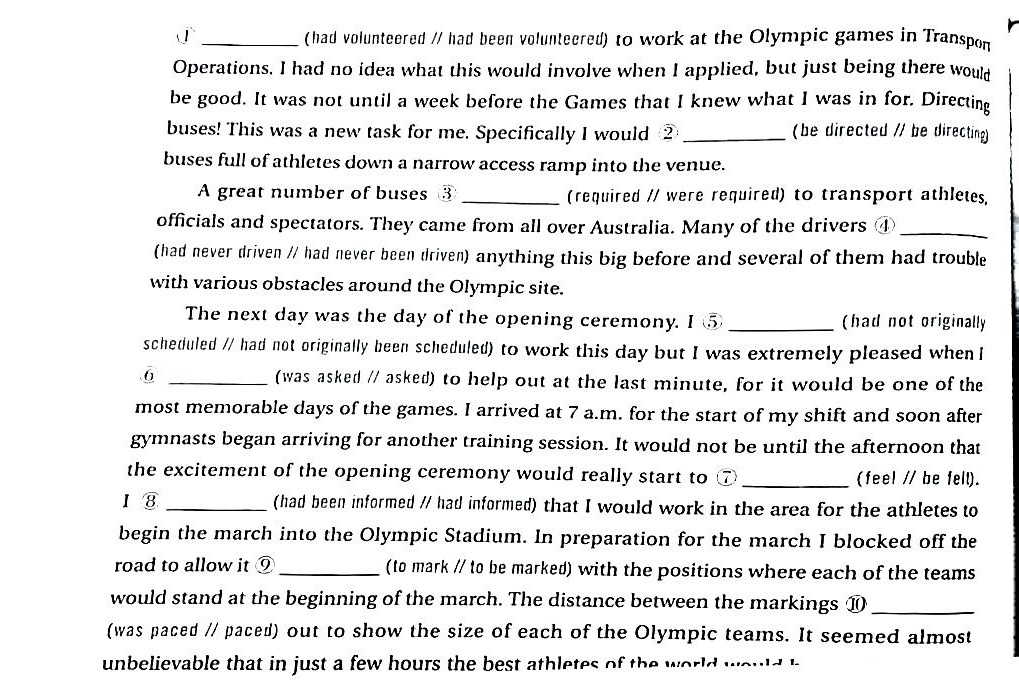
① __ (had volunteered /had been volunteered)to work at the Olympic games in Transpon-|||-Operations.I had no idea what this would involve when I applied,but just being there would-|||-be good.It was not until a week before the Games that I knew what I was in for.Directing-|||-buses! This was a new task for me.Specifically I would ② __ (he directed /be directing-|||-buses full of athletes down a narrow access ramp into the venue.-|||-A great number of buses ③ __ (required / were required) to transport athletes.-|||-officials and spectators.They came from all over Australia.Many of the drivers ④ __-|||-(had never driven /had never been driven) anything this big before and several of them had trouble-|||-with various obstacles around the Olympic site.-|||-The next day was the day of the opening ceremony.I ⑤ __ (had not originally-|||-scheduled / had not originally been scheduled) to work this day but I was extremely pleased when I-|||-6 __ (was asked /asked) to help out at the last minute,for it would be one of the-|||-most memorable days of the games.I arrived at 7 a.m.for the start of my shift and soon after-|||-gymnasts began arriving for another training session.It would not be until the afternoon that-|||-the excitement of the opening ceremony would really start to ⑦ __ 1 (1ee)ykparallel be ykparallel eykparallel e..-|||-1⑧ __ (had been informed /had informed)that I would work in the area for the athletes to-|||-begin the march into the Olympic Stadium. In preparation for the march I blocked off the-|||-road to allow it ⑨ __ ( marKykparallel 10 be marked) with the positions where each of the teams-|||-would stand at the beginning of the march.The distance between the markings⑩ __-|||-(was paced /paced) out to show the size of each of the Olympic teams.It seemed almost-|||-unbelievable that in just a few hours the best athletes of the MANPIN······1
题目解答
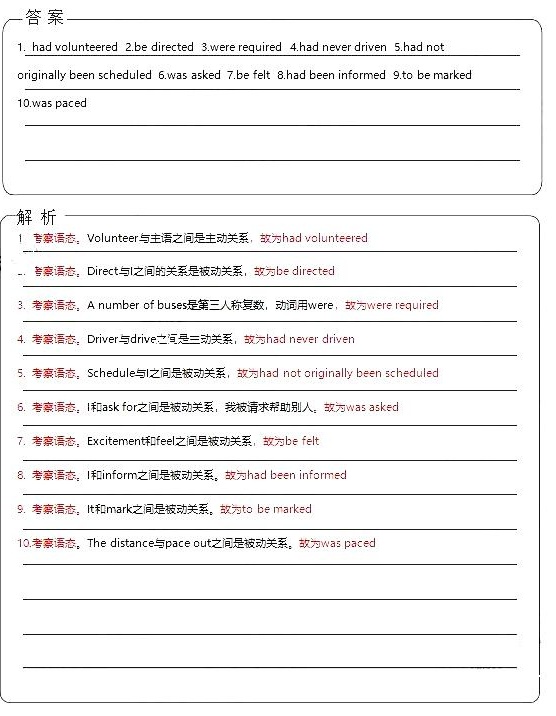
答案
解析
本题主要考查动词的时态和语态。解题的关键在于判断主语和动词之间的关系,若主语是动作的执行者,则用主动语态;若主语是动作的承受者,则用被动语态。同时,要根据上下文的语境来确定合适的时态。
①
“volunteer”表示“自愿做某事”,主语“I”和“volunteer”之间是主动关系,且“volunteer”这个动作发生在“knew”之前,即过去的过去,所以要用过去完成时的主动语态,故填“had volunteered”。
②
“direct”表示“指挥”,主语“I”和“direct”之间是被动关系,即“我被指挥”,且根据语境这里表示将来某个时间正在进行的动作,要用过去将来进行时的被动语态,其结构是“would be + 过去分词”,所以填“be directed”。
③
“require”表示“需要”,主语“A great number of buses”和“require”之间是被动关系,即“公交车被需要”,且句子描述的是过去的情况,要用一般过去时的被动语态,“A great number of buses”是复数,所以用“were required”。
④
“drive”表示“驾驶”,主语“Many of the drivers”和“drive”之间是主动关系,即“司机驾驶”,且“drive”这个动作发生在“had trouble”之前,即过去的过去,所以要用过去完成时的主动语态,故填“had never driven”。
⑤
“schedule”表示“安排”,主语“I”和“schedule”之间是被动关系,即“我被安排”,且“schedule”这个动作发生在“was extremely pleased”之前,即过去的过去,所以要用过去完成时的被动语态,故填“had not originally been scheduled”。
⑥
“ask”表示“请求”,主语“I”和“ask”之间是被动关系,即“我被请求”,且句子描述的是过去的情况,要用一般过去时的被动语态,所以填“was asked”。
⑦
“feel”表示“感受到”,主语“the excitement”和“feel”之间是被动关系,即“兴奋被感受到”,“would start to”后面接动词原形,所以用“be felt”。
⑧
“inform”表示“通知”,主语“I”和“inform”之间是被动关系,即“我被通知”,且“inform”这个动作发生在“arrived”之前,即过去的过去,所以要用过去完成时的被动语态,故填“had been informed”。
⑨
“mark”表示“标记”,“allow sb/sth to do sth”表示“允许某人/某物做某事”,这里“it”指代“the road”,和“mark”之间是被动关系,即“路被标记”,所以用“to be marked”。
⑩
“pace out”表示“用步测”,主语“The distance”和“pace out”之间是被动关系,即“距离被步测”,且句子描述的是过去的情况,要用一般过去时的被动语态,所以填“was paced”。