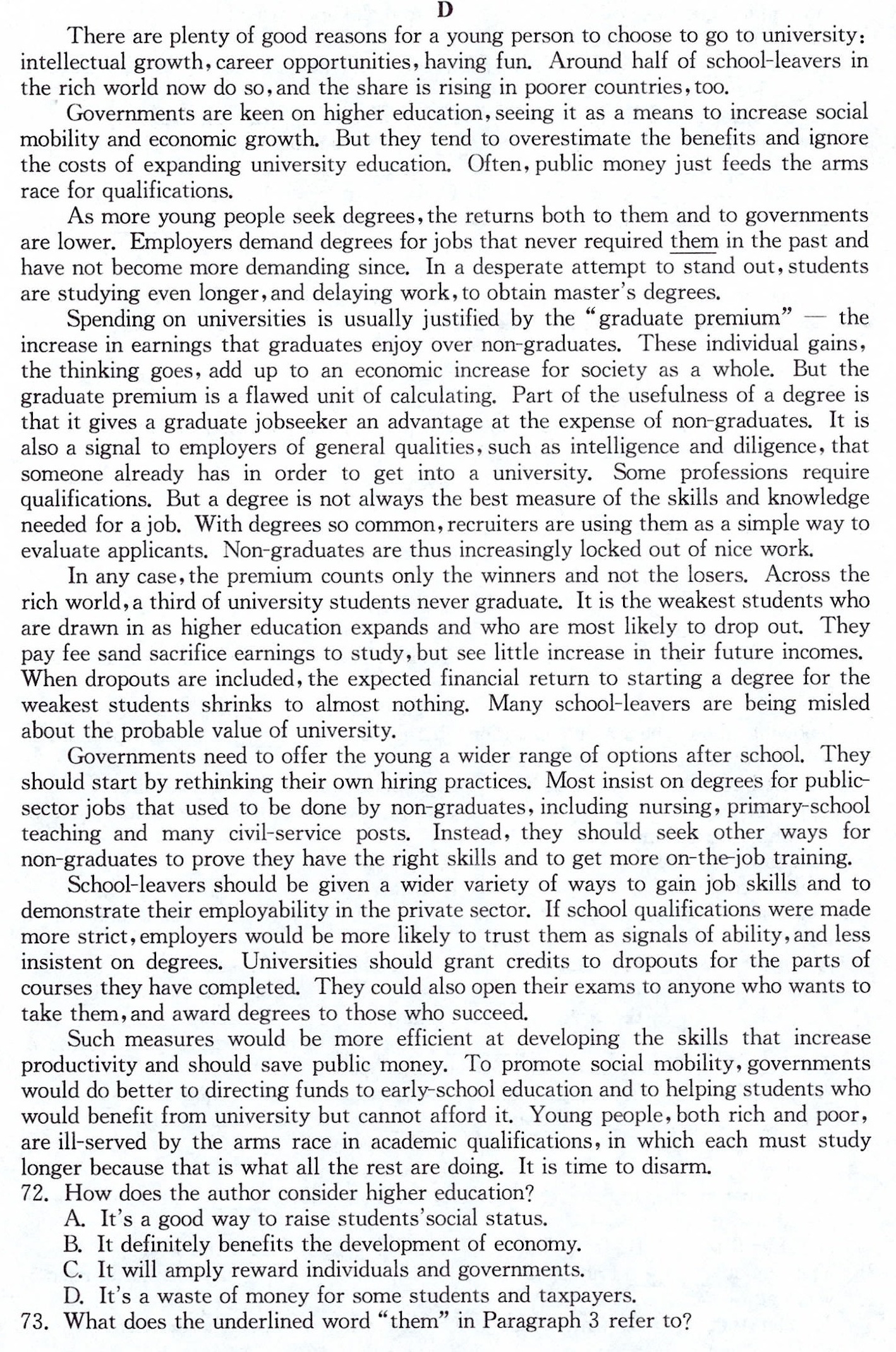
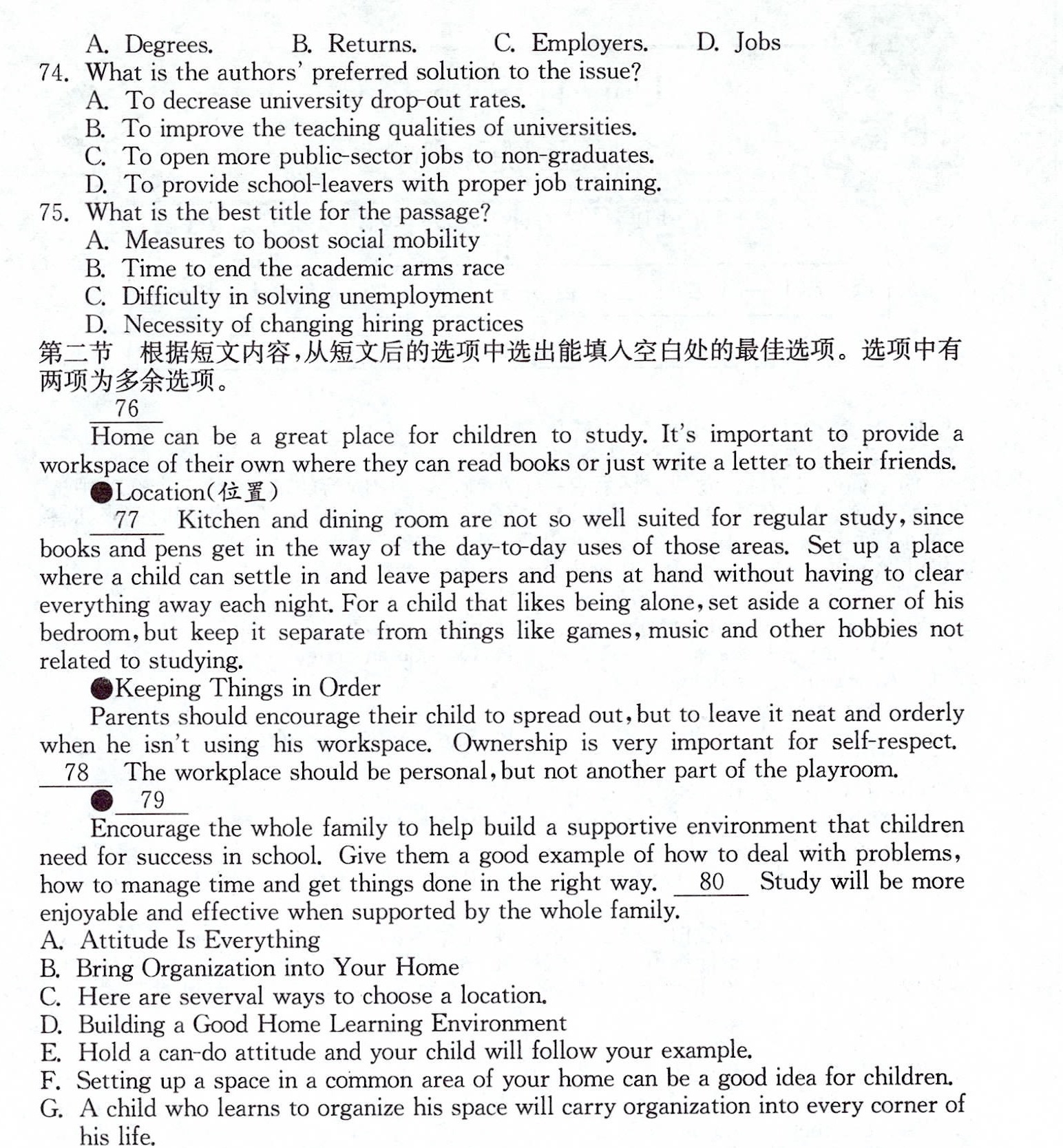
D-|||-There are plenty of good reasons for a young person to choose to go to university:-|||-intellectual growth,carecroportinities fun.Around half of school-leavers in-|||-the rich world now do so,and the share is rising in poorer countries,too.-|||-Governments are keen on higher education,seeing i means to increase social-|||-mobility and economic growth. But they tend to overestimate the benefits and ignore-|||-the costs of expanding university educ Often,public money just feeds the arms-|||-race for qualifications.-|||-As more young people seek degrees,the returns both to them and to governments-|||-arelower. Employers deman degrees for jobs that never required them in the past and-|||-have not become more demanding since.In a desperate attempt to stand out,students-|||-are studying even longer,and delaying work,to obtain master`s degrees.-|||-Spending on universities is usually justified by the"graduate premium"-the-|||-increase in earnings that graduates enjoy over non-graduates.These individual gains,-|||-the thinking goes,add up to an economic increase for society as a whole. But the-|||-graduate premium is a flawed unit of calculating. Part of the usefulness of a degree is-|||-that it gives a graduate jobseeker an advantage at the expense of non-graduates. It is-|||-also a signal to employers of general qualities,such as intelligence and diligence,that-|||-someone already has in order to get into a university.Some professions require-|||-qualifications.But a degree is not always the best measure of the skills and knowledge-|||-needed for a job.With degrees so common,recruiters are using them as a simple way to-|||-evaluate applicants.Nom graduates are thus increasingly locked out of nice work.-|||-In any case,the premium counts only the winners and not the losers. Across the-|||-rich world,a third of university students never graduate.It is the weakest students who-|||-are drawn in as higher education expands and who are most likely to drop out.They-|||-pay fee sand sacrifice earnings to study,but see little increase in their future incomes.-|||-When dropouts are included,the expected financial return to starting a degree for the-|||-weakest students shrinks to almost nothing.Many school-leavers are being misled-|||-about the probable value of university.-|||-Governments need to offer the young a wider range of options after school. They-|||-should start by rethinking their own hiring practices. Most insist on degrees for public--|||-sector jobs that used to be done by non-graduates,including nursi primary-school-|||-teaching and many civil-service posts.Instead,they should seek other ways for-|||-non-graduates to prove they have the right skills and to get more on-the-job training.-|||-School-leavers should be given a wider variety of ways to gain job skills and to-|||-denonstratethere employab the private sector. If school qualifications wer made-|||-more strict,employers wou be more likely to trust them as signals of ability,and less-|||-insistent on degrees.Universities should grant credits to dropouts for the parts of-|||-courses they have completed. They could also open their exams to anyone who wants to-|||-take them,and award degrees to those who succeed.-|||-Such measures would be more efficient at developing the skills that increase-|||-productivity and should save public money.To promote social mobility ,governments-|||-would do better to directing funds to earlysschooleducation helping students who-|||-would benefit from university but cannot afford it.Young people,both rich and poor,-|||-are ill-served by the arms race in academic qualification in which each must study-|||-longer because that is what all the rest are doing.It is time to disarm.-|||-72.How does the author consider higher education?-|||-A.It`s a good way to raise students`social status.-|||-B.It definitely benefits the development of econom-|||-C.It will amply reward individuals and governments.-|||-D.It`s a waste of money for some students and taxpayers.-|||-73.What does the underlined word"them"in Paragraph 3 refer to?D-|||-There are plenty of good reasons for a young person to choose to go to university:-|||-intellectual growth,carecroportinities fun.Around half of school-leavers in-|||-the rich world now do so,and the share is rising in poorer countries,too.-|||-Governments are keen on higher education,seeing i means to increase social-|||-mobility and economic growth. But they tend to overestimate the benefits and ignore-|||-the costs of expanding university educ Often,public money just feeds the arms-|||-race for qualifications.-|||-As more young people seek degrees,the returns both to them and to governments-|||-arelower. Employers deman degrees for jobs that never required them in the past and-|||-have not become more demanding since.In a desperate attempt to stand out,students-|||-are studying even longer,and delaying work,to obtain master`s degrees.-|||-Spending on universities is usually justified by the"graduate premium"-the-|||-increase in earnings that graduates enjoy over non-graduates.These individual gains,-|||-the thinking goes,add up to an economic increase for society as a whole. But the-|||-graduate premium is a flawed unit of calculating. Part of the usefulness of a degree is-|||-that it gives a graduate jobseeker an advantage at the expense of non-graduates. It is-|||-also a signal to employers of general qualities,such as intelligence and diligence,that-|||-someone already has in order to get into a university.Some professions require-|||-qualifications.But a degree is not always the best measure of the skills and knowledge-|||-needed for a job.With degrees so common,recruiters are using them as a simple way to-|||-evaluate applicants.Nom graduates are thus increasingly locked out of nice work.-|||-In any case,the premium counts only the winners and not the losers. Across the-|||-rich world,a third of university students never graduate.It is the weakest students who-|||-are drawn in as higher education expands and who are most likely to drop out.They-|||-pay fee sand sacrifice earnings to study,but see little increase in their future incomes.-|||-When dropouts are included,the expected financial return to starting a degree for the-|||-weakest students shrinks to almost nothing.Many school-leavers are being misled-|||-about the probable value of university.-|||-Governments need to offer the young a wider range of options after school. They-|||-should start by rethinking their own hiring practices. Most insist on degrees for public--|||-sector jobs that used to be done by non-graduates,including nursi primary-school-|||-teaching and many civil-service posts.Instead,they should seek other ways for-|||-non-graduates to prove they have the right skills and to get more on-the-job training.-|||-School-leavers should be given a wider variety of ways to gain job skills and to-|||-denonstratethere employab the private sector. If school qualifications wer made-|||-more strict,employers wou be more likely to trust them as signals of ability,and less-|||-insistent on degrees.Universities should grant credits to dropouts for the parts of-|||-courses they have completed. They could also open their exams to anyone who wants to-|||-take them,and award degrees to those who succeed.-|||-Such measures would be more efficient at developing the skills that increase-|||-productivity and should save public money.To promote social mobility ,governments-|||-would do better to directing funds to earlysschooleducation helping students who-|||-would benefit from university but cannot afford it.Young people,both rich and poor,-|||-are ill-served by the arms race in academic qualification in which each must study-|||-longer because that is what all the rest are doing.It is time to disarm.-|||-72.How does the author consider higher education?-|||-A.It`s a good way to raise students`social status.-|||-B.It definitely benefits the development of econom-|||-C.It will amply reward individuals and governments.-|||-D.It`s a waste of money for some students and taxpayers.-|||-73.What does the underlined word"them"in Paragraph 3 refer to?
题目解答
答案

解析
第一部分:阅读理解
72题:作者对高等教育的看法
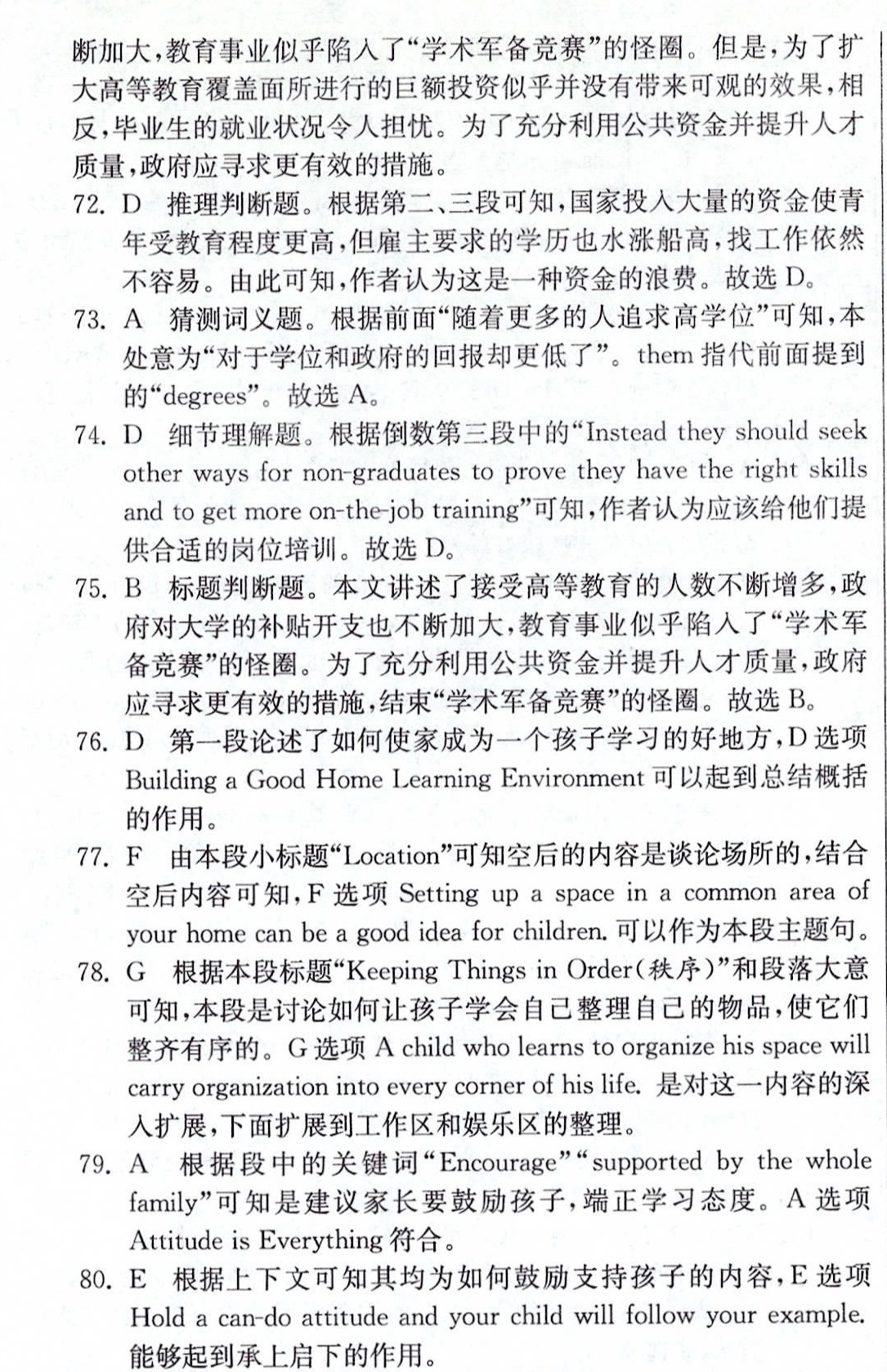
文章指出政府高估高等教育收益、忽视成本,更多年轻人追求学位但回报降低,三分之一学生未毕业且弱势学生财务回报几乎为零,公共资金可能浪费。选项D“对部分学生和纳税人来说是浪费金钱”符合文意。
73题:划线词“them”指代
第三段提到“As more young people seek degrees, the returns both to them and to governments are lower”,根据上下文,前文讲年轻人追求学位,此处“returns to them”指对“degrees”的回报,故“them”指代“Degrees”,选A。
74题:作者偏好的解决方案
倒数第三段提到“Instead, they should seek other ways for non-graduates to prove they have the right skills and to get more on-the-job training”,即作者建议为离校生提供适当的职业培训,选项D符合。
75题:最佳标题
文章核心是批判高等教育的“学术军备竞赛”(arms race for qualifications),呼吁结束这一现象,选项B“是时候结束学术军备竞赛了”准确概括主旨。
第二部分:七选五
76题:首段总起
首段强调家是孩子学习的好地方,需提供专属 workspace,D选项“Building a Good Home Learning Environment”(构建良好的家庭学习环境)是对全文的总结概括,适合作首句。
77题:位置建议
本段小标题为“Location”,讨论学习地点的选择。F选项“在你家的公共区域设置一个空间对孩子来说是个好主意”引出地点选择的话题,与后文“厨房和餐厅不适合”形成对比,符合语境。
78题:整理物品的意义
本段标题“Keeping Things in Order”强调有序,G选项“学会整理自己空间的孩子会将整理带入生活各个角落”是对“保持有序”的深层延伸,说明其重要性,符合段落逻辑。
79题:态度的重要性
本段讲家长要树立榜样,鼓励孩子,关键词“Attitude”“example”对应A选项“Attitude Is Everything”(态度决定一切),点出态度的关键作用。
80题:家长的榜样作用
前文建议家长给出好榜样,E选项“保持‘能做’的态度,你的孩子会效仿你”进一步说明家长态度对孩子的影响,与上下文衔接紧密。