[习题 8-14 ]将含有 .20molcdot (L)^-1N(H)_(3) 和 https:/img.cdnjtzy.com/zyb_95442502c69d8be6b8eeed1b81ee86b5.jpg.0molcdot (L)^-1(N{H)_(4)}^+ 的缓冲溶液与 .020molcdot (L)^-1-|||-([ Cu{(N{H)_(3))}_(4)] }^2+ 溶液等体积混合,有无Cu(OH)2沉淀生成?[已知Cu(OH)2的 _(sp)^theta =2.2times (10)^-20J

题目解答
答案
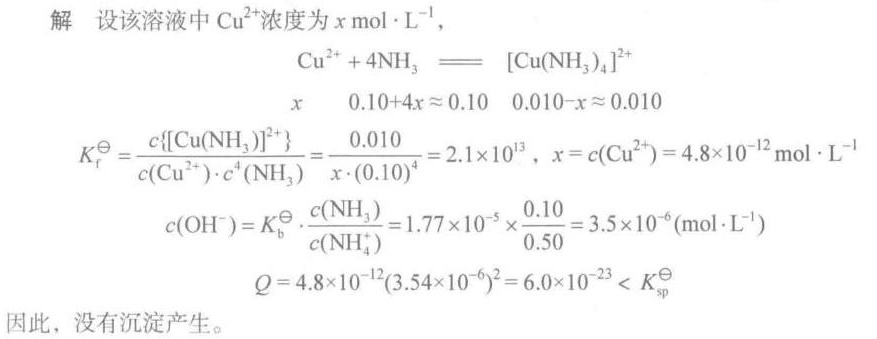
解析
本题考查缓冲溶液性质、配位化合物解离平衡及溶度积判断沉淀生成条件的综合应用。解题关键在于:
- 混合后浓度变化:等体积混合导致各物质浓度减半;
- 配位化合物解离:通过解离平衡计算溶液中实际存在的$[Cu^{2+}]$;
- 缓冲溶液pH计算:利用Henderson-Hasselbalch方程求$[OH^-]$;
- 溶度积比较:计算反应商$Q$,与$K_{sp}$对比判断沉淀是否生成。
混合后浓度变化
混合后各物质浓度:
- $[NH_3] = 0.20 \, \text{mol/L} \times \frac{1}{2} = 0.10 \, \text{mol/L}$;
- $[NH_4^+] = 1.0 \, \text{mol/L} \times \frac{1}{2} = 0.50 \, \text{mol/L}$;
- $[Cu(NH_3)_4^{2+}] = 0.020 \, \text{mol/L} \times \frac{1}{2} = 0.010 \, \text{mol/L}$。
配位化合物解离平衡
反应:$[Cu(NH_3)_4]^{2+} \rightleftharpoons Cu^{2+} + 4NH_3$
设解离出的$[Cu^{2+}] = x$,则:
- $[Cu(NH_3)_4^{2+}] \approx 0.010 \, \text{mol/L}$(解离度极小);
- $[NH_3] \approx 0.10 \, \text{mol/L}$(解离出的$4x$可忽略)。
解离常数$K_d = \dfrac{[Cu^{2+}][NH_3]^4}{[Cu(NH_3)_4^{2+}]} = \dfrac{x \cdot (0.10)^4}{0.010}$。
已知$K_d = \dfrac{1}{K_f} = \dfrac{1}{2.1 \times 10^{13}} \approx 4.76 \times 10^{-14}$,解得:
$x = \dfrac{K_d \cdot 0.010}{(0.10)^4} = \dfrac{4.76 \times 10^{-14} \cdot 0.010}{10^{-4}} = 4.8 \times 10^{-12} \, \text{mol/L}.$
缓冲溶液pH计算
利用Henderson-Hasselbalch方程:
$pH = pKa + \log \dfrac{[NH_3]}{[NH_4^+]}.$
其中,$pKa = -\log \left( \dfrac{K_w}{K_b} \right) = -\log \left( \dfrac{1.0 \times 10^{-14}}{1.77 \times 10^{-5}} \right) \approx 9.25$,代入得:
$pH = 9.25 + \log \dfrac{0.10}{0.50} = 9.25 - 0.699 = 8.55.$
对应$[OH^-] = 10^{-(14 - 8.55)} = 3.5 \times 10^{-6} \, \text{mol/L}$。
沉淀判据
计算反应商$Q$:
$Q = [Cu^{2+}][OH^-]^2 = (4.8 \times 10^{-12})(3.5 \times 10^{-6})^2 = 6.0 \times 10^{-23}.$
因$Q < K_{sp}$($6.0 \times 10^{-23} < 2.2 \times 10^{-20}$),故无$Cu(OH)_2$沉淀生成。