(1.167)(0.0248) (0.182865)t =(1.625)(4.1239) (0.080389)=0.584750 F=21.12278可以看出,的回归系数显著,而的回归系数不显著,不是很高,模型整体上对样本数据拟合一般。根据自适应模型的参数关系,有,代入得到:故局部调整模型为:经济意义:新增固定资产的变化取决于全省工业总产值的预期值。全省工业总产值每预期增加增加1(亿元),当期新增固定资产量为0.1037(亿元)。3)局部调整模型和自适应模型的区别在于:局部调整模型是对应变量的局部调整而得到的;而自适应模型是由解释变量[1]的自适应过程而得到的。由回归结果可见,Y滞后一期的回归系数并不显著,说明两个模型的设定都不合理。7.5 表7.14给出某地区各年末货币流通[2]量Y,社会商品零售额X1、城乡居民储蓄余额X 2的数据。表7.14 某地区年末货币流通量、社会商品零售额、城乡居民储蓄余额数据(单位:亿元)利用表中数据设定模型:(alpha )^*=gamma alpha , ({beta )_(0)}^*=gamma beta , ({beta )_(1)}=1-gamma , (mu )_(1)=(mu )_(1)-(1-r)(mu )_(1-1)(alpha )^*=gamma alpha , ({beta )_(0)}^*=gamma beta , ({beta )_(1)}=1-gamma , (mu )_(1)=(mu )_(1)-(1-r)(mu )_(1-1)其中,为长期(或所需求的)货币流通量。试根据局部调整假设,作模型变换,估计并检验参数,对参数经济意义做出解释。练习题7.5参考解答:1)在局部调整假定下,先估计一阶自回归模型:回归的估计结果如下:回归方程:(4344.078) (0.039610) (0.090534) (0.187220)t = (1.518442) (1.197940) (3.035736) (2.164699) (alpha )^*=gamma alpha , ({beta )_(0)}^*=gamma beta , ({beta )_(1)}=1-gamma , (mu )_(1)=(mu )_(1)-(1-r)(mu )_(1-1)=0.967247 F=275.6267 DW=2.109534根据局部调整模型的参数关系,有(alpha )^*=gamma alpha , ({beta )_(0)}^*=gamma beta , ({beta )_(1)}=1-gamma , (mu )_(1)=(mu )_(1)-(1-r)(mu )_(1-1)将上述估计结果代入得到:(alpha )^*=gamma alpha , ({beta )_(0)}^*=gamma beta , ({beta )_(1)}=1-gamma , (mu )_(1)=(mu )_(1)-(1-r)(mu )_(1-1) 故局部调整模型估计结果为:经济意义:在其他条件不变的情况下,该地区社会商品零售额每增加1亿元,则预期年末货币流通量增加0.07978亿元。同样,在其他条件不变的情况下,该地区城乡居民储蓄余额每增加1亿元,则预期年末货币流通量增加0.462126亿元。2)先对数变换模型形式,在局部调整假定下,先估计一阶自回归模型:(alpha )^*=gamma alpha , ({beta )_(0)}^*=gamma beta , ({beta )_(1)}=1-gamma , (mu )_(1)=(mu )_(1)-(1-r)(mu )_(1-1)回归的估计结果如下:回归方程:(alpha )^*=gamma alpha , ({beta )_(0)}^*=gamma beta , ({beta )_(1)}=1-gamma , (mu )_(1)=(mu )_(1)-(1-r)(mu )_(1-1) (1.677888) (0.255557) (0.154913) (0.531445)t = (0.384014) (0.806984) (1.163013) (4.864049)(alpha )^*=gamma alpha , ({beta )_(0)}^*=gamma beta , ({beta )_(1)}=1-gamma , (mu )_(1)=(mu )_(1)-(1-r)(mu )_(1-1)=0.968959 F=291.3458 DW=1.914829根据局部调整模型的参数关系,有将上述估计结果代入得到:(alpha )^*=gamma alpha , ({beta )_(0)}^*=gamma beta , ({beta )_(1)}=1-gamma , (mu )_(1)=(mu )_(1)-(1-r)(mu )_(1-1) 故局部调整模型估计结果为:经济意义:货币需求对社会商品零售额的长期弹性为:0.44104;货币需求对城乡居民储蓄余额的长期弹性为0.384518。7.6 设其中:M为实际货币流通量,(alpha )^*=gamma alpha , ({beta )_(0)}^*=gamma beta , ({beta )_(1)}=1-gamma , (mu )_(1)=(mu )_(1)-(1-r)(mu )_(1-1)为期望社会商品零售总额,为期望储蓄总额,对于期望值作如下假定: (alpha )^*=gamma alpha , ({beta )_(0)}^*=gamma beta , ({beta )_(1)}=1-gamma , (mu )_(1)=(mu )_(1)-(1-r)(mu )_(1-1)其中为期望系数,均为小于1的正数。(1) 如何利用可观测的量来表示(alpha )^*=gamma alpha , ({beta )_(0)}^*=gamma beta , ({beta )_(1)}=1-gamma , (mu )_(1)=(mu )_(1)-(1-r)(mu )_(1-1)?(2) 分析这样变换存在什么问题?(3) 利用7.5题的数据进行回归,估计模型,并作检验。练习题7.6参考解答:1)首先将M滞后一期并乘上得到再将原始方程减去该方程,得到(alpha )^*=gamma alpha , ({beta )_(0)}^*=gamma beta , ({beta )_(1)}=1-gamma , (mu )_(1)=(mu )_(1)-(1-r)(mu )_(1-1)(alpha )^*=gamma alpha , ({beta )_(0)}^*=gamma beta , ({beta )_(1)}=1-gamma , (mu )_(1)=(mu )_(1)-(1-r)(mu )_(1-1) (1)-(2) 于是(alpha )^*=gamma alpha , ({beta )_(0)}^*=gamma beta , ({beta )_(1)}=1-gamma , (mu )_(1)=(mu )_(1)-(1-r)(mu )_(1-1)可表示为:(alpha )^*=gamma alpha , ({beta )_(0)}^*=gamma beta , ({beta )_(1)}=1-gamma , (mu )_(1)=(mu )_(1)-(1-r)(mu )_(1-1)2)从上面的变化中可看出,随机扰动项变为(alpha )^*=gamma alpha , ({beta )_(0)}^*=gamma beta , ({beta )_(1)}=1-gamma , (mu )_(1)=(mu )_(1)-(1-r)(mu )_(1-1),这就可能导致出现随机扰动项的自相关,进而导致估计出来的结果是有偏的,而且不是一致估计。3)对((alpha )^*=gamma alpha , ({beta )_(0)}^*=gamma beta , ({beta )_(1)}=1-gamma , (mu )_(1)=(mu )_(1)-(1-r)(mu )_(1-1))回归的估计结果如下,回归方程:可以看到,只有的回归系数在10% 的显著性水平下是显著的,其他回归系数均不显著;F统计量较大,方程整体显著;较高,模型整体上对样本数据拟合较好。7.7 考虑如下回归模型:(alpha )^*=gamma alpha , ({beta )_(0)}^*=gamma beta , ({beta )_(1)}=1-gamma , (mu )_(1)=(mu )_(1)-(1-r)(mu )_(1-1)其中,y为通货膨胀率,x为生产设备使用率。1) 生产设备使用率对通货膨胀率的短期影响和总的影响分别是多大?2) 如果库伊克模型为(alpha )^*=gamma alpha , ({beta )_(0)}^*=gamma beta , ({beta )_(1)}=1-gamma , (mu )_(1)=(mu )_(1)-(1-r)(mu )_(1-1),你怎样得到生产设备使用率对通货膨胀率的短期影响和长期影响?练习题7.7参考解答:1)该模型为有限分布滞后模型,故生产设备使用率对通货膨胀的短期影响为0.1408,总的影响为0.1408+0.2306=0.3714。2)利用工具变量法,用来代替进行估计,则库伊克模型变换为。若原先有,则需估计的模型为,所以生产设备使用率对通货膨胀的短期影响为,总的影响为。7.8 表7.15中给出了某地区消费总额Y和货币收入总额X的年度资料。表7.15 某地区消费总额Y(亿元)和货币收入总额X(亿元)的年度资料(单位:亿元)分析该地区消费同收入的关系1) 做(alpha )^*=gamma alpha , ({beta )_(0)}^*=gamma beta , ({beta )_(1)}=1-gamma , (mu )_(1)=(mu )_(1)-(1-r)(mu )_(1-1)关于的回归,对回归结果进行分析判断;2) 建立适当的分布滞后模型,用库伊克变换转换为库伊克模型后进行估计,并对估计结果进行分析判断。练习题7.8参考解答:1)做(alpha )^*=gamma alpha , ({beta )_(0)}^*=gamma beta , ({beta )_(1)}=1-gamma , (mu )_(1)=(mu )_(1)-(1-r)(mu )_(1-1)关于的回归,回归的估计结果如下,回归方程:(7.945) (0.02284)t =(3.9447) (35.365)(alpha )^*=gamma alpha , ({beta )_(0)}^*=gamma beta , ({beta )_(1)}=1-gamma , (mu )_(1)=(mu )_(1)-(1-r)(mu )_(1-1)=0.978103 F=1250.713从回归结果来看,t检验值、F检验值及都显著,但在显著性水平上,DW值,说明模型扰动项存在正自相关,需对模型进行修改。2)事实上,当年消费不仅受当年收入的影响,而且还受过去各年收入水平的影响,因此,我们在上述模型中增添货币收入总额X的滞后变量进行分析。如前所述,对分布滞后模型直接进行估计会存在自由度损失和多重共线性等问题。在此,选择库伊克模型进行回归分析,即估计如下模型:回归的估计结果如下,年份XY年份XY1975103.16991.1581990215.539204.751976115.07109.11991220.391218.6661977132.21119.1871992235.483227.4251978156.574143.9081993280.975229.861979166.091155.1921994292.339244.231980155.099148.6731995278.116258.3631981138.175151.2881996292.654275.2481982146.936148.11997341.442299.2771983157.7156.7771998401.141345.471984179.797168.4751999458.567406.1191985195.779174.7372000500.915462.2231986194.858182.8022001450.939492.6621987189.179180.132002626.709539.0461988199.963190.4442003783.953617.5681989205.717196.92004890.637727.397回归结果显示,t检验值、F检验值及都显著,但(alpha )^*=gamma alpha , ({beta )_(0)}^*=gamma beta , ({beta )_(1)}=1-gamma , (mu )_(1)=(mu )_(1)-(1-r)(mu )_(1-1)在显著性水平上,查标准正态分布表得临界值,由于,则拒绝原假设,说明自回归模型存在一阶自相关,需对模型作进一步修改。When you are old and grey and full of sleep,A. nd nodding B. y the fire, take down this book, C. nd slowly read, and dream of the soft look D. Your eyes had once, and of their shadows deep; E. How many loved your moments of glad grace, F. nd loved your beauty with love false or true, G. ut one man loved the pilgrim soul in you, nd loved the sorrows of your changing face; nd ending down beside the glowing bars, Murmur, a little sadly, how love fled nd paced upon the mountains overhead crowd of stars. t distance in the world Is not between life and death ut when I stand in front of you Yet you don't know that I love you. t distance in the world I stand in front of you y love ut when undoubtedly knowing the love from both Yet cannot be together. t distance in the world Is not being apart while being in love ut when I plainly annot resist the yearning y heart. t distance in the world Is not struggling against the tides ut using one's indifferent heart To dig an uncrossable river or the one who loves you.
(1.167)(0.0248) (0.182865)
t =(1.625)(4.1239) (0.080389)
=0.584750 F=21.12278
可以看出,的回归系数显著,而的回归系数不显著,不是很高,模型整体上对样本数据拟合一般。
根据自适应模型的参数关系,有,代入得到:
故局部调整模型为:
经济意义:新增固定资产的变化取决于全省工业总产值的预期值。全省工业总产值每预期增加增加1(亿元),当期新增固定资产量为0.1037(亿元)。
3)局部调整模型和自适应模型的区别在于:局部调整模型是对应变量的局部调整而得到的;而自适应模型是由解释变量[1]的自适应过程而得到的。由回归结果可见,Y滞后一期的回归系数并不显著,说明两个模型的设定都不合理。
7.5 表7.14给出某地区各年末货币流通[2]量Y,社会商品零售额X1、城乡居民储蓄余额X 2的数据。
表7.14 某地区年末货币流通量、社会商品零售额、城乡居民储蓄余额数据(单位:亿元)
利用表中数据设定模型:

其中,为长期(或所需求的)货币流通量。试根据局部调整假设,作模型变换,估计并检验参数,对参数经济意义做出解释。
练习题7.5参考解答:
1)在局部调整假定下,先估计一阶自回归模型:
回归的估计结果如下:
回归方程:
(4344.078) (0.039610) (0.090534) (0.187220)
t = (1.518442) (1.197940) (3.035736) (2.164699) 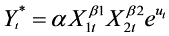 =0.967247 F=275.6267 DW=2.109534
根据局部调整模型的参数关系,有
将上述估计结果代入得到:

故局部调整模型估计结果为:
经济意义:在其他条件不变的情况下,该地区社会商品零售额每增加1亿元,则预期年末货币流通量增加0.07978亿元。同样,在其他条件不变的情况下,该地区城乡居民储蓄余额每增加1亿元,则预期年末货币流通量增加0.462126亿元。
2)先对数变换模型形式,
在局部调整假定下,先估计一阶自回归模型:

回归的估计结果如下:
回归方程: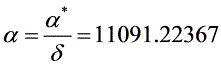 (1.677888) (0.255557) (0.154913) (0.531445)
t = (0.384014) (0.806984) (1.163013) (4.864049)
 =0.968959 F=291.3458 DW=1.914829
根据局部调整模型的参数关系,有
将上述估计结果代入得到:

故局部调整模型估计结果为:
经济意义:货币需求对社会商品零售额的长期弹性为:0.44104;货币需求对城乡居民储蓄余额的长期弹性为0.384518。
7.6 设
其中:M为实际货币流通量, 为期望社会商品零售总额,为期望储蓄总额,对于期望值作如下假定:

其中为期望系数,均为小于1的正数。
(1) 如何利用可观测的量来表示 ?
?
(2) 分析这样变换存在什么问题?
(3) 利用7.5题的数据进行回归,估计模型,并作检验。
练习题7.6参考解答:
1)首先将M滞后一期并乘上得到
再将原始方程减去该方程,得到

 (1)-(2) 于是
 可表示为:
可表示为:

2)从上面的变化中可看出,随机扰动项变为 ,这就可能导致出现随机扰动项的自相关,进而导致估计出来的结果是有偏的,而且不是一致估计。
3)对( )回归的估计结果如下,
回归方程:
可以看到,只有的回归系数在10% 的显著性水平下是显著的,其他回归系数均不显著;F统计量较大,方程整体显著;较高,模型整体上对样本数据拟合较好。
7.7 考虑如下回归模型:

其中,y为通货膨胀率,x为生产设备使用率。
1) 生产设备使用率对通货膨胀率的短期影响和总的影响分别是多大?
2) 如果库伊克模型为 ,你怎样得到生产设备使用率对通货膨胀率的短期影响和长期影响?
练习题7.7参考解答:
1)该模型为有限分布滞后模型,故生产设备使用率对通货膨胀的短期影响为0.1408,总的影响为0.1408+0.2306=0.3714。
2)利用工具变量法,用来代替进行估计,则库伊克模型变换为。若原先有,则需估计的模型为
,所以生产设备使用率对通货膨胀的短期影响为,总的影响为。
7.8 表7.15中给出了某地区消费总额Y和货币收入总额X的年度资料。
表7.15 某地区消费总额Y(亿元)和货币收入总额X(亿元)的年度资料(单位:亿元)
分析该地区消费同收入的关系
1) 做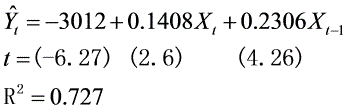 关于的回归,对回归结果进行分析判断;
2) 建立适当的分布滞后模型,用库伊克变换转换为库伊克模型后进行估计,并对估计结果进行分析判断。
练习题7.8参考解答:
1)做 关于的回归,回归的估计结果如下,
回归方程:
(7.945) (0.02284)
t =(3.9447) (35.365)
 =0.978103 F=1250.713
从回归结果来看,t检验值、F检验值及都显著,但在显著性水平上,DW值,说明模型扰动项存在正自相关,需对模型进行修改。
2)事实上,当年消费不仅受当年收入的影响,而且还受过去各年收入水平的影响,因此,我们在上述模型中增添货币收入总额X的滞后变量进行分析。如前所述,对分布滞后模型直接进行估计会存在自由度损失和多重共线性等问题。在此,选择库伊克模型进行回归分析,即估计如下模型:
回归的估计结果如下,
年份
X
Y
年份
X
Y
1975
103.169
91.158
1990
215.539
204.75
1976
115.07
109.1
1991
220.391
218.666
1977
132.21
119.187
1992
235.483
227.425
1978
156.574
143.908
1993
280.975
229.86
1979
166.091
155.192
1994
292.339
244.23
1980
155.099
148.673
1995
278.116
258.363
1981
138.175
151.288
1996
292.654
275.248
1982
146.936
148.1
1997
341.442
299.277
1983
157.7
156.777
1998
401.141
345.47
1984
179.797
168.475
1999
458.567
406.119
1985
195.779
174.737
2000
500.915
462.223
1986
194.858
182.802
2001
450.939
492.662
1987
189.179
180.13
2002
626.709
539.046
1988
199.963
190.444
2003
783.953
617.568
1989
205.717
196.9
2004
890.637
727.397
回归结果显示,t检验值、F检验值及都显著,但

在显著性水平上,查标准正态分布表得临界值,由于,则拒绝原假设,说明自回归模型存在一阶自相关,需对模型作进一步修改。
When you are old and grey and full of sleep,
A. nd noddingB. y the fire, take down this book,
C. nd slowly read, and dream of the soft look
D. Your eyes had once, and of their shadows deep;
E. How many loved your moments of glad grace,
F. nd loved your beauty with love false or true,
G. ut one man loved the pilgrim soul in you,
nd loved the sorrows of your changing face;
nd
ending down beside the glowing bars,
Murmur, a little sadly, how love fled
nd paced upon the mountains overhead
crowd of stars.
t distance in the world
Is not between life and death
ut when I stand in front of you
Yet you don't know that
I love you.
t distance in the world
I stand in front of you
y love
ut when undoubtedly knowing the love from both
Yet cannot be together.
t distance in the world
Is not being apart while being in love
ut when I plainly
annot resist the yearning
y heart.
t distance in the world
Is not struggling against the tides
ut using one's indifferent heart
To dig an uncrossable river
or the one who loves you.
题目解答
答案
And nodding by the fire, take down this book, And slowly read, and dream of the soft look Your eyes had once, and of their shadows deep; How many loved your moments of glad grace, And loved your beauty with love false or true, But one man loved the pilgrim soul in you, And loved the sorrows of your changing face; And bending down beside the glowing bars, Murmur, a little sadly, how love fled And paced upon the mountains overhead And hid his face amid a crowd of stars. The furthest distance in the world Is not between life and death But when I stand in front of you Yet you don't know that I love you. The furthest distance in the world Is not when I stand in front of you Yet you can't see my love But when undoubtedly knowing the love from both Yet cannot be together. The furthest distance in the world Is not being apart while being in love But when I plainly cannot resist the yearning Yet pretending you have never been in my heart. The furthest distance in the world Is not struggling against the tides But using one's indifferent heart To dig an uncrossable river For the one who loves you.