题目
设'(x)=(x-1)(2x+3),则在区间'(x)=(x-1)(2x+3)内( ) A. y=f(x)单调增加,曲线y=f(x)为凹的B. y=f(x)单调减少,曲线y=f(x)为凸的C.y=f(x)单调减少,曲线y=f(x)为凹的D.y=f(x)单调增加,曲线y=f(x)为凸的
设 ,则在区间
,则在区间 内( )
内( )
A. y=f(x)单调增加,曲线y=f(x)为凹的
B. y=f(x)单调减少,曲线y=f(x)为凸的
C.y=f(x)单调减少,曲线y=f(x)为凹的
D.y=f(x)单调增加,曲线y=f(x)为凸的
题目解答
答案
对于此时的函数f(x),我们已知其导数,在区间,有 ,
,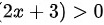 0" data-width="109" data-height="25" data-size="1706" data-format="png" style="max-width:100%">,故
 ,故
,故 ,则f(x)在区间单调减少;
对求导,可得 ,在区间,有
 0" data-width="93" data-height="20" data-size="1219" data-format="png" style="max-width:100%">,即
 0" data-width="95" data-height="25" data-size="1493" data-format="png" style="max-width:100%">,故此时f(x)为凹的。
综上所述,即可判断f(x)在区间内单调减少,且为凹的。
故本题选C。
解析
步骤 1:确定函数f(x)在区间$0,1] $的单调性
已知f'(x)=(x-1)(2x+3),在区间$0,1] $,有$(x-1)\leqslant 0$,$(2x+3)\gt 0$0" data-width="109" data-height="25" data-size="1706" data-format="png" style="max-width:100%">,故$(x-1)(2x+3)\leqslant 0$,即$f'(x)\leqslant 0$0" data-width="95" data-height="25" data-size="1493" data-format="png" style="max-width:100%">,故f(x)在区间$0,1] $单调减少。
步骤 2:确定函数f(x)在区间$0,1] $的凹凸性
对f'(x)=(x-1)(2x+3)求导,可得$f''(x)=4x+1$,在区间$0,1] $,有$1x+1\gt 0$0" data-width="93" data-height="20" data-size="1219" data-format="png" style="max-width:100%">,即$f''(x)\gt 0$0" data-width="95" data-height="25" data-size="1493" data-format="png" style="max-width:100%">,故此时f(x)为凹的。
已知f'(x)=(x-1)(2x+3),在区间$0,1] $,有$(x-1)\leqslant 0$,$(2x+3)\gt 0$0" data-width="109" data-height="25" data-size="1706" data-format="png" style="max-width:100%">,故$(x-1)(2x+3)\leqslant 0$,即$f'(x)\leqslant 0$0" data-width="95" data-height="25" data-size="1493" data-format="png" style="max-width:100%">,故f(x)在区间$0,1] $单调减少。
步骤 2:确定函数f(x)在区间$0,1] $的凹凸性
对f'(x)=(x-1)(2x+3)求导,可得$f''(x)=4x+1$,在区间$0,1] $,有$1x+1\gt 0$0" data-width="93" data-height="20" data-size="1219" data-format="png" style="max-width:100%">,即$f''(x)\gt 0$0" data-width="95" data-height="25" data-size="1493" data-format="png" style="max-width:100%">,故此时f(x)为凹的。